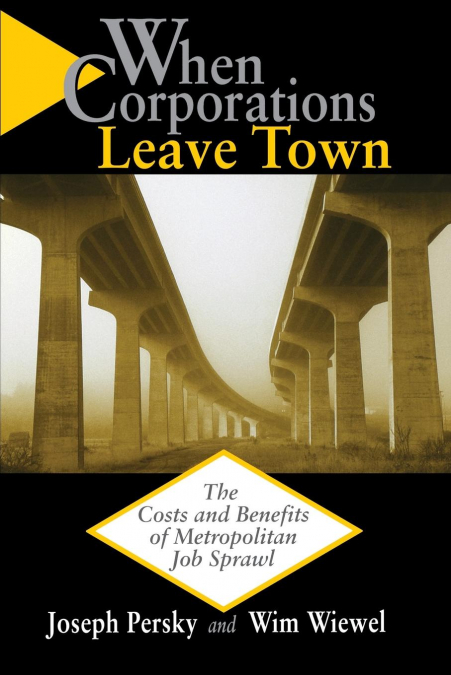

When Corporations Leave Town

When Corporations Leave Town

JOSEPH PERSKY / WIM WIEWEL

35,66 €
IVA incluido
Disponible
Editorial:
Wayne State University Press
Año de edición:
2000
Materia
Teoría y filosofía económicas
ISBN:
9780814329085
35,66 €
IVA incluido
Disponible

Selecciona una librería:

  • Librería Samer Atenea
  • Librería Aciertas (Toledo)
  • Kálamo Books
  • Librería Perelló (Valencia)
  • Librería Elías (Asturias)
  • Donde los libros
  • Librería Kolima (Madrid)
  • Librería Proteo (Málaga)

New suburban communities have sprung up all over America, while industrial plants and other commercial districts in the inner city have been left to decay. Nowhere is this more evident that the midwestern United States, where newly formed communities have funneled jobs and income from the inner city. Generally known as sprawl, the problem is particularly acute in those metropolitan areas where deconcentration is taking place—decline in the central city coupled with suburban growth. This process creates benefits in the sububrs, but also increasingly poses costs in the form of congestion and increased infrastructure costs. When Corporations Leave Town analyzes and develops a consistent and comprehensive cost-benefit analysis of employment deconcentration, focussing on central cities and their suburbs.Sprawl and deconcentration have become big issues in Vice President Albert Gore’s presidential campaign, and are the subject of a growing number of policy initiatives, conferences, and research efforts by organizing such as the Urban Land Institute, the National Homebuilders Association, and the Brookings Institute. Joseph Persky and Wim Wiewel compare the costs and benefits of a firm's locating in the central city with locating in the suburbs. They use a hypothetical model of a large manufacturing plant and a business services office in the Chicago metropolitan area to calculate tangible and intangible costs such as population and traffic congestion, air pollution, housing abandonment, loss of farmland, tax liabilities, and the strain put on suburban public resources. Persky and Wiewel then explore a broad range of public policies advocated for reversing or mitigating metropolitan deconcentration.

Artículos relacionados

  • Technological Change and the British Iron Industry, 1700-1870
    Charles K. Hyde
    This book describes technological change in an industry that played a central role in the Indsutrial Revolution. While earlier scholars have examined isolated aspects of ironmaking in the eighteenth- and nineteenth-century Britain, Charles Hyde surveys all aspects of its development. Costs, prices, profits, shrewd leaders, competition, new inventions, and productivity all figur...
    Disponible

    71,94 €

  • Corporate Governance in Asia
    ...
    Disponible

    72,99 €

  • The European Guilds
    Sheilagh Ogilvie
    A comprehensive analysis of European craft guilds through eight centuries of economic historyGuilds ruled many crafts and trades from the Middle Ages to the Industrial Revolution, and have always attracted debate and controversy. They were sometimes viewed as efficient institutions that guaranteed quality and skills. But they also excluded competitors, manipulated markets, and ...
  • Technological Change and the British Iron Industry, 1700-1870
    Charles K. Hyde
    This book describes technological change in an industry that played a central role in the Indsutrial Revolution. While earlier scholars have examined isolated aspects of ironmaking in the eighteenth- and nineteenth-century Britain, Charles Hyde surveys all aspects of its development. Costs, prices, profits, shrewd leaders, competition, new inventions, and productivity all figur...
  • Technology Differences over Space and Time
    Francesco Caselli
    Technology Differences over Space and Time looks at how countries use their productive resources-such as workers, skills, equipment and structures, and natural resources. Francesco Caselli develops methods to assess the efficiency with which productive inputs are used, and how these efficiencies vary across countries and over time.Caselli finds that richer countries use skilled...
  • Cybersecurity Measures for Logistics Industry Framework
    Global supply chains are becoming more customer-centric and sustainable thanks to next-generation logistics management technologies. Automating logistics procedures greatly increases the productivity and efficiency of the workflow. There is a need, however, to create flexible and dynamic relationships among numerous stakeholders and the transparency and traceability of the supp...