 Librería Samer Atenea
 Kálamo Books
 Librería Elías (Asturias)
 Librería Kolima (Madrid)
 Librería Proteo (Málaga)
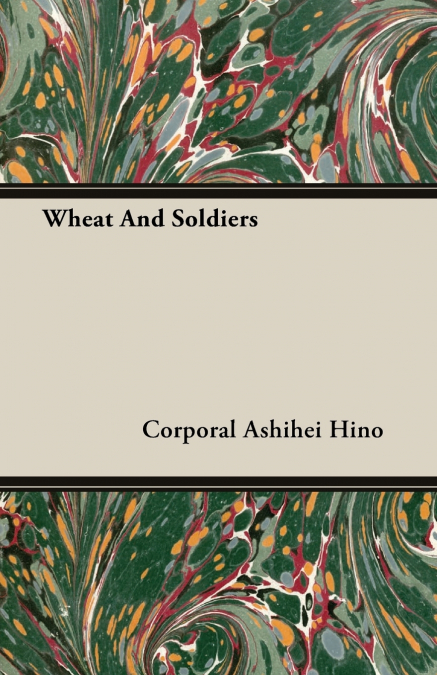
Wheat and Soldiers is, to the best of my knowl edge, the first deeply significant book to come out of the Sino-Japanese conflict. The author, Corporal Ashihei Hino, is a soldier in the ranks of the Jap anese army but the first quality that lifts his work far above the general run of war books is the complete absence of any propagandist element. Hino is neither prowar nor antiwar, neither pro-Japanese nor anti-Japanese. What he endeavors to do very successfully is to give the human side of the Japanese drive for Suchow-fu, in which he partici pated, to show himself and his fellow-soldiers not as legendary heroes but as credible men, their moments of despair and weakness blending with acts of great courage and devotion. Wheat and Soldiers possesses some of the time less, epic character that made Remarques All Quiet on the Western Front, by general agreement, the outstanding book on the World War, And it has already achieved in Japan the phenomenal success of All Quiet on the Western Front in Germany and other countries. Nearly a half million copies have been sold, although only a few months have passed since the book was published. The reason for this extraordinary popularity is obvious. Hino is telling what war really is, with all the elements of pain and terror that are systematically omitted from censored newspaper correspondence and official military pub lications. The Japanese people who have brothers, husbands, sons, friends at the front appreciate this fact and have responded to the appeal of the book in enormous numbers. Before the war Mr. Hino was a well-known writer in Japan and the winner of a literary prize. Less than a year after the outbreak of fighting between China and Japan, the Japanese public was startled by the appearance of a small book entitled Wheat and Soldiers. The cover identified the author as Corporal Ashihei Hino. He was an in fantryman, attached to a Japanese unit fighting in Central China. Wheat and Soldiers generated one of those storms of enthusiasm, common to all nations. It was the common soldier, the ordinary mud slog ger, and his view. And it had, besides, another unique quality. It was written, not in any cloistered study, from the perspective of afterthought, but set down from day to day, while the author was actually on the field of battle. He literally turned from seeing a scene to the description of it. Parts of Wheat and Soldiers are from his diary. Other sections were taken from his letters to his family. The book became an overnight sensation in Japan and then Corporal Hino was identified. His true name was Katsunori Tamai, born as a son of the president of a stevedore guild in Kyushu. He was already well-known to a small and perhaps exclusive section of the Japanese reading public. They remembered him as a contributor to literary magazines and the author of a collection of fan tasies called The Warship on the Mountain. The volume had hardly appeared before he was called to the front by an odd coincidence, it was while he was in the midst of his first campaign in China that word came to him that Japanese critics had bestowed upon him the Akutagawa Prize Japans highest literary honor for two of his earlier stories. At that very moment, he was writing the collection of letters and essays that were to be compiled in book form under the titles Earth and Soldiers and Wheat and Soldiers. Chronologically, Earth and Soldiers came first. But Wheat and Soldiers, written some months later, was the first to be published...