 Librería Samer Atenea
 Kálamo Books
 Librería Elías (Asturias)
 Librería Kolima (Madrid)
 Librería Proteo (Málaga)
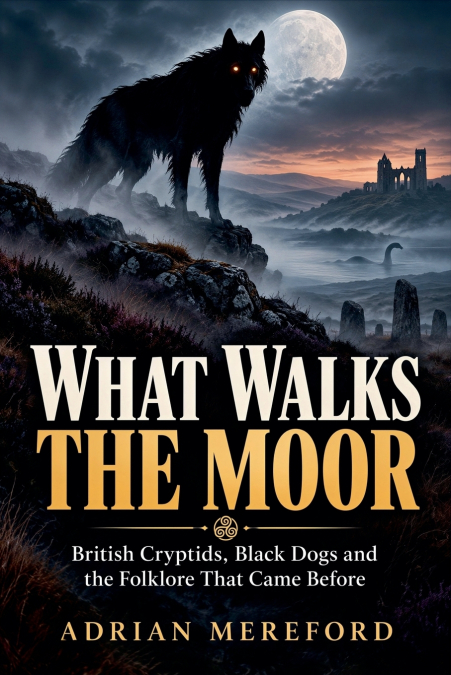
A black dog in a church in 1577. A beast in the River Ness. Big cats on Bodmin Moor. Britain has always had its monsters, and they are older than you think.Every year, people across Britain report animals that should not be there: black panthers on the moors, humps in the lochs, hairy figures among the pines, black dogs on lonely lanes. The newspapers call them British cryptids. But almost every one of them walks on ground where far older creatures were seen first.What Walks the Moor takes twelve of the most famous monster sightings in modern Britain and sets each one beside the folklore of the same place: the same loch, the same moor, the same road. The results are stranger, and more revealing, than any headline.Inside this book:• Black Shuck and the storm of 1577, and the dog skeleton dug up at Leiston Abbey that the headlines turned into a hellhound• The Loch Ness Monster: the first report of 1933, the hoax that fooled the world for sixty years, and St Columba’s beast of the River Ness• Morag of Loch Morar, the monster that was once a harbinger of death• The Big Grey Man of Ben Macdui: footsteps in the mist on Britain’s second highest mountain• The Kellas cats: real black cats caught in Moray, and the Highland fairy cat a Victorian minister described long before• Teggie of Bala and the afanc, the drowning beast of Welsh lakes• The Owlman of Mawnan and Morgawr, the Cornish sea serpent• The Beast of Bodmin and the Beast of Exmoor, and the hell-hounds of the western moors• The Hairy Hands of Dartmoor, one of England’s most notorious haunted roads• The Fen Tiger, the British Bigfoot of Cannock Chase and the Hexham HeadsNot just what people saw, but what was written down at the timeThis is not another collection of retold legends. For every case, the book separates what witnesses actually said at the time from what newspapers, investigators and hoaxers added later. You will see a skeleton become a hellhound in a single week of headlines, a harbinger of death become a zoological puzzle, and a Victorian ghost become the British Bigfoot.Drawing on first-hand records, official reports, museum specimens, scientific studies and centuries of Scottish, Welsh and English folklore, it asks what these creatures really are: misidentified animals, tricks of the mind, stories passed down through generations, or something the old storytellers knew better than we do.A practical afterword explains how to record a sighting of your own and how to visit the places in the book.For readers who love mysterious Britain, true monster stories and unexplained mysteries told with careAtmospheric, fair to sceptics and believers alike, and grounded in the evidence, What Walks the Moor is the second book in The Older Story series, after Not of This Island, and can be read on its own.Step onto the moor, just before dusk.