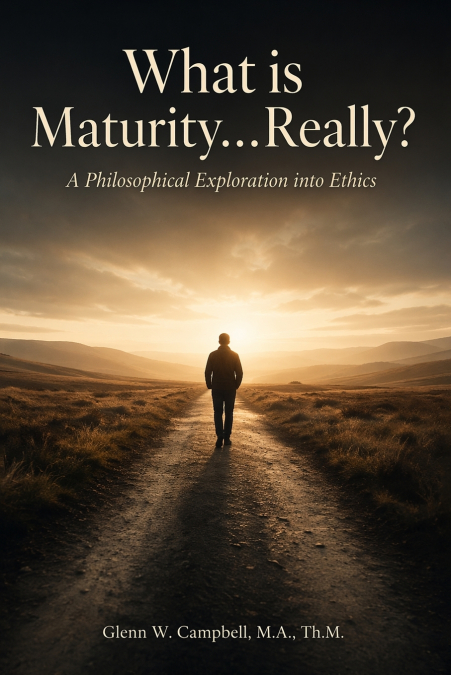

What is Maturity...Really?

What is Maturity...Really?

Glenn W. Campbell

28,03 €
IVA incluido
Disponible
Editorial:
Glenn W. Campbell
Año de edición:
2026
Materia
Ética y filosofía moral
ISBN:
9789695093344
28,03 €
IVA incluido
Disponible

Selecciona una librería:

  • Librería Samer Atenea
  • Kálamo Books
  • Librería Elías (Asturias)
  • Librería Kolima (Madrid)
  • Librería Proteo (Málaga)

Age happens to you. Maturity has to be built.We have no shared account of what a grown person is. Competence isn’t it. Neither is age, success, or good behavior in public.What is Maturity...Really? rebuilds the answer by tracing how the question itself was formed.It begins with Odysseus. Ten years of war, ten more of wandering, and twelve trials the gods designed as a curriculum, each one teaching him to hate a vice he would later have to judge in the men occupying his house.Plato follows, arguing that eternal life is not something that begins after death but a quality of experience available now, to anyone disciplined enough to chase beauty to its source. Then Aristotle, whose ethics are not about behaving well: the aim is not to become good at living, but to live in order to become good.With Moses the book turns. Campbell’s claim is that God worked through Greece to supply the right questions and through Israel to supply the right answers, and this ethics book is built in exactly that order.Augustine reads time as eternity stretched out to give us room to become good. Dante makes this world providential training for the next. Shakespeare’s King Lear shows character deciding conduct. Hegel names the engine: negation, contradiction working as an amplifier of the mind.Then the critics get their turn, Kierkegaard and Nietzsche read against Aquinas and Dewey, before a closing chapter answers Kant head-on rather than conceding to him.Campbell taught Philosophy, Religion, Greek and Mathematics at the university level while running a structural and forensic engineering firm. Twelve appendices carry you further into the Republic, the Nicomachean Ethics, Hume, Kant, Mill and Nietzsche.Maturity is not what happens to you.It is what you are being trained for.
Artículos relacionados

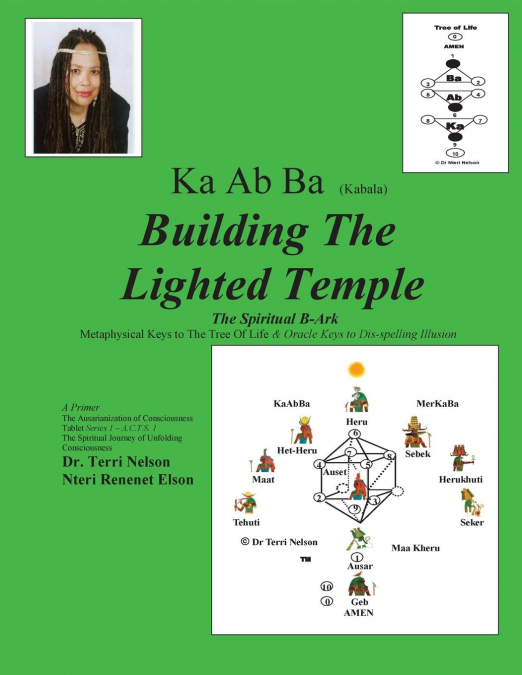
  • Ka Ab Ba Building The Lighted Temple
    Dr Terri R. Nelson / Dr Terri RNelson
    The book KaAbBa Building The Lighted Temple/Metaphysical Keys to the Tree of Life draws a circle that is inclusive of the Afrikan origin of the Ancient Kemetic/Egyptian wisdom. It reveals the undeniable root and link of Ancient Africa to all the religious systems that would develop worldwide. This book is explosive in its power to convey the meaning of KaAbBa, the Medu Neter  (...
    Disponible

    37,41 €

  • Technoethics and the Evolving Knowledge Society
    Rocci Luppicini
    Recently, there has been a major push to rediscover the ethical dimension of technology across the sciences, social sciences, and humanities. Technoethics and the Evolving Knowledge Society: Ethical Issues in Technological Design, Research, Development, and Innovation examines human processes and practices connected to technology embedded within social, political, and moral sph...
  • Kant
    Immanuel Kant
    Kant’s Groundwork of the Metaphysics of Morals is one of the most important works in modern moral philosophy. It belongs beside Plato, Aristotle, Machiavelli, and Hobbes. Here Kant sets out to articulate and defend the Categorical Imperative - the fundamental principle that underlies moral reasoning - and to lay the foundation for a comprehensive account of justice and human vi...
  • On the Duty of Civil Disobedience
    HENRY DAVID THOREAU
    Civil Disobedience argues that citizens should not permit their governments to overrule their consciences, and that they have a duty to avoid allowing their acquiescence to enable the government to make them the agents of injustice. Thoreau was motivated in part by his disgust with slavery and the Mexican-American War, but the sentiments he expresses here are just as pertinent ...
  • Beyond Good and Evil
    Friedrich Nietzsche
    Nietzsche, though primarily a philosopher, wrote widely on art, philology, history, religion, tragedy, culture, and science.  In 1886, at the height of his powers, he published Beyond Good and Evil.  Here he examines much of the best of human thought--dogmatic philosophy, Judeo-Christian morality, science and democracy – and finds it lacking.  Rejecting “slave-morality” he pres...
  • Beyond Good and Evil
    Friedrich Nietzsche
    Nietzsche, though primarily a philosopher, wrote widely on art, philology, history, religion, tragedy, culture, and science.  In 1886, at the height of his powers, he published Beyond Good and Evil.  Here he examines much of the best of human thought--dogmatic philosophy, Judeo-Christian morality, science and democracy – and finds it lacking.  Rejecting “slave-morality” he pres...
    Disponible

    9,99 €

Otros libros del autor

  • What is Reality...Really?
    Glenn W. Campbell
    The ancients assumed the universe was alive and had to explain death. We assume it is dead and cannot explain life.That reversal, Glenn W. Campbell argues, is why an age of extraordinary science feels so aimless underneath it.What is Reality...Really? traces the question across four eras, not as a survey to memorize but as an argument still running.Plato opens it. His late tril...
    Disponible

    24,35 €