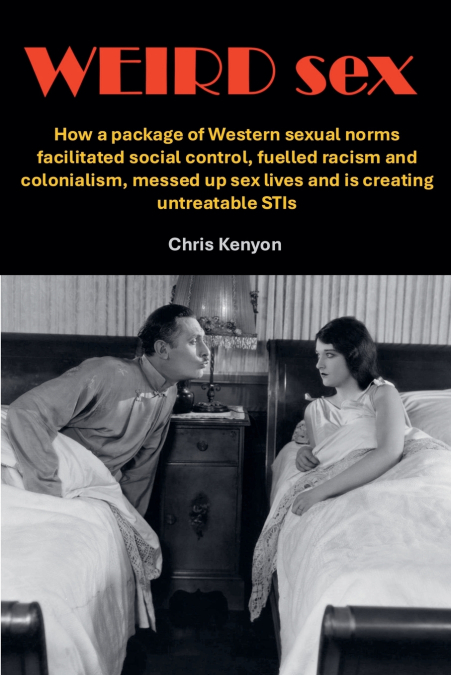

WEIRD sex

WEIRD sex

Chris Kenyon

40,09 €
IVA incluido
Disponible
Editorial:
Chris Kenyon
Año de edición:
2026
Materia
Historia
ISBN:
9798235426221
40,09 €
IVA incluido
Disponible

Selecciona una librería:

  • Librería Samer Atenea

  • Kálamo Books
  • Librería Elías (Asturias)
  • Librería Kolima (Madrid)
  • Librería Proteo (Málaga)

Why are bugs that are transmitted by sex so stigmatised? Why are they classified as 'essential pathogens' that should be eradicated wherever they are found, when far more pathogenic bugs that are not transmitted by sex are classified as less pathogenic? Why do people with STIs typically have to be treated in separate health facilities? What is the basis for the West’s insistence that monogamy is 'natural' and polygamy 'backward'? WEIRD Sex argues the answer doesn’t come from biology. It comes from a millennium of Western moral engineering hiding in plain sight as science.We think of our sexual morality as common sense, and our disease classifications as neutral biology. WEIRD Sex shows both are inheritances from a specific culture - Western, Educated, Industrialized, Rich, Democratic (WEIRD) - that got exported to the entire planet through empire, medicine, and law. It was then mistaken for human nature itself.Tracing a 'cultural ratchet' that runs from medieval church reform through the Enlightenment, colonial conquest, and Cold War-era science, the book identifies six pillars that fused into a single, self-reinforcing package: sex-negativity, mononormativity (the belief that monogamy is the most ethical form of partnering), heteronormativity, gender essentialism, sexism, and anti-miscegenation. European empires didn’t just conquer land - they criminalized local sexualities, erased third-gender traditions, suppressed polygamy, and weaponized STI panic to brand colonized peoples as 'immoral' and in need of control. Then, in a final twist, the West liberalized at home in the 20th century and began lecturing its former colonies for the very conservatism it had imposed on them.The same moral DNA, the book argues, shaped one of modern medicine’s biggest blind spots. When germ theory arrived, scientists didn’t discard old ideas about sinful sex - they relabeled them, branding certain microbes as inherently dangerous 'essential pathogens' simply because of how they spread. That century-old moral judgment still drives today’s STI policy, including the mass screening of people with no symptoms - a practice this book shows is scientifically unfounded, damages the microbiome, accelerates antibiotic resistance, deepens stigma, and hasn’t reduced STI rates.


Artículos relacionados

  • Raising Freedom's Banner
    Paul Harris
    World wide history of peaceful street demonstrations from their earliest beginning in eighteenth century England to their use throughout the world in the twenty-first century. Describes why some demonstration movements succeeded and others failed. Contrasts demonstrations within the law with civil disobedience demonstrations. Describes Peterloo, the Chartists, the Suffragettes,...
    Disponible

    23,59 €

  • Waipi’o Valley
    Jeffrey L. Gross
    Waipi’o Valley: A Polynesian Journey from Eden to Eden recounts the remarkable migrations of the Polynesians across a third of the circumference of the earth. Their amazing journey began from Kalana i Hau’ola, the biblical “Garden of Eden” located along the shore of the Persian Gulf, extended to the Indus River Valley of ancient Vedic India, to Egypt where some ancestors of the...
  • Floralia
    June Rainsford Butler
    A century characterized by a growing interest in science, the opportunity for travel, and leisure for gardening furnishes the setting for Butler’s book. The rise of landscape gardening in England is traced, and the origin and history of its most famous gardens are given. The close relation between England and America in the field of horticulture is also discussed.Originally pub...
    Disponible

    61,20 €

  • President Wilson’s Addresses
    Woodrow Wilson
    'These addresses of President Woodrow Wilson are almost entirely concerned with political affairs, and more specifically with defining Americanism. Yet they also show that even as he moved from academia to the heights of politics, Wilson retained something of the teacher’s interest in showing the relation between specific instances and the general forms of thought or action of ...
  • The Story of my Life
    John Albert Macy
    The Story of My Life, is Helen Keller’s autobiography detailing her early life, especially her experiences with Anne Sullivan. The book is dedicated to inventor Alexander Graham Bell. The dedication reads, 'To ALEXANDER GRAHAM BELL Who has taught the deaf to speak and enabled the listening ear to hear speech from the Atlantic to the Rockies, I dedicate this Story of My Life.' ...
  • The Story of My Life Vol. 6 Spanish Passions
    Giacomo Casanova
    Casanova was an Italian adventurer and author from the Republic of Venice. His autobiography, Histoire de ma vie (Story of My Life), is regarded as one of the most authentic sources of the customs and norms of European social life during the 18th century. He has become so famous for his often complicated and elaborate affairs with women that his name is now synonymous with 'wom...