

 Librería Samer Atenea
 Kálamo Books
 Librería Elías (Asturias)
 Librería Kolima (Madrid)
 Librería Proteo (Málaga)
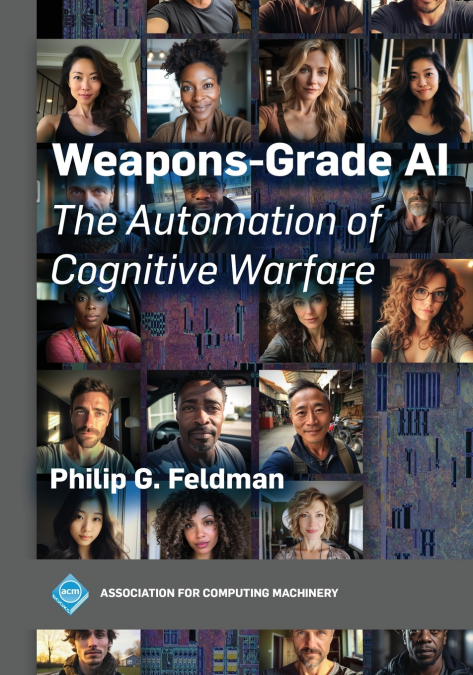
This book examines a new class of weapon-one powered not by explosives, but by information. Built using the same artificial intelligence (AI) technologies that drive today’s most advanced chatbots, these weapons target people who can be manipulated into becoming 'human munitions.' Their targets may be presidents and CEOs, mid-level bureaucrats and institutional decision-makers, or emotionally vulnerable individuals. Compared with kinetic weapons such as missiles and drone swarms, AI-enabled information weapons are inexpensive, scalable, and difficult to detect.Such weapons could be developed and deployed by nation-states, criminal enterprises, extremist organizations, corporations, or high-net-worth individuals. Capable of highly personalized psychological manipulation, they can target individuals with precision while operating across entire populations. The resulting potential for disruption and damage may rival that of conventional warfare, while requiring only a fraction of the cost and infrastructure to deploy.The author explores this emerging threat through five speculative scenarios-short stories that illustrate the potential real-world consequences of AI-driven manipulation and disruption. Each narrative is paired with an analysis of the underlying attack vectors, examining how such events could unfold using current or rapidly emerging technologies.The author also investigates potential defenses, including 'white-hat AI' systems designed to identify and flag manipulative content before users react impulsively. These technical interventions are considered alongside broader educational, institutional, and cultural strategies for strengthening human resilience-or 'hardening the human operating system'-against increasingly sophisticated forms of machine-driven influence.
The emergence of AI-enabled information weapons demands more than new cybersecurity tools. It requires a transition from an exploitable culture to one capable of recognizing, resisting, and thriving in the presence of machine-driven manipulation. This challenge also presents an opportunity: to build a healthier digital environment and establish the technical, institutional, and cultural foundations needed for society to prosper in an era when communication itself can be weaponized.





