
Waterhole Economies

Waterhole Economies

Samuel Layne

26,98 €
IVA incluido
Disponible
Editorial:
Maijai Press
Año de edición:
2025
Materia
Historia antigua: hasta c. 500 e. c.
ISBN:
9781733755542
26,98 €
IVA incluido
Disponible

Selecciona una librería:

  • Librería Samer Atenea
  • Librería Aciertas (Toledo)
  • Kálamo Books
  • Librería Perelló (Valencia)
  • Librería Elías (Asturias)
  • Donde los libros
  • Librería Kolima (Madrid)
  • Librería Proteo (Málaga)

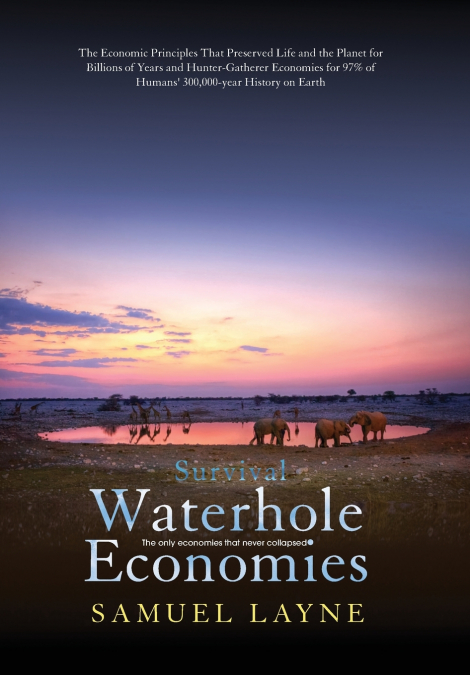
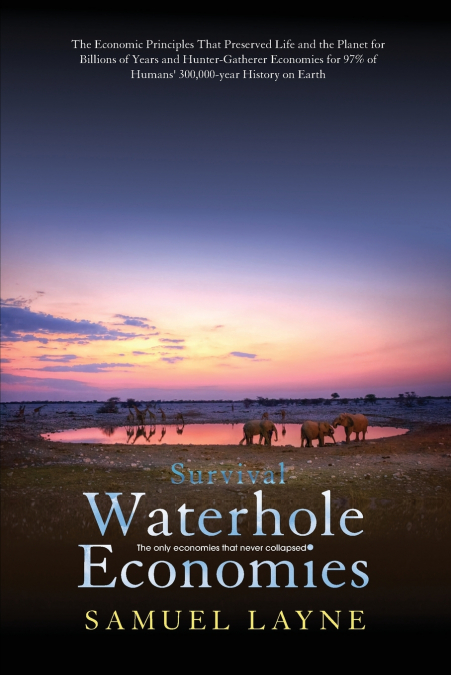
Pre-agriculture hunter-gatherer economies were waterhole economies, and were the only human economies that never collapsed.Ninety-seven percent of the time Homo sapiens lived on Earth, or until about 12,000 years ago, all peoples were foragers of wild food, living a type of subsistence lifestyle in economies that relied on hunting and fishing animals, foraging for wild vegetation and other nutrients, and converging around waterholes to slake their thirst. Their economies required a daily pursuit and collection of wild foods to make a living, collecting numerous species over whose reproduction and sustenance they had no control.And yet, they were the only human economies that persisted without collapse for 97 percent of our species’ existence, and somehow managed to do so for those 290,000 years mostly without ravaging the planet’s habitats and ecosystems and destroying its biodiversity, nor threatening the pre-agriculture hunter-gatherer societies that relied upon them to make a living, with risks of a potential extinction the way twenty-first century economies are threatening humans today.It bears asking (don’t you think?): Is there something our pre-agriculture hunter-gatherer forebears knew about how to make a living and survive on this Earth, without destroying its ecosystems and biodiversity, that Neolithic Revolution through twenty-first century humans, notwithstanding all our accumulated knowledge, science, technologies, innovations, and supposed superiority - still don’t get? Clearly, the answer must be yes. But what?Join me in exploring what modern humans may have forgotten.

Artículos relacionados

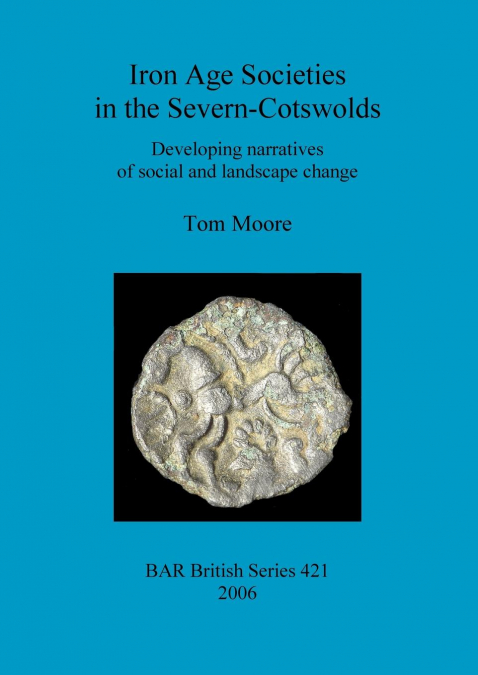
  • Iron Age Societies in the Severn-Cotswolds
    Tom Moore
    The central theme of this study is an examination of the processes of change in Iron Age social organisation and identity on a regional scale using the Severn-Cotswolds area in England as a case study. It aims to provide a coherent narrative of the period in the region based on the wealth of current data now available, providing a basic storyboard against which future studies c...
    Disponible

    144,57 €

  • Somewhere Beyond The Sea Les îles bretonnes (France)
    The Seminar on the Archaeology of Western France, which focused on the islands of Brittany, was held on 1 April 2014 at the University of Rennes 1. The desire to organize this seminar arose spontaneously from the dynamism which currently animates archaeological research on island spaces of the western seaboard of France. Indeed, the seminar took place during a pivotal period of...
    Disponible

    86,11 €

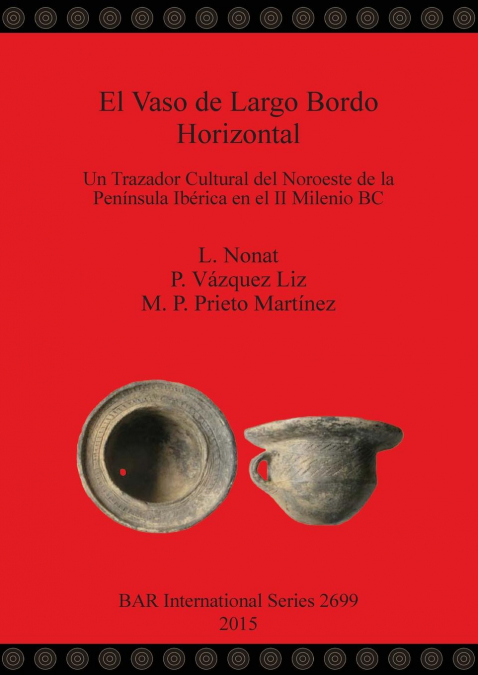
  • El Vaso de Largo Bordo Horizontal
    L. Nonat / LNonat / M. P. Prieto Martínez / MPPrieto Martínez / P. Vázquez Liz / PVázquez Liz
    In this paper the authors study a specific type of pottery from the northwest Iberian Peninsula, known as the Wide Horizontal Rim (WHR) vessel. One of its distinctive aspects is precisely the fact that it is exclusively found in this region, which now comprises the Spanish region of Galicia and northern Portugal, as far south as the River Duero. This type of pottery, of which t...
    Disponible

    115,71 €

  • A Connecting Sea
    Stašo Forenbaher
    This book includes papers stemming from a session at the EAA conference held in Zadar in September 2007.                          ...
    Disponible

    79,97 €

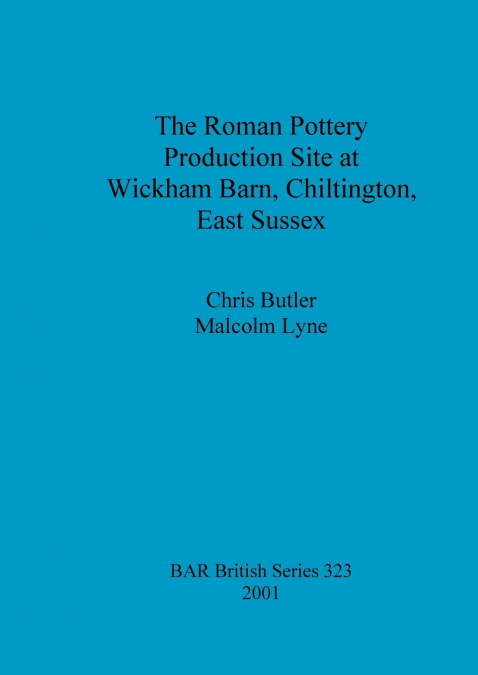
  • The Roman Pottery Production Site at Wickham Barn, Chiltington, East Sussex
    Chris Butler / Malcolm Lyne
    The excavations undertaken at Chiltington in East Sussex revealed two Roman pottery kilns, as well as remains from prehistory and from medieval period.The kilns are well documented, and all the finds were examined and catalogued. Three phases were identified. The pottery produced on the site indicate a strong New Forest influence. ...
    Disponible

    55,62 €

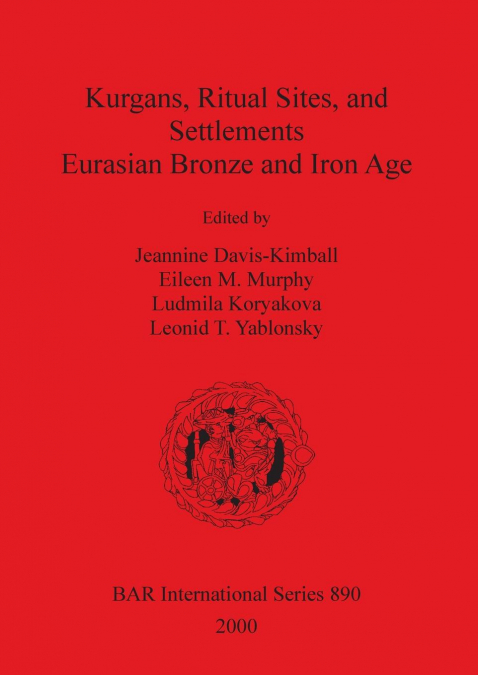
  • Kurgans, Ritual Sites, and Settlements
    Edited by: Jeannine Davis-Kimball, Eileen M. Murphy, Ludmila Koryakova and Leonid T. YablonskyThis richly illustrated volume adds immensely to the small but growing corpus of Eurasian Archaeology published in the English language. Comprised of thirty articles, the authors have focused on the Bronze Age, continuing to include the first millennium BC Early Iron Age, with a termin...
    Disponible

    158,26 €

Otros libros del autor

  • Waterhole Economies
    Samuel Layne
    Pre-agriculture hunter-gatherer economies were waterhole economies, and were the only human economies that never collapsed.Ninety-seven percent of the time Homo sapiens lived on Earth, or until about 12,000 years ago, all peoples were foragers of wild food, living a type of subsistence lifestyle in economies that relied on hunting and fishing animals, foraging for wild vegetati...
  • Survival
    Samuel Layne
    2021 NEXT GENERATION INDIE BOOK AWARDS - FINALIST (NATURE/ENVIRONMENT)2020 14TH ANNUAL NATIONAL INDIE EXCELLENCE AWARDS - FINALISTHow different might the history of our species have been had our hunter-gatherer forebears failed to migrate out of Africa in time to survive 70,000 years ago when threatened by extinction due to climate change brought on by the last ice age? Simply ...
    Disponible

    19,43 €

  • Survival
    Samuel Layne
    2021 NEXT GENERATION INDIE BOOK AWARDS - FINALIST (NATURE/ENVIRONMENT)2020 14TH ANNUAL NATIONAL INDIE EXCELLENCE AWARDS - FINALISTHow different might the history of our species have been had our hunter-gatherer forebears failed to migrate out of Africa in time to survive 70,000 years ago when threatened by extinction due to climate change brought on by the last ice age? Simply ...