Inicio > Humanidades > Filosofía > Ética y filosofía moral > Was heisst lebenswertes und lebenunwertes Leben?
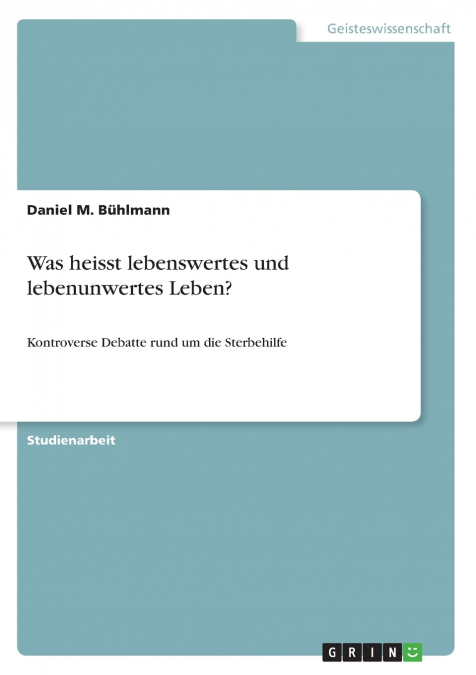
Was heisst lebenswertes und lebenunwertes Leben?

Was heisst lebenswertes und lebenunwertes Leben?

Daniel M. Bühlmann / Daniel MBühlmann

21,04 €
IVA incluido
Disponible
Editorial:
GRIN Verlag
Año de edición:
2010
Materia
Ética y filosofía moral
ISBN:
9783640591565
21,04 €
IVA incluido
Disponible

Selecciona una librería:

  • Librería Samer Atenea
  • Librería Aciertas (Toledo)
  • Kálamo Books
  • Librería Perelló (Valencia)
  • Librería Elías (Asturias)
  • Donde los libros
  • Librería Kolima (Madrid)
  • Librería Proteo (Málaga)

Studienarbeit aus dem Jahr 2004 im Fachbereich Ethik, Note: 1, Facoltà di Teologia di Lugano, Sprache: Deutsch, Abstract: Im Rahmen des Kurses Bioetica di fine vite möchte ich bei dieser Arbeit mich mit einer aktuellen Frage auseinandersetzen. Es geht um den Menschen mit seiner letzten Entscheidung: dem Tod. André Malraux’s Werk La condition humaine kann als ein Werk der Sinnlosigkeit des Lebens proklamiert werden. Dort wo der Tod als sinnlos angesehen wird, wird das ganze Leben der Leere ausgeliefert sein. „Sie kennen den Satz: ‚Neun Monate sind nötig, um einen Menschen zu schaffen, aber ein einziger Tag genügt, um ihn zu töten.’ Wir beide haben es zur Genüge erfahren. Doch hören Sie zu: nicht neun Monate, sondern fünfzig Jahre sind erforderlich, um einen Menschen zu schaffen. Fünfzig Jahre an Opfern, an Wollen, ach... an so vielen Dingen! Und wenn dieser Mensch dann erschaffen ist, wenn nichts von Kindlichkeit ihm mehr innewohnt, wenn er endlich ein fertiger Mensch geworden ist, dann taugt er nur noch zum Sterben.' Der Existentialist Malraux beschreibt einen Menschen, der von Gefühlen wie der Angst und der Hoffnung geprägt ist. Die Angst, als ständigen Begleiter, der den Menschen zum Handeln antreibe. Der Mensch wählt sich, denn das Leben - so Malraux - habe keinen Endzweck. Da er jedoch immer wieder am Leben scheitert, mache nicht der Mensch etwas aus seinem Leben, sondern umgekehrt. Was den Menschen auszeichne, sei das Bewusstsein seines Todes, welches als Beweis der Absurdität seines Daseins gilt. Der Tod als Absurdität unserer Existenz? Ist der Mensch also Opfer des Daimons oder des Schicksals? Wie kann das Christentum auf eine solche Haltung antworten? Welchen Sinn hat das Leben und den Tod?Die Analysen des Werkes Action von Maurice Blondel sind für unsere Fragen relevant. Um was geht es dabei? Blondel ist davon überzeugt, dass das menschliche ‚Wollen’ immer schon unendlich mehr setzt als das, was der Mensch tatsächlich in einem konkreten Willensakt ‚will’
Artículos relacionados

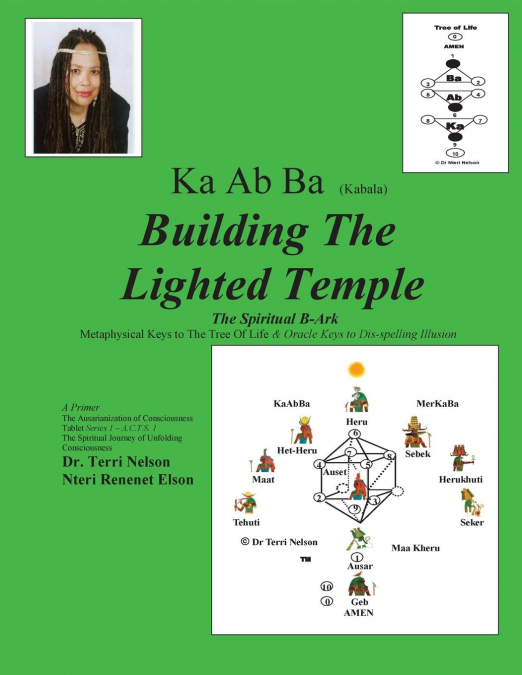
  • Ka Ab Ba Building The Lighted Temple
    Dr Terri R. Nelson / Dr Terri RNelson
    The book KaAbBa Building The Lighted Temple/Metaphysical Keys to the Tree of Life draws a circle that is inclusive of the Afrikan origin of the Ancient Kemetic/Egyptian wisdom. It reveals the undeniable root and link of Ancient Africa to all the religious systems that would develop worldwide. This book is explosive in its power to convey the meaning of KaAbBa, the Medu Neter  (...
    Disponible

    37,41 €

  • Technoethics and the Evolving Knowledge Society
    Rocci Luppicini
    Recently, there has been a major push to rediscover the ethical dimension of technology across the sciences, social sciences, and humanities. Technoethics and the Evolving Knowledge Society: Ethical Issues in Technological Design, Research, Development, and Innovation examines human processes and practices connected to technology embedded within social, political, and moral sph...
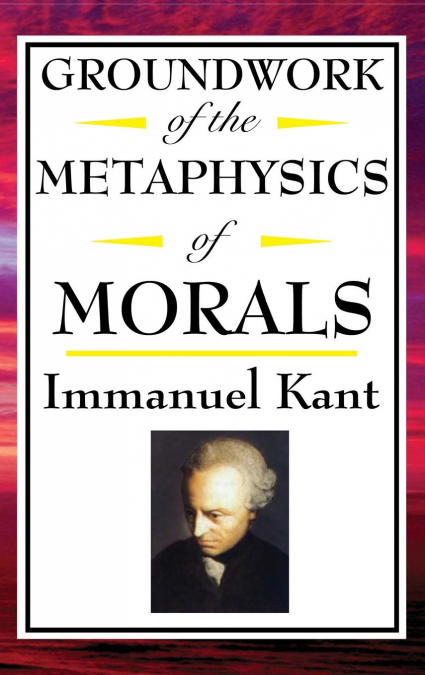
  • Kant
    Immanuel Kant
    Kant’s Groundwork of the Metaphysics of Morals is one of the most important works in modern moral philosophy. It belongs beside Plato, Aristotle, Machiavelli, and Hobbes. Here Kant sets out to articulate and defend the Categorical Imperative - the fundamental principle that underlies moral reasoning - and to lay the foundation for a comprehensive account of justice and human vi...
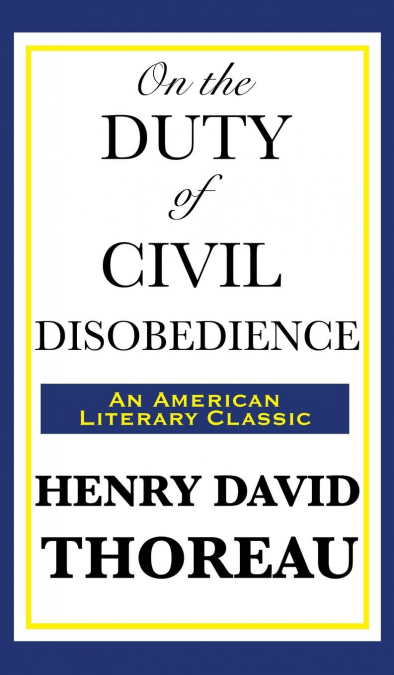
  • On the Duty of Civil Disobedience
    HENRY DAVID THOREAU
    Civil Disobedience argues that citizens should not permit their governments to overrule their consciences, and that they have a duty to avoid allowing their acquiescence to enable the government to make them the agents of injustice. Thoreau was motivated in part by his disgust with slavery and the Mexican-American War, but the sentiments he expresses here are just as pertinent ...
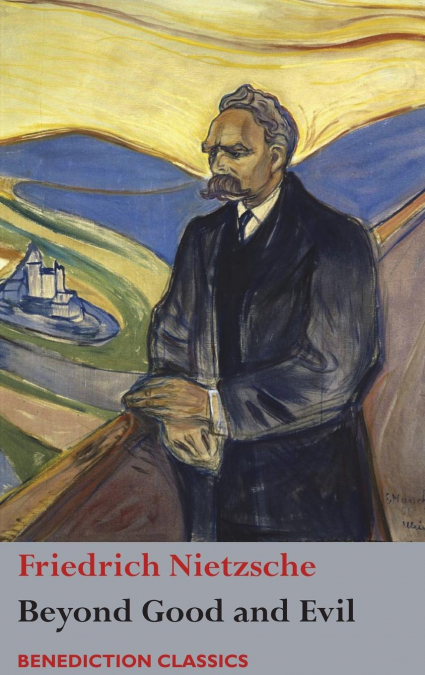
  • Beyond Good and Evil
    Friedrich Nietzsche
    Nietzsche, though primarily a philosopher, wrote widely on art, philology, history, religion, tragedy, culture, and science.  In 1886, at the height of his powers, he published Beyond Good and Evil.  Here he examines much of the best of human thought--dogmatic philosophy, Judeo-Christian morality, science and democracy – and finds it lacking.  Rejecting “slave-morality” he pres...
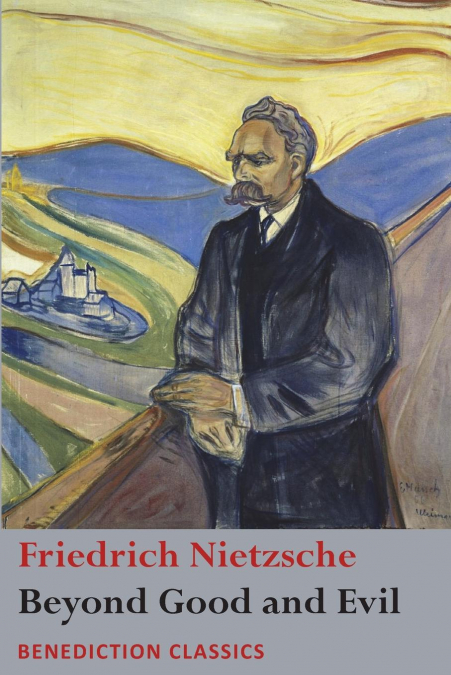
  • Beyond Good and Evil
    Friedrich Nietzsche
    Nietzsche, though primarily a philosopher, wrote widely on art, philology, history, religion, tragedy, culture, and science.  In 1886, at the height of his powers, he published Beyond Good and Evil.  Here he examines much of the best of human thought--dogmatic philosophy, Judeo-Christian morality, science and democracy – and finds it lacking.  Rejecting “slave-morality” he pres...
    Disponible

    9,99 €