

Jean Jacques 1716-1795 Barthélemy
 Librería Samer Atenea
 Kálamo Books
 Librería Elías (Asturias)
 Librería Kolima (Madrid)
 Librería Proteo (Málaga)
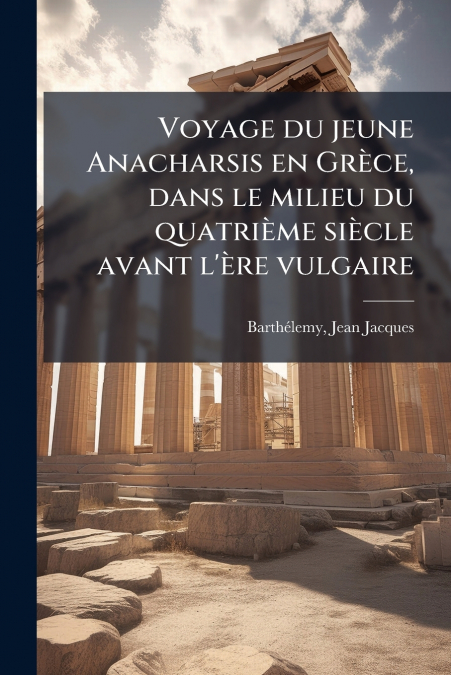
'Voyage du jeune Anacharsis en Grèce' by Jean Jacques Barthélemy, originally published in the late 18th century, remains a captivating journey through ancient Greece. Presented as the travels of a young Scythian named Anacharsis, this historical fiction provides a detailed and immersive portrayal of Greek life, culture, and philosophy in the 4th century BC. The narrative blends historical accuracy with imaginative storytelling, offering readers a unique perspective on the intellectual and artistic achievements of the Hellenic world.This edition allows a modern audience to rediscover Barthélemy’s influential work, appreciated for its contribution to the understanding and appreciation of classical antiquity. Its enduring appeal lies in its accessible style and vivid descriptions, making it a valuable resource for both scholars and enthusiasts of ancient history and French literature.This work has been selected by scholars as being culturally important, and is part of the knowledge base of civilization as we know it. This work was reproduced from the original artifact, and remains as true to the original work as possible. Therefore, you will see the original copyright references, library stamps (as most of these works have been housed in our most important libraries around the world), and other notations in the work.This work is in the public domain in the United States of America, and possibly other nations. Within the United States, you may freely copy and distribute this work, as no entity (individual or corporate) has a copyright on the body of the work.As a reproduction of a historical artifact, this work may contain missing or blurred pages, poor pictures, errant marks, etc. Scholars believe, and we concur, that this work is important enough to be preserved, reproduced, and made generally available to the public. We appreciate your support of the preservation process, and thank you for being an important part of keeping this knowledge alive and relevant.






