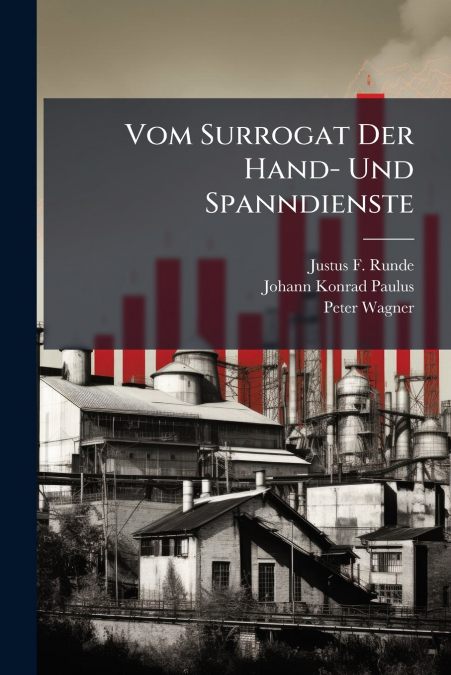
Justus F. Runde / Peter Wagner / Johann Konrad Paulus
 Librería Samer Atenea
 Kálamo Books
 Librería Elías (Asturias)
 Librería Kolima (Madrid)
 Librería Proteo (Málaga)
'Vom Surrogat Der Hand- Und Spanndienste' presents two award-winning treatises concerning the commutation of socage labor in 18th-century Hesse-Cassel. Authored by Justus F. Runde, Johann Konrad Paulus, and Peter Wagner, the work examines the economic and social implications of replacing traditional labor services with monetary payments or other substitutes. This volume includes a preface detailing the origins and structure of the Hochfürstlich Hessen-casselische Gesellschaft des Ackerbaues und der Künste (Princely Hessian-Cassel Society of Agriculture and Arts), which awarded the prize to these essays on March 5, 1775. The texts offer insights into the historical context of agrarian reforms, economic policies, and the transition from feudal labor systems to more modern economic arrangements in the German states. A valuable resource for scholars of economic history and 18th-century European studies.This work has been selected by scholars as being culturally important, and is part of the knowledge base of civilization as we know it. This work was reproduced from the original artifact, and remains as true to the original work as possible. Therefore, you will see the original copyright references, library stamps (as most of these works have been housed in our most important libraries around the world), and other notations in the work.This work is in the public domain in the United States of America, and possibly other nations. Within the United States, you may freely copy and distribute this work, as no entity (individual or corporate) has a copyright on the body of the work.As a reproduction of a historical artifact, this work may contain missing or blurred pages, poor pictures, errant marks, etc. Scholars believe, and we concur, that this work is important enough to be preserved, reproduced, and made generally available to the public. We appreciate your support of the preservation process, and thank you for being an important part of keeping this knowledge alive and relevant.