Inicio > Derecho > Derecho internacional > Völkerrecht als Rechtsordnung
Völkerrecht als Rechtsordnung

Völkerrecht als Rechtsordnung

Paul Gragl

20,64 €
IVA incluido
Disponible
Editorial:
GRIN Verlag
Año de edición:
2009
Materia
Derecho internacional
ISBN:
9783640264094
20,64 €
IVA incluido
Disponible

Selecciona una librería:

  • Librería Samer Atenea
  • Librería Aciertas (Toledo)
  • Kálamo Books
  • Librería Perelló (Valencia)
  • Librería Elías (Asturias)
  • Donde los libros
  • Librería Kolima (Madrid)
  • Librería Proteo (Málaga)

Studienarbeit aus dem Jahr 2009 im Fachbereich Jura - Europarecht, Völkerrecht, Internationales Privatrecht, Note: Sehr Gut, Karl-Franzens-Universität Graz (Institut für Völkerrecht und Internationale Beziehungen), Veranstaltung: Rechtsbefolgung im Völkerrecht, Sprache: Deutsch, Abstract: Ausgehend von Hans-Joachim Cremers kritischem Aufsatz „Völkerrecht - alles nur Rhetorik', in dem er sich mit Jack L. Goldsmiths und Eric A. Posners Buch „The Limits of International Law' auseinandersetzt, versucht diese Arbeit, die Argumente der genannten beiden Autoren zu entkräften. Im Zentrum der Gegenargumente steht dabei vor allem, dass sie zwar den Nutzen des Völkerrechts anerkennen, aber seine Verbindlichkeit als Rechtsordnung leugnen, ja sogar davon ausgehen, dass es sich um kein Recht im Sinne dieses Begriffs handelt. Kapitel 1 wird sich der Bedeutung des Rechtsbegriffs für das Völkerrecht widmen und dabei untersuchen, welche Elemente für diesen Begriff notwendig sind, welche Eigenschaften das Völkerrecht als Ordnungssystem besitzt und wie es sich mit dem schwächsten Punkt einer Verteidigung vereinbaren lässt, dem Fehlen eines zentralisierten Durchsetzungsmechanismus.Kapitel 2 wird sich mit möglichen Erklärungen für zwischenstaatliches Handeln beschäftigen. Der erste Abschnitt verfolgt Gegenargumente zur reduktionistischen rational choice-Theorie, mit der Goldsmith und Posner sehr ungeschickt Politik und Recht miteinander vermischen und sodann das daraus resultierende Staatenverhalten kausalwissenschaftlich und nicht normativ erklären wollen. Dabei stehen für sie nur die Staatsinteressen im Mittelpunkt, deren Zweck es gerade ist, Völkerrecht nicht oder nur als bloßes Mittel einzuhalten. Der zweite Abschnitt widmet sich der Problematik rund um das Völkergewohnheitsrecht und einer Verteidigung dieser speziellen Institution des Völkerrechts, die immer besonders heftiger Kritik von Seiten der Leugner und Skeptiker ausgesetzt war. Hier und im dritten Abschnitt, in dem es um da
Artículos relacionados

  • Comparative regulation, economic analysis, and applications of private equity in the united states and european union
    Irini Liakopoulou
    The present work examines the economics and legal doctrine of private equity. After a consideration of private equity’s origins, the book will explore the evolution of private equity in the United States and Europe. The reference economic model then will be reconstructed, with particular attention to financial flows to and from private equity firms and funds. This reconstructio...
  • Complicity in International Law
    Dimitris Liakopoulous
    Complicity in International Law aims to analyze questions arising from a state’s complicity in conflict with another state or an international organization. On the basis of international legal provisions, a state that assists the illicit fact of another state or an international organization in turn commits an offense if it is aware of the main fact and is bound by the same obl...
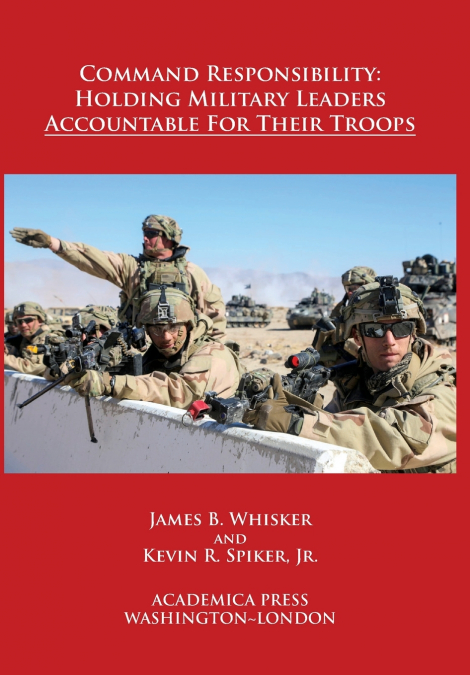
  • Command responsibility
    James B Whisker / Kevin R Spiker
    Command responsibility, or executive accountability, assumes that leaders are responsible for the actions of their subordinates. If subordinates misbehave, violate basic moral laws, transgress international law, or thwart international standards of behavior, their leader may be called before to justice. Standards that set the boundaries of human action have been evolving for ma...
  • International Organizations and Reparations
    Dimitris Liakopoulos
    In the first part of this book, noted legal scholar Dimtris Liakopoulos deals with reconstructing the legal regulatory framework governing human rights violations in the activities of organizations. After identifying rules that are generally applicable to organizations’ offenses and govern the profile of reparations, this study assesses primary rules that guarantee the right to...
  • International Organizations and Legal Sanctions Against Governments
    Dimitris Liakopoulos
    This book examines the relationship between governments and international organizations under international law. After surveying the policing powers of international organizations under international law, it illustrates some normative aspects of law that distinguish regulation from enforcement via study of recent legal cases before international judicial bodies. According to Di...
  • The EU Foreign Subsidies Regulation
    Andreas Reindl / Isabelle Van Damme
    'The EU Foreign Subsidies Regulation' is a pioneering manual authored by legal experts Andreas Reindl and Isabelle Van Damme. This essential guide, the first of its kind, is tailored for legal practitioners, offering a thorough exploration of the tools and mechanisms embedded within this novel European regulatory framework. The authors meticulously dissect the EU Foreign Subsid...

Otros libros del autor

  • Legal Monism
    Paul Gragl
    In response to a climate in which respect for international law and the law of the European Union is rapidly losing ground, Paul Gragl advocates for the revival of legal monism as a solution to potentially irresolvable normative conflicts between different bodies of law. In this firstcomprehensive monograph on the theory as envisaged by the Pure Theory of Law of the Vienna Scho...
  • The Accession of the European Union to the European Convention on Human Rights
    Paul Gragl
    After more than 30 years of discussion, negotiations between the Council of Europe and the European Union on the EU’s accession to the European Convention on Human Rights have resulted in a Draft Accession Agreement. This will allow the EU to accede to the Convention within the next couple of years. As a consequence, the Union will become subject to the external judicial superv...