 Librería Samer Atenea
 Kálamo Books
 Librería Elías (Asturias)
 Librería Kolima (Madrid)
 Librería Proteo (Málaga)
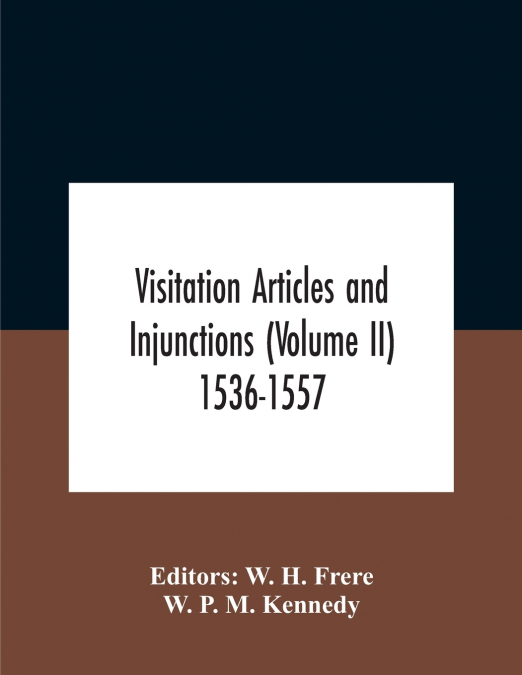
A revealing administrative mirror of the English Reformation.Vital for students and collectors.This carefully assembled collection of visitation articles and injunctions from 1536-1557 details how ecclesiastical authority was exercised and contested. As a primary source anthology of Tudor church documents and ecclesiastical visitation records, it documents historical religious injunctions in the language of governance - the directives, local reports and sanctions that governed parish life. That plain, procedural record gives modern readers direct access to the mechanics of church governance reforms and to the everyday realities behind English Reformation history. Useful as an academic research collection for historians and scholars and as a readable reference for theologians, the volume bridges specialist study and general interest in Church of England studies. Because the texts are documentary rather than interpretive, they make an ideal starting point for archival work, coursework and informed historical reading; they allow readers to follow how national policy translated into parish practice across sixteenth century England.Republished by Alpha Editions in a careful modern edition, this volume preserves the spirit of the original while making it effortless to enjoy today - a heritage title prepared for readers and collectors alike.Taken together, these visitation materials illuminate sixteenth century England in a way that narrative histories cannot: they are evidence, not commentary. For researchers tracing the 1530s to 1550s England, the articles supply the administrative traces by which historians reconstruct parish practice, clerical discipline and the local experience of liturgical change. As a focused primary source anthology the volume serves as a rigorous reference for theologians and an indispensable tool for historians and scholars pursuing church governance reforms. Casual readers curious about English Reformation history will find the immediacy of local directives revealing, while classic-literature collectors and libraries will prize the work as an authentic Tudor documentary corpus. Concise yet rich, the material repays close study and rewards anyone wanting to see how national reforms were lived and enforced at parish level.