
Inicio > Humanidades > Filosofía > Ética y filosofía moral > Virtue, Happiness and Duclos’ Histoire de Madame de Luz
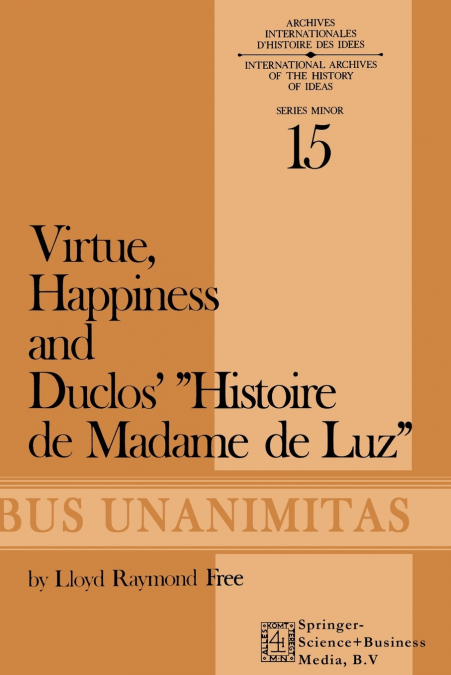
Virtue, Happiness and Duclos’ Histoire de Madame de Luz

Virtue, Happiness and Duclos’ Histoire de Madame de Luz

L.R. Free

67,13 €
IVA incluido
Disponible
Editorial:
Springer Nature B.V.
Año de edición:
1974
Materia
Ética y filosofía moral
ISBN:
9789024716692
67,13 €
IVA incluido
Disponible

Selecciona una librería:

  • Librería Samer Atenea
  • Librería Aciertas (Toledo)
  • Kálamo Books
  • Librería Perelló (Valencia)
  • Librería Elías (Asturias)
  • Donde los libros
  • Librería Kolima (Madrid)
  • Librería Proteo (Málaga)

Charles Pinot Duclos’ biography dramatizes the evolution from the rigid separation of the aristocratic and plebeian classes in the seventeenth century to the gradual social democratization in the eighteenth. This son of a Brittany merchant from the little village of Dinan rose to social prominence in the aristocratic salon circles of Paris and to literary pre­ eminence, as attest contemporary memoirs, the success of his novels, histories and moral writings as well as his official positions - a member of two academies, Royal Historiographer, Perpetual Secretary of the French Academy -a feat nearly impossible in the stratified society of seventeenth­ century France. Moreover, not only was Duclos, the exceptional con­ versationalist, a persona grata among the Parisian social elite, but he was also aligned with the progressive philosophical forces, a friend or ally of the foremost mid-century men of letters. Indeed, as Karl Toth has so ably demonstrated, Duclos perhaps more than any other important writer 1 of his day can be considered the true representative of his Age. 1 Karl Toth, Woman and Rococo in France (London, 1931), p. 29. For amplified documentation on the character and life of Duclos consult the following sources: Louis Simon Auger, 'Notice sur Duclos,' Oeuvres completes de Duclos, Paris, 1806. Emile Henriot, 'Un honnete homme au XVIIIe siecle -Duclos,' La Nouvelle Revue (oct. -nov. 1910), XVII, pp. 553-64; (nov. -dec. 1910) XVIII, pp. 124-33. Leo Le Bourgo, Un homme de lettres au XVIII' siecle, Duclos, sa vie et ses ouvrages (Bordeaux, 1902).
Artículos relacionados

  • Ka Ab Ba Building The Lighted Temple
    Dr Terri R. Nelson / Dr Terri RNelson
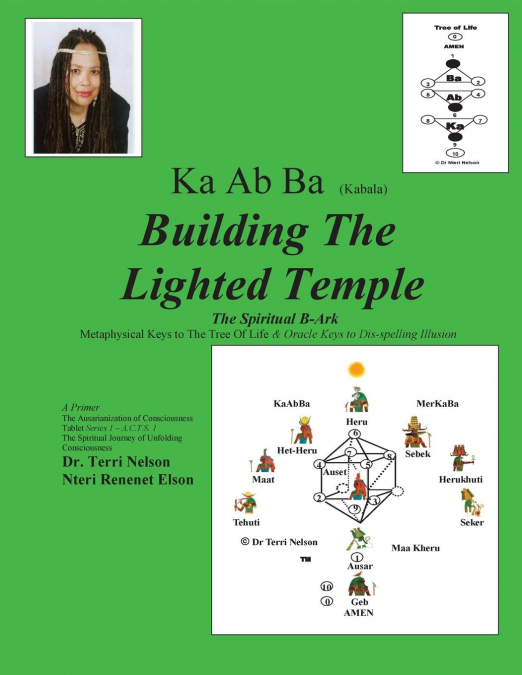
    The book KaAbBa Building The Lighted Temple/Metaphysical Keys to the Tree of Life draws a circle that is inclusive of the Afrikan origin of the Ancient Kemetic/Egyptian wisdom. It reveals the undeniable root and link of Ancient Africa to all the religious systems that would develop worldwide. This book is explosive in its power to convey the meaning of KaAbBa, the Medu Neter  (...
    Disponible

    37,41 €

  • Technoethics and the Evolving Knowledge Society
    Rocci Luppicini
    Recently, there has been a major push to rediscover the ethical dimension of technology across the sciences, social sciences, and humanities. Technoethics and the Evolving Knowledge Society: Ethical Issues in Technological Design, Research, Development, and Innovation examines human processes and practices connected to technology embedded within social, political, and moral sph...
  • Kant
    Immanuel Kant
    Kant’s Groundwork of the Metaphysics of Morals is one of the most important works in modern moral philosophy. It belongs beside Plato, Aristotle, Machiavelli, and Hobbes. Here Kant sets out to articulate and defend the Categorical Imperative - the fundamental principle that underlies moral reasoning - and to lay the foundation for a comprehensive account of justice and human vi...
  • On the Duty of Civil Disobedience
    HENRY DAVID THOREAU
    Civil Disobedience argues that citizens should not permit their governments to overrule their consciences, and that they have a duty to avoid allowing their acquiescence to enable the government to make them the agents of injustice. Thoreau was motivated in part by his disgust with slavery and the Mexican-American War, but the sentiments he expresses here are just as pertinent ...
  • Beyond Good and Evil
    Friedrich Nietzsche
    Nietzsche, though primarily a philosopher, wrote widely on art, philology, history, religion, tragedy, culture, and science.  In 1886, at the height of his powers, he published Beyond Good and Evil.  Here he examines much of the best of human thought--dogmatic philosophy, Judeo-Christian morality, science and democracy – and finds it lacking.  Rejecting “slave-morality” he pres...
  • Beyond Good and Evil
    Friedrich Nietzsche
    Nietzsche, though primarily a philosopher, wrote widely on art, philology, history, religion, tragedy, culture, and science.  In 1886, at the height of his powers, he published Beyond Good and Evil.  Here he examines much of the best of human thought--dogmatic philosophy, Judeo-Christian morality, science and democracy – and finds it lacking.  Rejecting “slave-morality” he pres...
    Disponible

    9,99 €