
Inicio > Derecho > Teoría general del derecho > Vermögensübertragung im Wege der vorweggenommenen Erbfolge
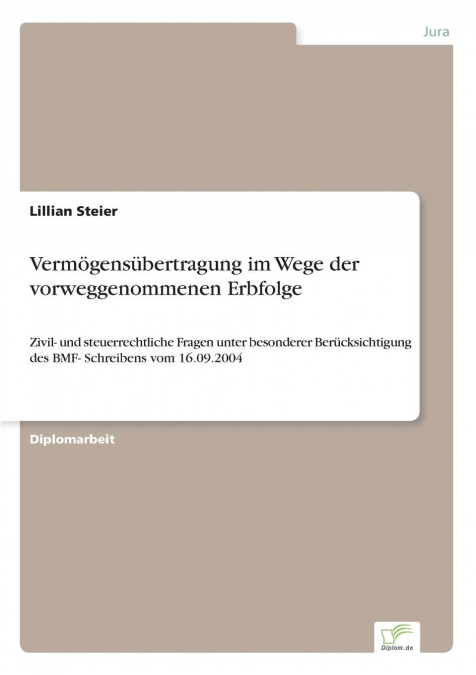
Vermögensübertragung im Wege der vorweggenommenen Erbfolge

Vermögensübertragung im Wege der vorweggenommenen Erbfolge

Lillian Steier

88,32 €
IVA incluido
Disponible
Editorial:
diplom.de
Año de edición:
2007
Materia
Teoría general del derecho
ISBN:
9783836601382
88,32 €
IVA incluido
Disponible

Selecciona una librería:

  • Librería Samer Atenea
  • Librería Aciertas (Toledo)
  • Kálamo Books
  • Librería Perelló (Valencia)
  • Librería Elías (Asturias)
  • Donde los libros
  • Librería Kolima (Madrid)
  • Librería Proteo (Málaga)

Inhaltsangabe:Einleitung: Nach einer aktuellen Untersuchung des Instituts für Mittelstandsforschung, Bonn, gibt es in Deutschland 2.122.000 Unternehmen mit einem Jahresumsatz von über 50.000 Euro. Den mit Abstand größten Teil dieser Unternehmen machen die in dieser Gesamtzahl enthaltenen 2.005.000 Familienunternehmer aus. In den nächsten 5 Jahren, also zwischen 2005 und 2010, werden ca. 354.000 Unternehmen innerhalb der Familie oder an Erwerber übertragen. Allein im Jahre 2005 wurden 70.900 Unternehmen mit ca. 678.000 Beschäftigten übergeben. Die Entwicklung wird sich in den nächsten Jahren weiter beschleunigen, denn die durchaus vermögensstarke Nachkriegsgesellschaft befindet sich bereits in ihrem Lebensabend. Nach Schätzung des Deutschen Instituts für Altersvorsorge (kurz: DIA) werden ca.15 Millionen Haushalte beerbt und bis zum Jahr 2010 fast zwei Billionen Euro an Vermögen erhalten, darunter im Wege der vorweggenommenen Erbfolge im Zentrum der Planungen der Vorbereitung des Generationswechsels. Angesichts der finanziellen Notlage der öffentlichen Haushalte ist es deshalb nicht verwunderlich, dass sich der Fiskus mancher Finanzpolitiker vermehrt auf die Erbschaft- und Schenkungssteuer richtet, auch wenn dadurch Unternehmensfortführungen womöglich erschwert werden. Bisher wurde unter Unternehmensnachfolge vorrangig der Übergang von Einzelunternehmen bzw. Anteilen an Personen – und Kapitalgesellschaften im Wege der Schenkung oder Nachfolge von Todes wegen verstanden. Diese familieninterne Nachfolge bildet einen Aspekt der Unternehmensnachfolge, der nur dann zu wirtschaftlich sinnvollen Ergebnissen führt, wenn zumindest ein geeigneter Nachfolger in der Familie vorhanden ist. Soweit dies nicht der Fall ist, werden Unternehmen – in jüngerer Zeit zunehmend – an fremde Dritte verkauft. Daher wird zwischen der familienexternen Unternehmensnachfolge in Form des Verkaufs und der familieninternen Unternehmensnachfolge differenziert. Die Bedeutung der Gestaltung familie


Artículos relacionados

  • EU General Data Protection Regulation (GDPR)
    IT Governance Privacy Team
    An in-depth guide to complying with the EU GDPR.Now in its second edition, EU GDPR – An Implementation and Compliance Guide is a clear and comprehensive guide to this new data protection law, providing a detailed commentary on the Regulation, and setting out the obligations of data  processors and controllers in clear and comprehensible terms.Read this book to learn: How the ...
    Disponible

    30,10 €

  • Banking Laws and Regulations in Nigeria
    Bello Mohammed Magaji
    Banking Law and Regulations in Nigeria: Selected Themes essentially deals with the laid down rules or code of conduct meant to control and set standards for banking business. Indeed, the main aim of the ongoing banking reforms in Nigeria, started in 2004, is to ensure banks’ conformity to the laid down banking rules and regulations. The eleven-chapter book contains vital and ri...
    Disponible

    41,17 €

  • States and the Interpretation of Treaties
    Dimitris Liakopoulos
    States and the Interpretation of Treaties opens with a provocative reconsideration of a debate on the subject of comparative international legal obligations by the United Nations’s International Law Commission. In this book, distinguished Tufts University legal scholar Dimitris Liakopoulos identifies and explores relevant considerations in the work of the Commission and offers ...
  • The role of customs in international treaties
    Dimitris Liakopoulos
    The Role of Customs in International Treaties concentrates on issues of friction between member states of the United Nations. In view of the role played by the United Nations in resolving international disputes, Dimitris Liakopoulos hypothesizes that 'practical guides' based on custom often catalyze the positions taken by states, courts, scholars, and other actors, constituting...
  • Debtor protection in American and European Union bankruptcy law
    Dimitris Liakopoulos
    In Debtor Protection in American and European Union Bankruptcy Law, international law scholar Dimitris Liakopulos raises a delicate issue at the foundations of the modern banking system by analyzing US bankruptcy law with a focus on the concept of automatic stay. His work identifies legal sources and authorities having repercussions in terms of operational protection. It then e...
  • Capital punishment in American courts
    James Biser Whisker / Kevin Spiker
    In the 400 years since the first known execution was carried out for treason in Virginia, American jurisdictions have debated both the appropriateness and methods of capital punishment. Over that time, courts have placed varying restrictions on its application, excluding categories of citizens (for example the insane or the underaged) and evaluating and excluding methods of exe...