Frédéric Gustave Eichhoff / Jacob Heinrich Kaltschmidt
 Librería Samer Atenea
 Kálamo Books
 Librería Elías (Asturias)
 Librería Kolima (Madrid)
 Librería Proteo (Málaga)
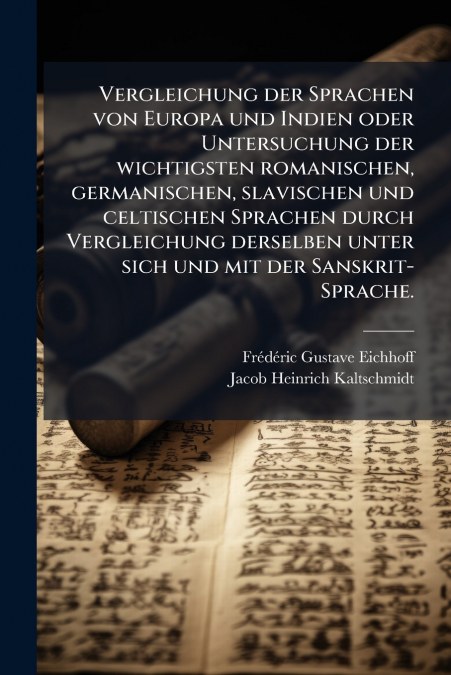
Vergleichung der Sprachen von Europa und Indien, published in 1840, offers a comprehensive comparative analysis of European and Indian languages. This seminal work examines the key Romance, Germanic, Slavic, and Celtic languages, comparing them both amongst themselves and with Sanskrit. Written by Frédéric Gustave Eichhoff and Jacob Heinrich Kaltschmidt, the book delves into the intricate relationships between these language families, providing valuable insights into their historical development and mutual influences. This volume remains an important resource for linguists and historians interested in the evolution of Indo-European languages and the historical connections between diverse cultures. It provides a detailed and scholarly exploration of linguistic patterns and structures, making it essential for understanding the roots and transformations of language across Europe and India.This work has been selected by scholars as being culturally important, and is part of the knowledge base of civilization as we know it. This work was reproduced from the original artifact, and remains as true to the original work as possible. Therefore, you will see the original copyright references, library stamps (as most of these works have been housed in our most important libraries around the world), and other notations in the work.This work is in the public domain in the United States of America, and possibly other nations. Within the United States, you may freely copy and distribute this work, as no entity (individual or corporate) has a copyright on the body of the work.As a reproduction of a historical artifact, this work may contain missing or blurred pages, poor pictures, errant marks, etc. Scholars believe, and we concur, that this work is important enough to be preserved, reproduced, and made generally available to the public. We appreciate your support of the preservation process, and thank you for being an important part of keeping this knowledge alive and relevant.