
Inicio > Sociedad y ciencias sociales > Política y gobierno > Gobierno central > Políticas del Gobierno central > Using Discrete Choice Experiments to Value Health and Health Care
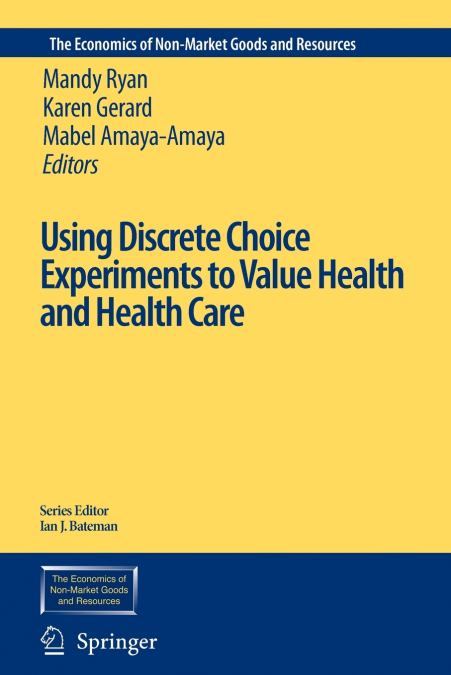
Using Discrete Choice Experiments to Value Health and Health Care

Using Discrete Choice Experiments to Value Health and Health Care


195,47 €
IVA incluido
Disponible
Editorial:
Springer Nature B.V.
Año de edición:
2010
Materia
Políticas del Gobierno central
ISBN:
9789048170364
195,47 €
IVA incluido
Disponible

Selecciona una librería:

  • Librería Samer Atenea
  • Librería Aciertas (Toledo)
  • Kálamo Books
  • Librería Perelló (Valencia)
  • Librería Elías (Asturias)
  • Donde los libros
  • Librería Kolima (Madrid)
  • Librería Proteo (Málaga)

List of contributors. Preface. Introduction; K. Gerard, M. Ryan, and M. Amaya-Amaya. Part 1: DCEs - what are they and their application in health: a users guide. 1. Discrete choice experiments in a nutshell; M. Amaya-Amaya, K Gerard and M Ryan. 2. Designing discrete choice experiments for health care; D.J. Street, L. Burgess, R. Viney and J. Louviere. 3. Practical issues in conducting a discrete choice experiment; M. Ryan, V. Watson and K. Gerard. Part 2: Case Studies in Valuing Health and Health Care. 4. Using discrete choice experiments to go beyond clinical outcomes when evaluating clinical practice; M. Ryan, D. Skåtun and K. Major. 5. Using discrete choice modelling to investigate breast screening participation; K. Gerard, M. Shanahan and J. Louviere. 6. Preferences for health care programmes: Results from a general population discrete choice survey; S. Bryan and T. Roberts. 7. Examining the preferences of health care providers: An application to hospital consultants; A. Scott, C. Ubach, F. French and G. Needham. Part 3 Methodological issues. 8. The price proxy in discrete choice experiments: Issues of relevance for future research; D. Gyrd-Hansen and U. Slothuus Skjoldborg. 9. ’Irrational’ stated preference: a quantitative and qualitative investigation; F. San Miguel, M. Ryan and M. Amaya-Amaya. 10. Using stated preference and revealed preference data fusion modeling in health care; T. Mark and J. Swait. PART 4: CONCLUSIONS. 11. Concluding thoughts; M. Ryan, M. Amaya-Amaya and K. Gerard. Index.


Artículos relacionados

  • Managing E-Government Projects
    Stephen Kwamena Aikins
    E-government promises efficient communication, streamlined operations, citizen involvement, improved services, and increased transparency. However, despite huge investments in e-government, evidence suggests numerous e-government projects are late, over budget, and inadequate. Managing E-Government Projects: Concepts, Issues, and Best Practices collects the work of some of the ...
  • Trumplandia
    Tiberiu Dianu
    Trumplandia: Populist Nationalism in America is a collection of essays about the transformation of America, which has turned from a united nation to one more divided than ever under the presidency of Donald Trump. Some pundits predict that if things don’t change another civil war could occur. Have we reached a point of no return? Author and attorney Tiberiu Dianu writes in the ...
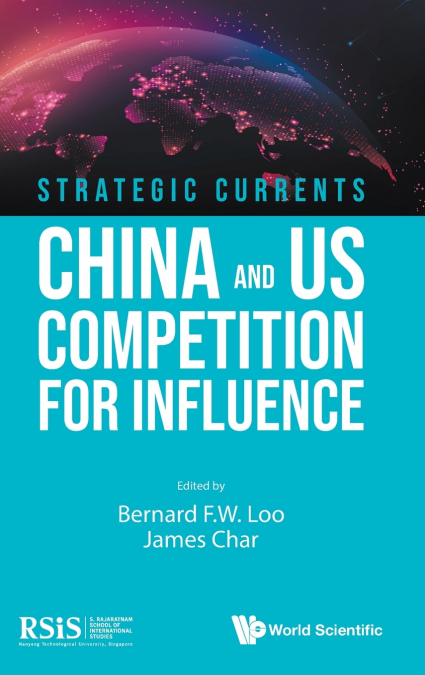
  • STRATEGIC CURRENTS
    JAMES CHAR BERNARD F W LOO / LOO BERNARD F W
    The advent of the 4th Industrial Revolution amidst the increasingly intensified global competition between the United States and China promises to be a major inflection point in human history. The authors assembled in this volume provide a sober assessment of this techno-nationalist contest and their implications for the rest of the world. ...
  • At a Turning Point
    Australia is at a much-needed turning point in work, care and family policy. Australian women, families and communities are struggling to manage the complex demands of work and care.Rapid social and demographic change, alongside new workplace, labour market trends and the aftermath of the COVID-19 pandemic, requires a policy revamp that will allow all Australians to work, care ...
    Disponible

    25,96 €

  • Shadows of Catastrophe
    Richard Skiba
    This book explores the concept of S-Risks, or suffering risks, and delves into their significance, distinguishing them from conspiracy theories and alarmism. It categorizes S-Risks into agential, natural, and incidental types, discussing the disjunctive nature and various factors influencing them. Examining technological progress, the existence of powerful agents, and unintende...
    Disponible

    22,35 €

  • The Economic Theory of Eminent Domain
    Thomas J. Miceli
    ...
    Disponible

    47,12 €