
Inicio > Consulta, información y materias interdisciplinarias > Estudios interdisciplinarios > Using American Community Survey Data to Expand Access to the School Meals Programs
Using American Community Survey Data to Expand Access to the School Meals Programs

Using American Community Survey Data to Expand Access to the School Meals Programs

AA.VV

56,11 €
IVA incluido
Disponible
Editorial:
National Academies Press
Año de edición:
2012
Materia
Estudios interdisciplinarios
ISBN:
9780309257206
56,11 €
IVA incluido
Disponible

Selecciona una librería:

  • Librería Samer Atenea
  • Librería Aciertas (Toledo)
  • Kálamo Books
  • Librería Perelló (Valencia)
  • Librería Elías (Asturias)
  • Donde los libros
  • Librería Kolima (Madrid)
  • Librería Proteo (Málaga)

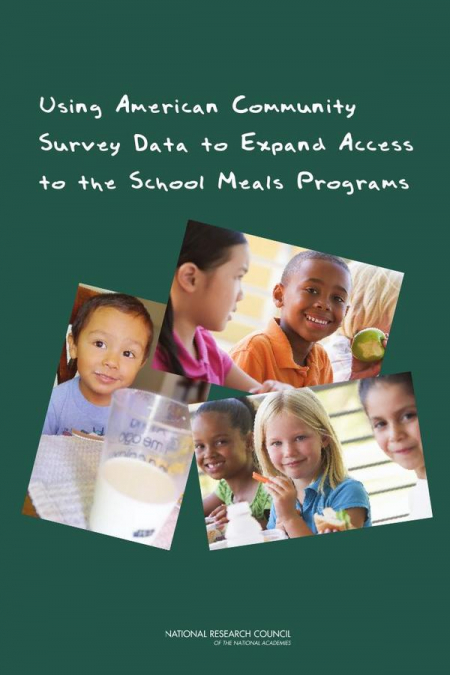
The National School Lunch and School Breakfast Programs, administered by the Food and Nutrition Service (FNS) of the U.S. Department of Agriculture (USDA), are key components of the nation’s food security safety net, providing free or low-cost meals to millions of schoolchildren each day. To qualify their children each year for free or reduced-price meals, many families must submit applications that school officials distribute and review. To reduce this burden on families and schools and to encourage more children to partake of nutritious meals, USDA regulations allow school districts to operate their meals programs under special provisions that eliminate the application process and other administrative procedures in exchange for providing free meals to all students enrolled in one or more school in a district.FNS asked the National Academies’ Committee on National Statistics and Food and Nutrition Board to convene a panel of experts to investigate the technical and operational feasibility of using data from the continuous American Community Survey (ACS) to estimate students eligible for free and reduced-price meals for schools and school districts. The ACS eligibility estimates would be used to develop ’claiming percentages’ that, if sufficiently accurate, would determine the USDA reimbursements to districts for schools that provided free meals to all students under a new special provision that eliminated the ongoing base-year requirements of current provisions.Using American Community Survey Data to Expand Access to the School Meals Program was conducted in two phases. It first issued an interim report (National Research Council, 2010), describing its planned approach for assessing the utility of ACS-based estimates for a special provision to expand access to free school meals. This report is the final phase which presents the panel’s findings and recommendations.

Artículos relacionados

  • Bioactive Compounds Of Jaboticaba (Plinia Sp.)
    Flávio Alves Da Silva / Nara Rúbia Rodrigues Do Nascimento-Silva / Rodrigo Barbosa Monteiro Cavalcante
    The Whole Jaboticaba Fruit Stood Out For Its High Levels Of Total Polyphenols, Mainly Anthocyanins (Cyanidin And Delphinidin), Ellagic Acid, Methylellagic Acid, Gallic Acid, Myricetin, Quercetin, Castalagin, Pedunculagin And Vescalagin. When Evaluating The Behavior Of These Compounds After In Vitro Digestion, It Is Observed That Anthocyanins Did Not Suffer As Much In The Saliva...
    Disponible

    11,96 €

  • Obesidad, genética y entorno. El papel de la flexibilidad metabólica
    Fundación alimentación saludable
    Afortunadamente, gracias a la investigación, somos más conscientes de que la obesidad no es una patología que se deba en exclusiva a la desidia ola falta de voluntad del sujeto y que los mensajes de culpabilidad o estigmatización hacia los pacientes no sólo no ayudan a poner freno al sobrepeso, sino que pueden perjudicar seriamente su salud mental. También sabemos, y esto es mu...
    Disponible

    20,00 €

  • FOOD AND NUTRITION ECONOMICS P
    GEORGE C DAVIS
    ...
    Disponible

    118,89 €

  • Maternal-Fetal Nutrition During Pregnancy and Lactation
    ...
  • The Myths About Nutrition Science
    David Lightsey
    The Myths About Nutrition Science provides an authoritative, yet readily understandable, overview of the common misunderstandings that are commonplace within consumer or athletic communities regarding the food production process and nutrition science, which may affect their physical development, performance, and long-term health ...
  • Local Food Environments
    Allison E. Karpyn / Kimberly B. Morland / Yael M. Lehmann
    This second edition contains four sections including (1) disparities between local food environments in the United States; (2) effect of restricted local food environments on dietary intake; (3) interventions to local food environment and their impact on communities; and (d) macro-level influence on the development of local food environments. ...