 Librería Samer Atenea
 Kálamo Books
 Librería Elías (Asturias)
 Librería Kolima (Madrid)
 Librería Proteo (Málaga)
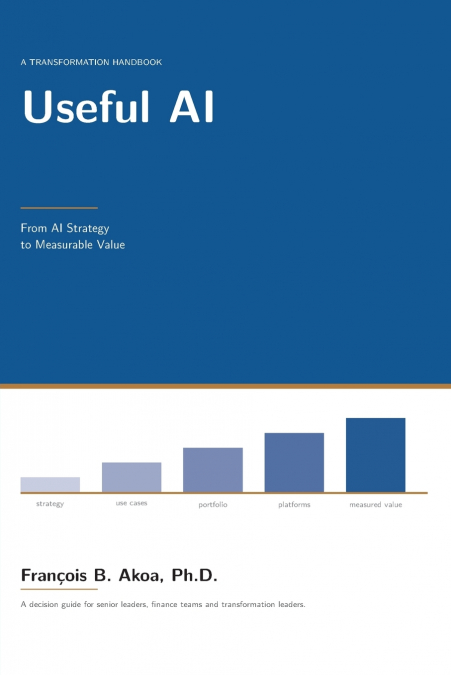
Almost every organisation now uses artificial intelligence. Far fewer can show what it has changed.Between the stated ambition and the value actually delivered, the gap is almost always one of method: AI use cases chosen vaguely, pilots cut off from real operating conditions, governance that arrives after the rollout. Boards approve budgets. Dashboards multiply. Nobody can say which decision improved.Most of this handbook is spent on the one stretch that decides the outcome: what happens to an idea between the moment someone has it and the moment its effect can be measured.Across 48 chapters it follows that pathway step by step, and it is written for enterprise AI programmes rather than experiments. Where to look for AI use cases in real processes and decisions. How to formulate one precisely enough to be assessed. How to run a portfolio of thirty or fifty ideas through an innovation tournament to surface the serious candidates. How to qualify the survivors against value, feasibility, data and risk. How to design a pilot that tests a hypothesis rather than staging a demonstration. How to deploy, how to secure AI adoption, how to monitor a model as data drifts, and how to measure impact honestly against a baseline into measurable value.It says plainly that most ideas should not survive that journey, and it gives the criteria for dropping one without regret. A serious portfolio shrinks from a hundred ideas to a handful of deployments. That attrition is a sign of health, not failure.The book then changes level. Where the value pools sit in the organisation’s value chain. How to build an AI investment case that holds up before a board, with total cost of ownership and a defensible baseline. Which AI operating model to choose, from a central team to a federated network, and what each one trades away. Which data foundations and shared platforms to fund, and how AI implementation differs from a data strategy. And how to govern agentic AI: systems that chain actions on their own, where guardrails, human oversight and an emergency stop stop being optional.AI governance here is proportionate, not uniform. An internal document assistant and a score that affects someone’s access to a service do not deserve the same controls. The book grades the level of oversight to the level of impact, autonomy, opacity and risk, drawing on the NIST AI Risk Management Framework, the EU AI Act, ISO/IEC 42001 and the OECD principles without hiding behind them.It also takes the critics seriously. Cathy O’Neil, Kate Crawford, Brent Mittelstadt, Arvind Narayanan and Sayash Kapoor are engaged rather than name-checked, and their arguments are turned into a working test of impact against contestability.Written for executive committees, finance functions, data and IT leaders, risk and compliance teams, and digital transformation consultants. Its examples run across the public sector, banking and insurance, health, education, industry, logistics and professional services, because the discipline does not change with the sector, only its intensity.A practical, sober, sometimes uncomfortable guide for anyone who would rather deploy three AI use cases that work than announce thirty that do not.Includes a complete toolkit: an AI strategy canvas, a baseline assessment grid, a use case record, a qualification grid, a value-feasibility-risk matrix, the tournament method, a pilot record, a deployment checklist and an impact measurement table. With an annotated glossary and a guide to the international reference frameworks.