
Use of Proxies in Paleoceanography

Use of Proxies in Paleoceanography

G. Fischer / G. Wefer

406,94 €
IVA incluido
Consulta disponibilidad
Editorial:
Springer Nature B.V.
Año de edición:
1999
Materia
Geología y la litosfera
ISBN:
9783540663409

Selecciona una librería:

  • Librería Samer Atenea
  • Librería Aciertas (Toledo)
  • Kálamo Books
  • Librería Perelló (Valencia)
  • Librería Elías (Asturias)
  • Donde los libros
  • Librería Kolima (Madrid)
  • Librería Proteo (Málaga)

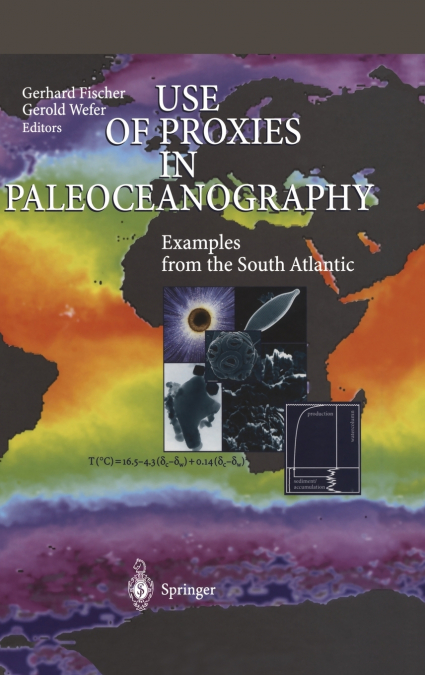
Paleoceanographic proxies provide infonnation for reconstructions of the past, including climate changes, global and regional oceanography, and the cycles of biochemical components in the ocean. These prox­ ies are measurable descriptors for desired but unobservable environmental variables such as tempera­ ture, salinity, primary productivity, nutrient content, or surface-water carbon dioxide concentrations. The proxies are employed in a manner analogous to oceanographic methods. The water masses are first characterized according to their specific physical and chemical properties, and then related to particular assemblages of certain organisms or to particular element or isotope distributions. We have a long-standing series of proven proxies available. Marine microfossil assemblages, for instance, are employed to reconstruct surface-water temperatures. The calcareous shells of planktonic and benthic microorgan­ isms contain a wealth of paleoceanographic information in their isotopic and elemental compositions. Stable oxygen isotope measurements are used to detennine ice volume, and MglCa ratios are related to water temperatures, to cite a few examples. Organic material may also provide valuable infonnation, e. g. , about past productivity conditions. Studying the stable carbon isotope composition of bulk organic matter or individual marine organic components may provide a measure of past surface-water CO 2 conditions within the bounds of certain assumptions. Within the scope of paleoceanographic investigations, the existing proxies are continuously evolving and improving, while new proxies are being studied and developed. The methodology is improved by analysis of samples from the water column and surface sediments, and through laboratory experiments.
Artículos relacionados

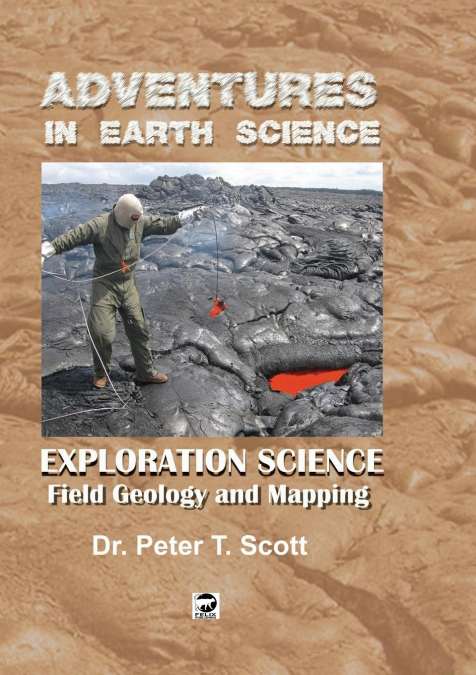
  • Exploration Science
    Dr Peter T Scott
    About Exploration ScienceHave you wondered what the science of geology is all about?Together we will explore of the surface and sub-surface of the Earth, the sub-branches of geology, including mineralogy, petrology (rocks), palaeontology (fossils), geochemistry, seismology (earthquakes), engineering geology, and many more.The scientific method used by all scientists as well as ...
    Disponible

    30,12 €

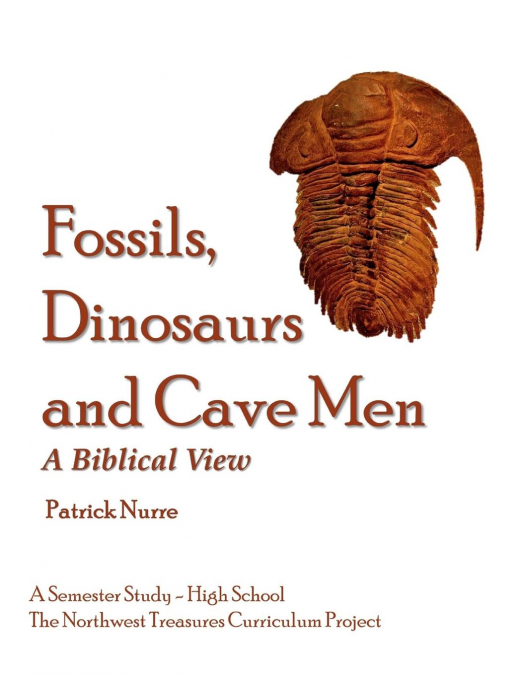
  • Fossils, Dinosaurs and Cave Men
    Patrick Nurre
    This textbook is a high school, semester study of the differences between the Biblcal and secular views of fossils, dinosaurs, and cave men.  Topics include the cause and mechanism for a global flood, the geologic time table, living fossils, the Tower of Babel, modern classification of dinosaurs, and more.  Students will also learn to interpret the geologic column from a Biblic...
    Disponible

    43,86 €

  • Adventures in Earth Science
    Dr Peter T Scott
    ADVENTURES in EARTH SCIENCE is not just an in-depth textbook but a series of adventures across seven continents and beyond in the sciences of astronomy, geology, meteorology and oceanography. It has been written with over forty years of experience in studying, researching and teaching earth science. Whilst it has been designed for senior high school and junior university or col...
    Disponible

    142,25 €

  • Timefulness
    Marcia Bjornerud
    Why an awareness of Earth’s temporal rhythms is critical to our planetary survivalFew of us have any conception of the enormous timescales in our planet’s long history, and this narrow perspective underlies many of the environmental problems we are creating for ourselves. The passage of nine days, which is how long a drop of water typically stays in Earth’s atmosphere, is somet...
  • The Long Thaw
    David Archer
    Why a warmer climate may be humanity’s longest-lasting legacyThe human impact on Earth’s climate is often treated as a hundred-year issue lasting as far into the future as 2100, the year in which most climate projections cease. In The Long Thaw, David Archer, one of the world’s leading climatologists, reveals the hard truth that these changes in climate will be 'locked in,' ess...
    Disponible

    24,10 €

  • THE EPEMBE CARBONATITE DYKE, NORTH-WEST NAMIBIA
    Kamuhitua Humavindu
    This book gives a bright perspective on the nature of carbonatites along with different magmatic and hydrothermal processes that affect the distribution of these dykes. In the past there has been several debates on the enrichment mechanisms of rare-earth elements, making it a significant book especially now with the increase in technology. The research is filled with exciting f...
    Disponible

    75,64 €