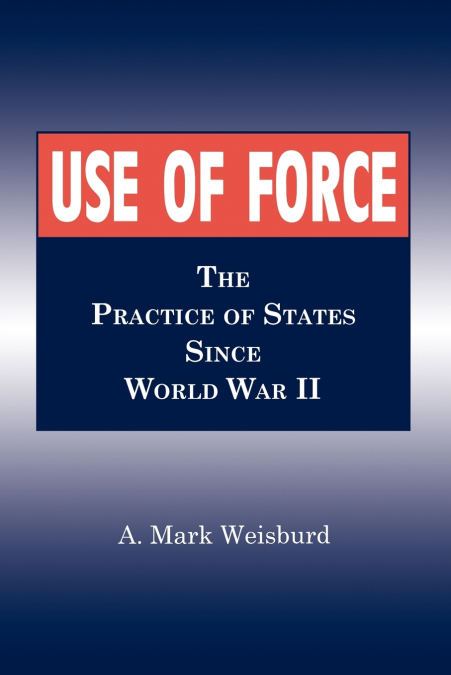
Use of Force

Use of Force

AMark Weisburd / Arthur Mark Weisburd

84,42 €
IVA incluido
Disponible
Editorial:
Penn State University Press
Año de edición:
1997
Materia
Relaciones internacionales
ISBN:
9780271016801
84,42 €
IVA incluido
Disponible

Selecciona una librería:

  • Librería Samer Atenea
  • Kálamo Books
  • Librería Elías (Asturias)
  • Librería Kolima (Madrid)
  • Librería Proteo (Málaga)

This book is among the few to develop in detail the proposition that international law on the subject of interstate force is better derived from practice than from treaties. Mark Weisburd assembles here a broad body of evidence to support practice-based rules of law on the subject of force. Analyses of a particular use of force by a state against another state generally begin with the language of the Charter of the United Nations. This approach is seriously flawed, argues Weisburd. States do not, in fact, behave as the Charter requires. If the legal rule regulating the use of force is the rule of the Charter, then law is nearly irrelevant to the interstate use of force. However, treaties like the Charter are not the only source of public international law. Customary law, too, is binding on states. If state behavior can be shown to conform generally to what amount to tacit rules on the use of force, and if states generally enforce such rules against other states, then the resulting pattern of practice strongly supports the argument that the use of force is affected by law at a very practical level. This work aims to demonstrate that such patterns exist and to explain their content. Weisburd discusses over one hundred interstate conflicts that took place from 1945 through 1991. He focuses on the behavior of the states using force and on the reaction of third parties to the use of force. He concentrates upon state practice rather than upon treaty law and does not assume a priori that any particular policy goal can be attributed to the international legal system, proceeding instead on the assumption that the system’s goals can be determined only by examining the workings of the system. 6
Artículos relacionados

  • Realism in Practice
    The purpose of this book is to appraise the current relevance and validity of realism as an interpretative tool in contemporary International Relations. All chapters of the book are animated by a theoretical effort to define the conceptual aspects of realism and attempt to establish whether the tradition still provides the necessary conceptual tools to scholars.The chapters add...
    Disponible

    20,36 €

  • Predicting gender violence in India
    Shritha K Vasudevan
    In this provocative new book, Shritha Vasudevan argues that feminist international relations (IR) theory has inadvertently resulted in a biased worldview, the very opposite of what feminist IR set out to try to rectify. This book contests theoretical presumptions of Western feminist IR and attempts to reformulate it in contexts of non-Western cultures. Vasudevan deftly utilizes...
  • Contemporary security issues in Africa
    Isiaka Alani Badmus / Lere Amusan
    In volume, an emerging generation of African scholars examines specific states in Africa where instability is the order of the day. Considerations of African instability are highly relevant in today’s world, where one examines the types of regimes that were put in place after the Cold War and their effects on Africa. Multiparty systems introduced in Africa, rather than bringing...
  • Chronicles of the first and second chechen wars
    Ilya Milyukov
    Presented by Russian author and attorney Ilya Milyukov, Chronicles of the First and Second Chechen War presents the main events of the First (1994-1996) and Second (1999-2009) Wars in Chechnya, Russia’s deadliest conflicts since World War II. The First War began in December 1994 and lasted for one year and nine months, ending in August 1996. There were two major urban battles -...
  • Political instability in Africa
    Isiaka Alani Badmus / Lere Amusan
    This book offers broad-gauged analyses of the causes, nature, and changing patterns of armed conflict in Africa as well as the reasons for these patterns. It also situates conflicts that have been haunting the African continent since the time of decolonization within the various theoretical schools such as 'new war,' 'economic war,' 'neo-patrimonial,' and 'globalization.' It be...
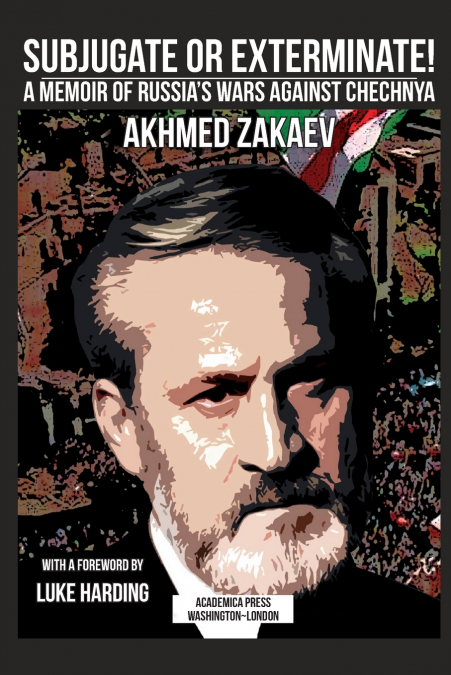
  • Subjugate or exterminate!
    Akhmed Zakaev / Arch Tait
    Foreword by Luke HardingAkhmed Zakaev is a symbol of the indomitable will of the Chechen nation. In this important memoir, he tells the story of the Chechen struggle as he experienced it, describing the conflict in human terms and providing a detailed documentary record of little known or badly understood events that will be of benefit to historians for generations to come.- Da...
    Disponible

    41,63 €