UN Peacekeeping in Africa

UN Peacekeeping in Africa

Kwame Akonor

74,18 €
IVA incluido
Disponible
Editorial:
Springer Nature B.V.
Año de edición:
2016
Materia
Relaciones internacionales
ISBN:
9783319391601
74,18 €
IVA incluido
Disponible

Selecciona una librería:

  • Librería Samer Atenea
  • Librería Aciertas (Toledo)
  • Kálamo Books
  • Librería Perelló (Valencia)
  • Librería Elías (Asturias)
  • Donde los libros
  • Librería Kolima (Madrid)
  • Librería Proteo (Málaga)

This timely volume explores the 'dark side' of United Nations (UN) Peacekeeping in Africa: when rather than help establish a rule of law in the host country, they become perpetrators of crime. The work of the UN peacekeepers is generally comprised of police and military personnel, from countries who contribute voluntarily to assist war-torn countries create conditions for lasting peace. Overall, these peacekeeping efforts are perceived positively, with volunteers giving their time and risking their lives to bring normalcy and peace to civilians in countries with conflict. In fact, there are cases where UN Peacekeepers are sometimes the victims of violent crimes, and need security and protection themselves. Although instances of abuse are not widespread and are certainly not isolated to Africa, this work focuses on Africa because there is a high concentration of UN Peacekeepers there, and lessons learned can be applied to other regions. The instances of abuse cover serious crimes including sexual abuse and exploitation, child and arms trafficking, and corruption, all of some of the most vulnerable populations in the world at the time. Although these instances are not extensive, they remain a fundamental problem because there is no existing mechanism for prosecution in the international area: it is only the troops’ home country, not the UN, who has the right to exercise criminal jurisdiction. The also undermine the good work that UN Peacekeepers are doing all over the world. This work is concerned with highlighting why these instances occur, and why specific forms of abuse are more prevalent than others. It also discusses how to prevent abuse and violations from happening in the first place, and creating a culture of change and accountability. Finally, taking into account cultural and legal systems from troops’ home countries, the author considers the ways that local rules can be aligned with international standards. In will be of interest to researchers in Criminology and Criminal Justice, International Relations, Sociology and Demography, Public Health, Comparative Law, and other related disciplines.

Artículos relacionados

  • Realism in Practice
    The purpose of this book is to appraise the current relevance and validity of realism as an interpretative tool in contemporary International Relations. All chapters of the book are animated by a theoretical effort to define the conceptual aspects of realism and attempt to establish whether the tradition still provides the necessary conceptual tools to scholars.The chapters add...
    Disponible

    20,36 €

  • Predicting gender violence in India
    Shritha K Vasudevan
    In this provocative new book, Shritha Vasudevan argues that feminist international relations (IR) theory has inadvertently resulted in a biased worldview, the very opposite of what feminist IR set out to try to rectify. This book contests theoretical presumptions of Western feminist IR and attempts to reformulate it in contexts of non-Western cultures. Vasudevan deftly utilizes...
  • Contemporary security issues in Africa
    Isiaka Alani Badmus / Lere Amusan
    In volume, an emerging generation of African scholars examines specific states in Africa where instability is the order of the day. Considerations of African instability are highly relevant in today’s world, where one examines the types of regimes that were put in place after the Cold War and their effects on Africa. Multiparty systems introduced in Africa, rather than bringing...
  • Chronicles of the first and second chechen wars
    Ilya Milyukov
    Presented by Russian author and attorney Ilya Milyukov, Chronicles of the First and Second Chechen War presents the main events of the First (1994-1996) and Second (1999-2009) Wars in Chechnya, Russia’s deadliest conflicts since World War II. The First War began in December 1994 and lasted for one year and nine months, ending in August 1996. There were two major urban battles -...
  • Political instability in Africa
    Isiaka Alani Badmus / Lere Amusan
    This book offers broad-gauged analyses of the causes, nature, and changing patterns of armed conflict in Africa as well as the reasons for these patterns. It also situates conflicts that have been haunting the African continent since the time of decolonization within the various theoretical schools such as 'new war,' 'economic war,' 'neo-patrimonial,' and 'globalization.' It be...
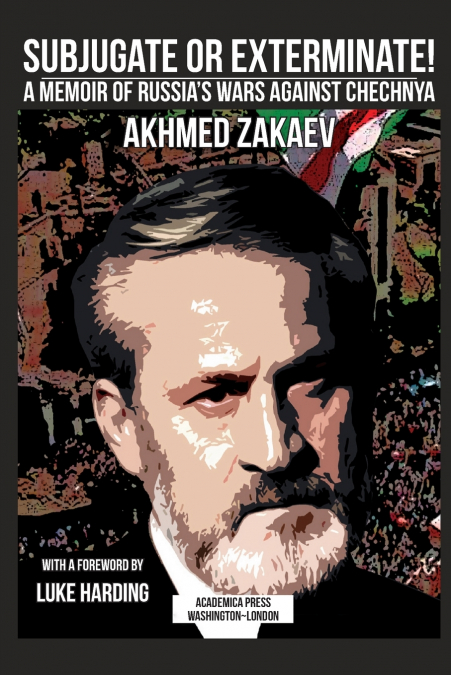
  • Subjugate or exterminate!
    Akhmed Zakaev / Arch Tait
    Foreword by Luke HardingAkhmed Zakaev is a symbol of the indomitable will of the Chechen nation. In this important memoir, he tells the story of the Chechen struggle as he experienced it, describing the conflict in human terms and providing a detailed documentary record of little known or badly understood events that will be of benefit to historians for generations to come.- Da...
    Disponible

    41,63 €

Otros libros del autor

  • African Economic Institutions
    Kwame Akonor
    This book examines and assesses the principal international economic organizations (IEO’s) based in Africa, analysing how African IEOs have evolved and what contributions they have made to the continents’s socio-economic development. ...
    Disponible

    65,54 €

  • African Economic Institutions
    Kwame Akonor
    This book examines and assesses the principal international economic organizations (IEO’s) based in Africa, analysing how African IEOs have evolved and what contributions they have made to the continents’s socio-economic development. ...