

 Librería Samer Atenea
 Kálamo Books
 Librería Elías (Asturias)
 Librería Kolima (Madrid)
 Librería Proteo (Málaga)
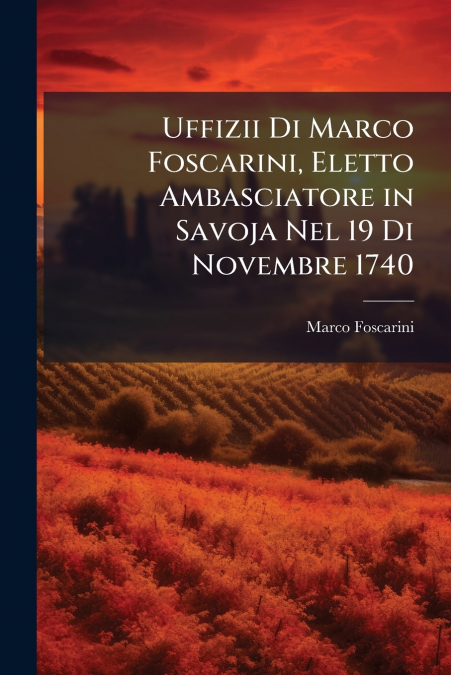
Uffizii Di Marco Foscarini, Eletto Ambasciatore in Savoja Nel 19 Di Novembre 1740 offers a fascinating glimpse into the diplomatic activities of Marco Foscarini, a prominent figure in the Venetian Republic. This work likely contains official correspondence, reports, and other documents related to Foscarini’s ambassadorship to Savoy (Sardinia) in 1740. As a historical document, it provides valuable insights into the political landscape of 18th-century Europe and the intricate relationships between Venice, Savoy, and other European powers. The book sheds light on the diplomatic strategies and challenges faced by Venetian ambassadors during this period, offering a unique perspective on the art of negotiation and statecraft. Researchers and historians interested in Venetian history, Italian politics, and European diplomacy will find this work a valuable resource. The primary author, Marco Foscarini, was himself a key player in these events, making this a firsthand account of significant historical importance.This work has been selected by scholars as being culturally important, and is part of the knowledge base of civilization as we know it. This work was reproduced from the original artifact, and remains as true to the original work as possible. Therefore, you will see the original copyright references, library stamps (as most of these works have been housed in our most important libraries around the world), and other notations in the work.This work is in the public domain in the United States of America, and possibly other nations. Within the United States, you may freely copy and distribute this work, as no entity (individual or corporate) has a copyright on the body of the work.As a reproduction of a historical artifact, this work may contain missing or blurred pages, poor pictures, errant marks, etc. Scholars believe, and we concur, that this work is important enough to be preserved, reproduced, and made generally available to the public. We appreciate your support of the preservation process, and thank you for being an important part of keeping this knowledge alive and relevant.





