

 Librería Samer Atenea
 Kálamo Books
 Librería Elías (Asturias)
 Librería Kolima (Madrid)
 Librería Proteo (Málaga)
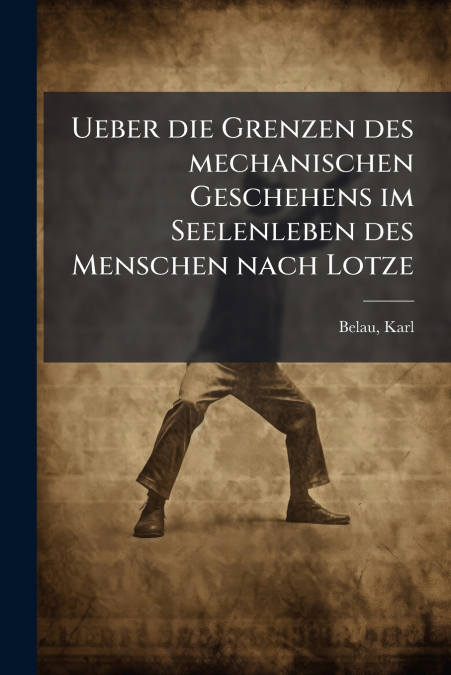
Ueber die Grenzen des mechanischen Geschehens im Seelenleben des Menschen nach Lotze, written by Karl Belau and published in 1900, explores the limits of mechanical processes in the human soul, drawing upon the philosophical ideas of Hermann Lotze. This work delves into the intersection of psychology and philosophy, examining the extent to which mechanical laws can explain the complexities of human consciousness and the soul’s inner workings.Belau’s investigation provides insights into the historical development of philosophical thought concerning the mind-body problem and the relationship between mechanistic explanations and subjective human experience. The book offers a valuable contribution to the understanding of 19th-century psychological and philosophical debates surrounding the nature of the soul and the limitations of mechanistic approaches to understanding human life.This work has been selected by scholars as being culturally important, and is part of the knowledge base of civilization as we know it. This work was reproduced from the original artifact, and remains as true to the original work as possible. Therefore, you will see the original copyright references, library stamps (as most of these works have been housed in our most important libraries around the world), and other notations in the work.This work is in the public domain in the United States of America, and possibly other nations. Within the United States, you may freely copy and distribute this work, as no entity (individual or corporate) has a copyright on the body of the work.As a reproduction of a historical artifact, this work may contain missing or blurred pages, poor pictures, errant marks, etc. Scholars believe, and we concur, that this work is important enough to be preserved, reproduced, and made generally available to the public. We appreciate your support of the preservation process, and thank you for being an important part of keeping this knowledge alive and relevant.





