 Librería Samer Atenea
 Kálamo Books
 Librería Elías (Asturias)
 Librería Kolima (Madrid)
 Librería Proteo (Málaga)
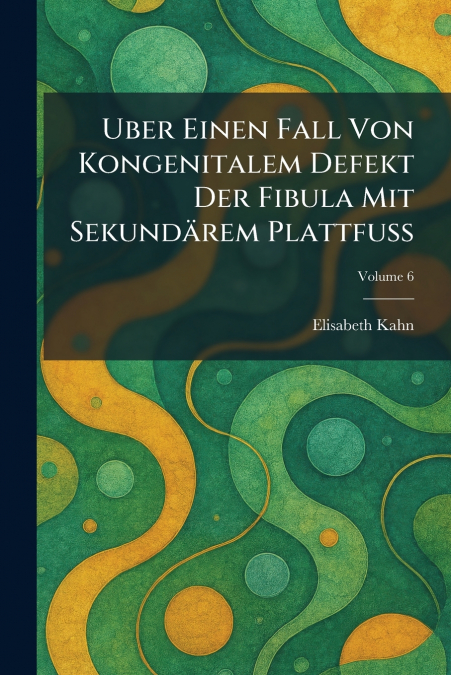
'Uber Einen Fall Von Kongenitalem Defekt Der Fibula Mit Sekundarem Plattfub' ist eine detaillierte medizinische Fallstudie aus dem frühen 20. Jahrhundert, die sich mit einer spezifischen orthopädischen Anomalie befasst. Die Autorin Elisabeth Kahn untersucht die klinischen Merkmale und die pathologische Entwicklung eines angeborenen Fibula-Defekts und dessen Auswirkungen auf die FuÃanatomie, insbesondere die Entstehung eines sekundären PlattfuÃes. Dieses Werk bietet einen tiefen Einblick in die orthopädische Forschung der 1920er Jahre und dokumentiert die damaligen Methoden der klinischen Beobachtung und Diagnose. Durch die präzise Darstellung des Krankheitsbildes leistet die Schrift einen wertvollen Beitrag zur Medizingeschichte und zur Erforschung kongenitaler Fehlbildungen der unteren Extremitäten. Für Medizinhistoriker und Fachleute im Bereich der Orthopädie stellt diese Abhandlung ein wichtiges Referenzdokument dar, das die historische Entwicklung chirurgischer und anatomischer Erkenntnisse beleuchtet.This work has been selected by scholars as being culturally important, and is part of the knowledge base of civilization as we know it. This work was reproduced from the original artifact, and remains as true to the original work as possible. Therefore, you may see the original copyright references, library stamps (as most of these works have been housed in our most important libraries around the world), and other notations in the work.This work is in the public domain in the United States of America, and possibly other nations. Within the United States, you may freely copy and distribute this work, as no entity (individual or corporate) has a copyright on the body of the work.As a reproduction of a historical artifact, this work may contain missing or blurred pages, poor pictures, errant marks, etc. Scholars believe, and we concur, that this work is important enough to be preserved, reproduced, and made generally available to the public. We appreciate your support of the preservation process, and thank you for being an important part of keeping this knowledge alive and relevant.