 Librería Samer Atenea
 Kálamo Books
 Librería Elías (Asturias)
 Librería Kolima (Madrid)
 Librería Proteo (Málaga)
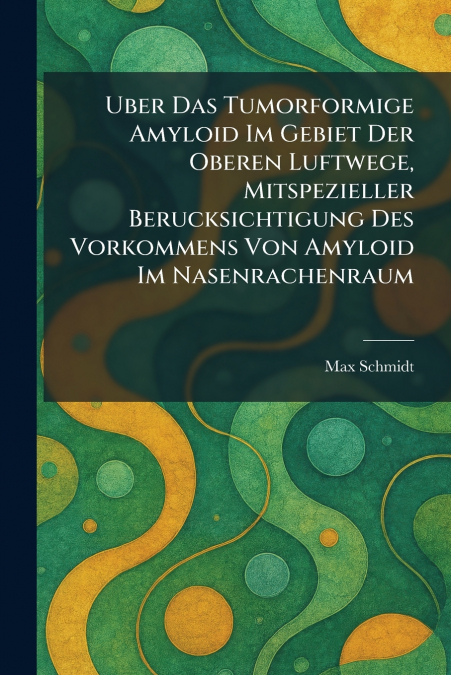
'Uber Das Tumorformige Amyloid Im Gebiet Der Oberen Luftwege' ist eine spezialisierte medizinische Studie, die sich intensiv mit der Pathologie der Amyloidose im Bereich der oberen Atemwege auseinandersetzt. Der Autor Max Schmidt konzentriert sich in dieser wissenschaftlichen Arbeit insbesondere auf das Auftreten von tumorähnlichen Amyloid-Ablagerungen im Nasenrachenraum, ein Thema von bedeutendem Interesse für die historische Hals-Nasen-Ohren-Heilkunde.Das Werk bietet eine detaillierte Analyse klinischer Fälle und pathologischer Beobachtungen, die die Komplexität der Diagnose und Behandlung von Amyloid-Tumoren verdeutlichen. Durch die systematische Untersuchung der betroffenen Gewebestrukturen leistet Schmidt einen wertvollen Beitrag zum Verständnis seltener pathologischer Zustände der Atemwege. Für Medizinhistoriker und Fachärzte stellt dieses Buch ein wichtiges Referenzwerk dar, das den Wissensstand der späten 1920er Jahre präzise dokumentiert. Es beleuchtet die frühen wissenschaftlichen Ansätze zur Erforschung von Stoffwechselerkrankungen und deren Manifestationen in der Otolaryngologie und bietet Einblicke in die Entwicklung der diagnostischen Kriterien jener Zeit.This work has been selected by scholars as being culturally important, and is part of the knowledge base of civilization as we know it. This work was reproduced from the original artifact, and remains as true to the original work as possible. Therefore, you may see the original copyright references, library stamps (as most of these works have been housed in our most important libraries around the world), and other notations in the work.This work is in the public domain in the United States of America, and possibly other nations. Within the United States, you may freely copy and distribute this work, as no entity (individual or corporate) has a copyright on the body of the work.As a reproduction of a historical artifact, this work may contain missing or blurred pages, poor pictures, errant marks, etc. Scholars believe, and we concur, that this work is important enough to be preserved, reproduced, and made generally available to the public. We appreciate your support of the preservation process, and thank you for being an important part of keeping this knowledge alive and relevant.