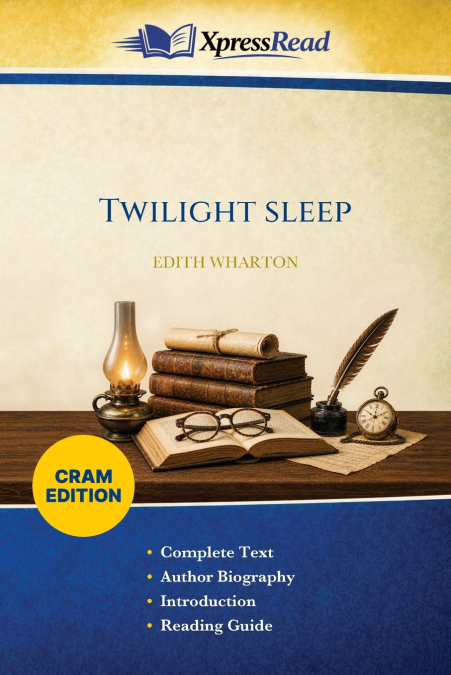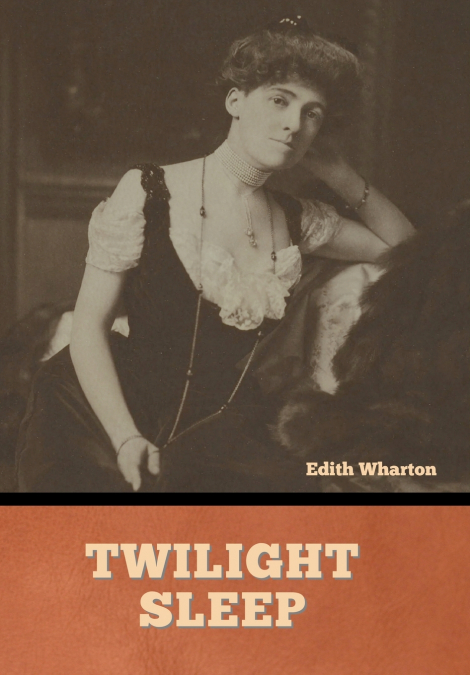

Twilight Sleep

Twilight Sleep

Edith Wharton

29,43 €
IVA incluido
Consulta disponibilidad
Editorial:
Bibliotech Press
Año de edición:
2023
Materia
Ficción clásica
ISBN:
9798888302118

Selecciona una librería:

  • Librería Samer Atenea
  • Librería Aciertas (Toledo)
  • Kálamo Books
  • Librería Perelló (Valencia)
  • Librería Elías (Asturias)
  • Donde los libros
  • Librería Kolima (Madrid)
  • Librería Proteo (Málaga)

Twilight Sleep is a novel by American author Edith Wharton and was first published in 1927 as a serial in the Pictorial Review before being published as a novel in the same year. The story, filled with irony, is centered around a socialite family navigating the New York of the Jazz Age and their relationships. This novel landed at number one on the best-selling list just two months after its publication and finished the year at number 7. Even as a best selling novel Twilight Sleep was not well received by critics at the time, who, while appreciating Wharton as a writer, struggled with the scenarios and characters she had created in the novel. While it was not considered as such in its own time period, today Twilight Sleep is widely considered to be a modernist novel as it employs modernist literary devices, such as an ever changing narration among the novel’s characters and a close examination of the characters’ self-identities and relationships with one another. When the Pictorial Review published Twilight Sleep as a serialized story, the headline proclaimed it 'the finest novel of New York society,' and the sales seem to agree. Twilight Sleep appears on many lists, such as Publishers Weekly, in the top ten bestsellers of 1927, but upon its release, the critics were largely underwhelmed. Percy Hutchison wrote in The New York Times that he did not believe Wharton could live up to Ethan Frome and The House of Mirth, but he mostly begins his review praising her and her past works. He uses these works to excuse certain shortcomings of Twilight Sleep: 'But she maintains herself at so consistently high a level that any occasional faltering of the imagination may be charitably set down as nothing more serious than a change of pace, any lapse in artistry as a mere peccadillo of the pen.' Edmund Wilson of The New Republic is less critical of the novel, as well, and finds Wharton’s loss 'of her old harshness' to be an acceptable turn and uses it to excuse her novel being 'proportionately less vivid.' Like Hutchison and Wilson, many of the other reviewers appear to have had a great appreciation for Wharton’s work in itself, but they had much to say about this one not quite adding up to the others.America voiced a concern 'that her latest novel 'Twilight Sleep' is an inartistic abandonment of her former office of telling what ought to be known about well-bred people in order to describe the vagaries of the new war-made rich.' The people are an issue for several reviewers, The Atlantic was disappointed with the characters, calling them 'puppets, pulled at times by too inadequate strings.' The puppet theme continues as Hutchison refers to the characters as 'marionettes,' but his bigger issue stems from the disconnect to America he feels from Wharton and that these puppets are being 'operated from a distance rather than persons actually at our side.' The Atlantic then gives the verdict that there is a lack of 'compelling naturalness in character and in situation.' There is a fair amount of critique on the scenarios these characters are put in. America’s review counts them as 'fantastic,' particularly with the people Pauline manages to throw together at her dinner parties. The finale of the novel is no exception. Wilson classified it this way: 'when the catastrophe finally occurs, it is not quite dramatic enough.' (wikipedia.org)
Artículos relacionados

  • Black Beauty
    Anna Sewell
    Black Beauty is the autobiography of a horse. This gentle book follows the life a well bred horse, from his early childhood in a pleasant meadow, through a myriad of owners—some kind and some cruel—until fate returns him to the meadow in which he was born. A wonderful story that will remain with you and your child. ...
  • Flower Fables
    Louisa May Alcott
    Louisa May Alcott was an American novelist best known as author of the novel Little Women. In the mid-1860s, Alcott wrote passionate, fiery novels and sensational stories. She also produced wholesome stories for children, and after their positive reception, she did not generally return to creating works for adults. Alcott continued to write until her death. ...
  • Civil War Stories
    Ambrose Bierce
    Bierce was considered a master of pure English by his contemporaries, and virtually everything that came from his pen was notable for its judicious wording and economy of style. He wrote in a variety of literary genres. His short stories are held among the best of the 19th century, providing a popular following based on his roots. He wrote realistically of the terrible things h...
  • Jonas on a Farm in Winter
    Jacob Abbott
    ...
  • A Message to Garcia
    Elbert Hubbard
    A Message to Garcia is one of the most widely read inspirational stories of all time. Since it’s publication it has sold more than 40 million copies. This is the touching story of an American soldier who must get a message through enemy lines to General Garcia. The lessons contained within it have changed the lives of countless people. Prepare to be inspired. This edition also ...
  • Beyond the Gates
    Elizabeth Stuart Phelps
    I had been ill for several weeks with what they called brain fever. The events which I am about to relate happened on the fifteenth day of my illness. ...

Otros libros del autor

  • The Refugees (Esprios Classics)
    Edith Wharton
    Edith Wharton (1862-1937) was an American novelist, short story writer, and designer. Wharton drew upon her insider’s knowledge of the upper class New York 'aristocracy' to realistically portray the lives and morals of the Gilded Age. In 1921, she became the first woman to win the Pulitzer Prize in Literature, for her novel The Age of Innocence. She was inducted into the Nation...
  • The Gods Arrive (Esprios Classics)
    Edith Wharton
    Edith Wharton (1862-1937) was an American novelist, short story writer, and designer. Wharton drew upon her insider’s knowledge of the upper class New York 'aristocracy' to realistically portray the lives and morals of the Gilded Age. In 1921, she became the first woman to win the Pulitzer Prize in Literature, for her novel The Age of Innocence. She was inducted into the Nation...
  • A Bottle of Perrier, and After Holbein (Esprios Classics)
    Edith Wharton
    Edith Wharton (1862-1937) was an American novelist, short story writer, and designer. Wharton drew upon her insider’s knowledge of the upper class New York 'aristocracy' to realistically portray the lives and morals of the Gilded Age. In 1921, she became the first woman to win the Pulitzer Prize in Literature, for her novel The Age of Innocence. She was inducted into the Nation...
  • New Year’s Day (The ’Seventies) (Esprios Classics)
    Edith Wharton
    Edith Wharton (1862-1937) was an American novelist, short story writer, and designer. Wharton drew upon her insider’s knowledge of the upper class New York 'aristocracy' to realistically portray the lives and morals of the Gilded Age. In 1921, she became the first woman to win the Pulitzer Prize in Literature, for her novel The Age of Innocence. She was inducted into the Nation...
  • The Choice, and Coming Home (Esprios Classics)
    Edith Wharton
    Edith Wharton (1862-1937) was an American novelist, short story writer, and designer. Wharton drew upon her insider’s knowledge of the upper class New York 'aristocracy' to realistically portray the lives and morals of the Gilded Age. In 1921, she became the first woman to win the Pulitzer Prize in Literature, for her novel The Age of Innocence. She was inducted into the Nation...
  • Old New York (Esprios Classics)
    Edith Wharton
    Old New York (1924) is a collection of four novellas by Edith Wharton, revolving around upper-class New York City society in the 1840s, 1850s, 1860s, and 1870s. The novellas are not directly interconnected, though certain fictional characters appear in more than one story. The New York of these stories is the same as the New York of The Age of Innocence (1920), from which sever...