
Inicio > Lenguas > Lingüistica > Trends in Parsing Technology
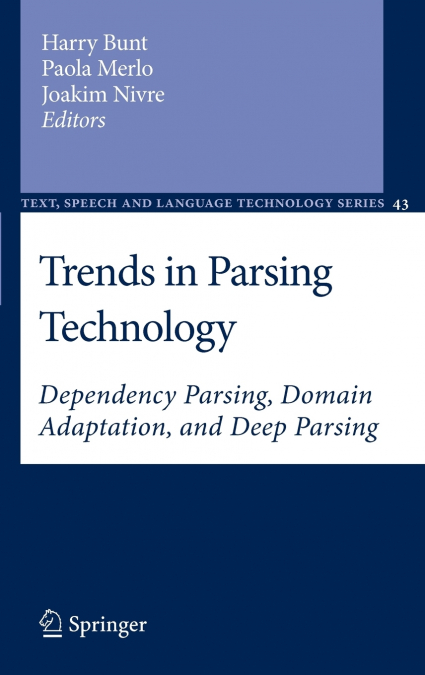
Trends in Parsing Technology

Trends in Parsing Technology


132,49 €
IVA incluido
Consulta disponibilidad
Editorial:
Springer Nature B.V.
Año de edición:
2010
Materia
Lingüistica
ISBN:
9789048193516

Selecciona una librería:

  • Librería Samer Atenea
  • Librería Aciertas (Toledo)
  • Kálamo Books
  • Librería Perelló (Valencia)
  • Librería Elías (Asturias)
  • Donde los libros
  • Librería Kolima (Madrid)
  • Librería Proteo (Málaga)

Computer parsing technology, which breaks down complex linguistic structures into their constituent parts, is a key research area in the automatic processing of human language. This volume is a collection of contributions from leading researchers in the field of natural language processing technology, each of whom detail their recent work which includes new techniques as well as results. The book presents an overview of the state of the art in current research into parsing technologies, focusing on three important themes: dependency parsing, domain adaptation, and deep parsing.The technology, which has a variety of practical uses, is especially concerned with the methods, tools and software that can be used to parse automatically. Applications include extracting information from free text or speech, question answering, speech recognition and comprehension, recommender systems, machine translation, and automatic summarization. New developments in the area of parsing technology are thus widely applicable, and researchers and professionals from a number of fields will find the material here required reading.As well as the other four volumes on parsing technology in this series this book has a breadth of coverage that makes it suitable both as an overview of the field for graduate students, and as a reference for established researchers in computational linguistics, artificial intelligence, computer science, language engineering, information science, and cognitive science. It will also be of interest to designers, developers, and advanced users of natural language processing systems, including applications such as spoken dialogue, text mining, multimodal human-computer interaction, and semantic web technology.
Artículos relacionados

  • User-Centered Computer Aided Language Learning
    Giorgos Zacharia / Panayiotis Zaphiris
    ...
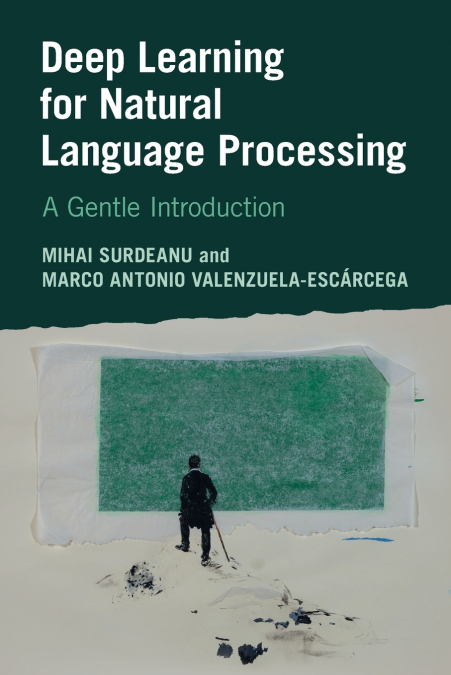
  • Deep Learning for Natural Language Processing
    Marco Antonio Valenzuela-Escárcega / Mihai Surdeanu
    ...
    Disponible

    47,60 €

  • Deep Learning for Natural Language Processing
    Marco Antonio Valenzuela-Escárcega / Mihai Surdeanu
    ...
  • Lecciones sobre espinosa medrano
    Luis Jaime Cisneros Vizquerra
    La obra de Juan de Espinosa Medrano, apodado en su tiempo «El Lunarejo» (c. 1629-1688), fue uno de los mayores focos de interés académico de Luis Jaime Cisneros (1921-2011). En 1980 aparecieron sus primeros trabajos dedicados a estudiar los textos capitales de Espinosa Medrano (el Apologético en favor de don Luis de Góngora, la Panegírica declamación por la protección de las ci...
    Disponible

    17,63 €

  • Lyre Book
    Matthew Kilbane
    Redefines modern lyric poetry at the intersection of literary and media studies.In The Lyre Book, Matthew Kilbane urges literary scholars to consider lyric not as a genre or a reading practice but as a media condition: the generative tension between writing and sound. In addition to clarifying issues central to the study of modern poetry--including its proximity to popular song...
    Disponible

    50,84 €

  • Translation-mediated Communication in a Digital World
    David Ashworth / Minako O’Hagan
    The Internet is accelerating globalization by exposing organizations and individuals to global audiences. This in turn is driving teletranslation and teleinterpretation, new types of multilingual support, which are functional in digital communications environments. The book describes teletranslation and teleinterpretation by exploring a number of key emerging contexts for langu...
    Disponible

    45,19 €