Inicio > Derecho > Teoría general del derecho > Treatise of Socio-Islamic Criminology
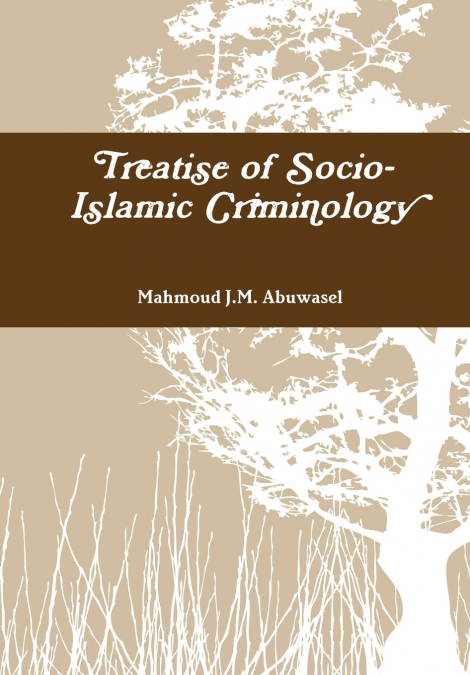
Treatise of Socio-Islamic Criminology

Treatise of Socio-Islamic Criminology

Treatise of Socio-Islamic Criminology

Mahmoud J. M. Abuwasel / Mahmoud JMAbuwasel

27,97 €
IVA incluido
Consulta disponibilidad
Editorial:
Lulu Press
Año de edición:
2014
Materia
Teoría general del derecho
ISBN:
9781312297760

Selecciona una librería:

  • Librería Samer Atenea
  • Librería Aciertas (Toledo)
  • Kálamo Books
  • Librería Perelló (Valencia)
  • Librería Elías (Asturias)
  • Donde los libros
  • Librería Kolima (Madrid)
  • Librería Proteo (Málaga)

Treatise of Socio-Islamic Criminology is an overview of criminal behaviour being a result of economic deprivation, through modern criminological thought. Within acknowledgement of the relevant Euro-American studies and schools of thought that have contributed to understanding the effects of socio-economics towards criminal activity, this treatise highlights the parallel perspectives of scholars regarding the dogmatic nature of Islamic economics.The methodology of Islamic economics is depicted to present a clearer view on the differences with that of methodology of economics. Within the scope of economic methodology, the treatise approaches problems relating to the assumption of rationality, to statistical identification of equations, and to measurement errors. Within Islamic economics, the treatise contrasts these attributes with the reasoning, assumptions, problem-solving methods and systematization effects that have evolved with Islamic economics.


Artículos relacionados

  • EU General Data Protection Regulation (GDPR)
    IT Governance Privacy Team
    An in-depth guide to complying with the EU GDPR.Now in its second edition, EU GDPR – An Implementation and Compliance Guide is a clear and comprehensive guide to this new data protection law, providing a detailed commentary on the Regulation, and setting out the obligations of data  processors and controllers in clear and comprehensible terms.Read this book to learn: How the ...
    Disponible

    30,10 €

  • Banking Laws and Regulations in Nigeria
    Bello Mohammed Magaji
    Banking Law and Regulations in Nigeria: Selected Themes essentially deals with the laid down rules or code of conduct meant to control and set standards for banking business. Indeed, the main aim of the ongoing banking reforms in Nigeria, started in 2004, is to ensure banks’ conformity to the laid down banking rules and regulations. The eleven-chapter book contains vital and ri...
    Disponible

    41,17 €

  • States and the Interpretation of Treaties
    Dimitris Liakopoulos
    States and the Interpretation of Treaties opens with a provocative reconsideration of a debate on the subject of comparative international legal obligations by the United Nations’s International Law Commission. In this book, distinguished Tufts University legal scholar Dimitris Liakopoulos identifies and explores relevant considerations in the work of the Commission and offers ...
  • The role of customs in international treaties
    Dimitris Liakopoulos
    The Role of Customs in International Treaties concentrates on issues of friction between member states of the United Nations. In view of the role played by the United Nations in resolving international disputes, Dimitris Liakopoulos hypothesizes that 'practical guides' based on custom often catalyze the positions taken by states, courts, scholars, and other actors, constituting...
  • Debtor protection in American and European Union bankruptcy law
    Dimitris Liakopoulos
    In Debtor Protection in American and European Union Bankruptcy Law, international law scholar Dimitris Liakopulos raises a delicate issue at the foundations of the modern banking system by analyzing US bankruptcy law with a focus on the concept of automatic stay. His work identifies legal sources and authorities having repercussions in terms of operational protection. It then e...
  • Capital punishment in American courts
    James Biser Whisker / Kevin Spiker
    In the 400 years since the first known execution was carried out for treason in Virginia, American jurisdictions have debated both the appropriateness and methods of capital punishment. Over that time, courts have placed varying restrictions on its application, excluding categories of citizens (for example the insane or the underaged) and evaluating and excluding methods of exe...