
Inicio > Derecho > Derecho internacional > Traveller Vulnerability in the Context of Travel and Tourism Contracts
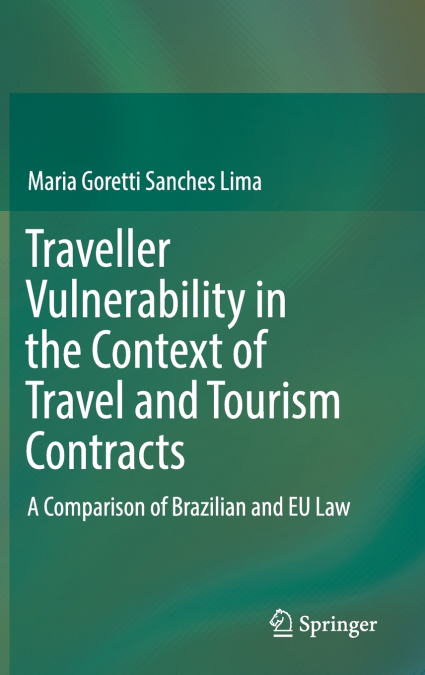
Traveller Vulnerability in the Context of Travel and Tourism Contracts

Traveller Vulnerability in the Context of Travel and Tourism Contracts

Maria Goretti Sanches Lima

134,77 €
IVA incluido
Consulta disponibilidad
Editorial:
Springer Nature B.V.
Año de edición:
2018
Materia
Derecho internacional
ISBN:
9783319983752

Selecciona una librería:

  • Librería Samer Atenea
  • Librería Aciertas (Toledo)
  • Kálamo Books
  • Librería Perelló (Valencia)
  • Librería Elías (Asturias)
  • Donde los libros
  • Librería Kolima (Madrid)
  • Librería Proteo (Málaga)

The book highlights the link between consumers and travellers, identifying the meaning of vulnerability in Brazil and the EU. It also covers different types of contracts for tourism and travel services, including online booking processes. Only after 2015, as a result of the directive on package travel and linked travel arrangements, did the EU begin viewing travellers as consumers in the sense of Union Consumer Law; conversely, in Brazil, the traveller has no legal status whatsoever and is considered solely a consumer. As the traveller is implicitly a consumer he/she is subject to vulnerability. However, the definition of vulnerability differs considerably between Brazil and the EU: while in Brazil it is a principle stemming from the Consumer Defence Code, covering all consumers, in the EU vulnerability is not an established principle. In the EU, although the average consumer is assumed to be reasonably well informed, observant and circumspect, they are also recognised as the weaker party in the contract. That recognition does not fit with the notion of 'confident consumer'. Vulnerable consumers in the EU are those whose individual characteristics, such as their age, physical or mental infirmity, or credulity, make them particularly susceptible to unfair commercial practices. Conversely, in Brazil these consumers are seen as being hyper-vulnerable, rather than solely vulnerable. In this context, travellers are in a weaker position than regular consumers buying goods or services, because they are outside of their domicile or jurisdiction for a brief or extended period of time. This book examines two types of traveller vulnerability that make travellers, particularly international ones, a special type of consumers: 1. External and 2. Legal (jurisdiction). Travellers’ vulnerability mainly stems from consumers travelling to different markets and different cultures. As such, they are subject to different laws that require special global attention. While both the EU and Brazilian system have their respective advantages and disadvantages, the goal of both must be to further increase protection for travellers, including business travellers. In consumer societies, the traveller is indeed a consumer by logical causation and hence a 'special consumer'. 
Artículos relacionados

  • Comparative regulation, economic analysis, and applications of private equity in the united states and european union
    Irini Liakopoulou
    The present work examines the economics and legal doctrine of private equity. After a consideration of private equity’s origins, the book will explore the evolution of private equity in the United States and Europe. The reference economic model then will be reconstructed, with particular attention to financial flows to and from private equity firms and funds. This reconstructio...
  • Complicity in International Law
    Dimitris Liakopoulous
    Complicity in International Law aims to analyze questions arising from a state’s complicity in conflict with another state or an international organization. On the basis of international legal provisions, a state that assists the illicit fact of another state or an international organization in turn commits an offense if it is aware of the main fact and is bound by the same obl...
  • Command responsibility
    James B Whisker / Kevin R Spiker
    Command responsibility, or executive accountability, assumes that leaders are responsible for the actions of their subordinates. If subordinates misbehave, violate basic moral laws, transgress international law, or thwart international standards of behavior, their leader may be called before to justice. Standards that set the boundaries of human action have been evolving for ma...
  • International Organizations and Reparations
    Dimitris Liakopoulos
    In the first part of this book, noted legal scholar Dimtris Liakopoulos deals with reconstructing the legal regulatory framework governing human rights violations in the activities of organizations. After identifying rules that are generally applicable to organizations’ offenses and govern the profile of reparations, this study assesses primary rules that guarantee the right to...
  • International Organizations and Legal Sanctions Against Governments
    Dimitris Liakopoulos
    This book examines the relationship between governments and international organizations under international law. After surveying the policing powers of international organizations under international law, it illustrates some normative aspects of law that distinguish regulation from enforcement via study of recent legal cases before international judicial bodies. According to Di...
  • The EU Foreign Subsidies Regulation
    Andreas Reindl / Isabelle Van Damme
    'The EU Foreign Subsidies Regulation' is a pioneering manual authored by legal experts Andreas Reindl and Isabelle Van Damme. This essential guide, the first of its kind, is tailored for legal practitioners, offering a thorough exploration of the tools and mechanisms embedded within this novel European regulatory framework. The authors meticulously dissect the EU Foreign Subsid...