
Inicio > Derecho > Derecho internacional > Transnational, European, and National Labour Relations
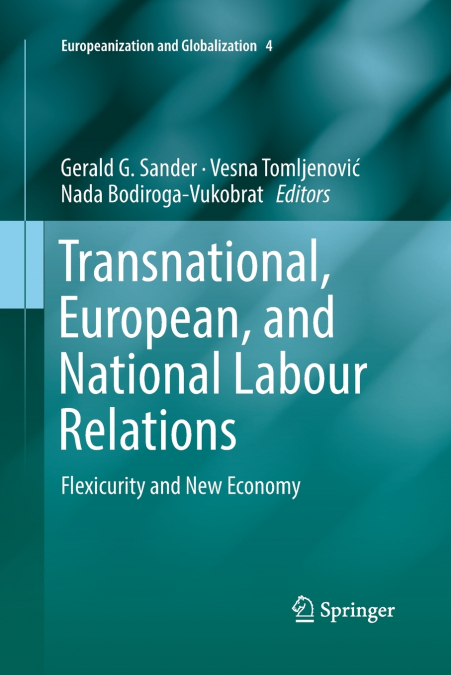
Transnational, European, and National Labour Relations

Transnational, European, and National Labour Relations


161,02 €
IVA incluido
Disponible
Editorial:
Springer Nature B.V.
Año de edición:
2019
Materia
Derecho internacional
ISBN:
9783030132224
161,02 €
IVA incluido
Disponible

Selecciona una librería:

  • Librería Samer Atenea
  • Librería Aciertas (Toledo)
  • Kálamo Books
  • Librería Perelló (Valencia)
  • Librería Elías (Asturias)
  • Donde los libros
  • Librería Kolima (Madrid)
  • Librería Proteo (Málaga)

This book employs an innovative approach to explore the topic of flexicurity and related changes in the working world, the importance of which for the overall economic and social development is gradually being recognised. It focuses on the changing nature of work and its impact on EU law and national labour and social security laws. Though the transformation of regulatory and institutional frameworks of labour relations follows different patterns in different EU Member States, it is nevertheless a common phenomenon that offers an excellent opportunity for mutual learning experiences and comparing notes on best practices. Taking these ideas as a starting point, the book presents a collection of research on various aspects and implications of changing labour relations in the EU Member States. The opening chapters address the internal market dimension of the transformation of employment relations by investigating how social dumping, integration of migrant workers, and cross-border mergers influence national labour policies and laws. The book further analyses linguistic and terminological challenges in the field of labour law in the EU’s multi-lingual legal environment. Subsequent chapters cover various theoretical and practical issues, such as the impact of chain-liability regulatory models on the legal situation of workers in subcontracting networks, and modern work arrangements in the collaborative or ’gig’ economy. Other chapters are dedicated to issues of jurisdiction and law applicable to individual employment contracts, as well as alternative resolution mechanisms in labour disputes. The next section offers fresh insights on and a critical overview of the well-known Danish and Dutch models of flexicurity, often cited as role models for reforms of labour markets in other EU Member States. Three individual chapters investigate specific aspects of flexicurity in Croatia, in terms of individual dismissals, life-long learning and the impact of non-standard employment on future pension entitlements. One paper explores temporary agency work in Germany as an important instrument of flexicurity, while another discusses various forms of work used in Slovenia in the context of flexibilization of work relations. Many challenges still lie ahead, and the primary aim of this book is to provide a solid basis for informed future discussions.


Artículos relacionados

  • Comparative regulation, economic analysis, and applications of private equity in the united states and european union
    Irini Liakopoulou
    The present work examines the economics and legal doctrine of private equity. After a consideration of private equity’s origins, the book will explore the evolution of private equity in the United States and Europe. The reference economic model then will be reconstructed, with particular attention to financial flows to and from private equity firms and funds. This reconstructio...
  • Complicity in International Law
    Dimitris Liakopoulous
    Complicity in International Law aims to analyze questions arising from a state’s complicity in conflict with another state or an international organization. On the basis of international legal provisions, a state that assists the illicit fact of another state or an international organization in turn commits an offense if it is aware of the main fact and is bound by the same obl...
  • Command responsibility
    James B Whisker / Kevin R Spiker
    Command responsibility, or executive accountability, assumes that leaders are responsible for the actions of their subordinates. If subordinates misbehave, violate basic moral laws, transgress international law, or thwart international standards of behavior, their leader may be called before to justice. Standards that set the boundaries of human action have been evolving for ma...
  • International Organizations and Reparations
    Dimitris Liakopoulos
    In the first part of this book, noted legal scholar Dimtris Liakopoulos deals with reconstructing the legal regulatory framework governing human rights violations in the activities of organizations. After identifying rules that are generally applicable to organizations’ offenses and govern the profile of reparations, this study assesses primary rules that guarantee the right to...
  • International Organizations and Legal Sanctions Against Governments
    Dimitris Liakopoulos
    This book examines the relationship between governments and international organizations under international law. After surveying the policing powers of international organizations under international law, it illustrates some normative aspects of law that distinguish regulation from enforcement via study of recent legal cases before international judicial bodies. According to Di...
  • The EU Foreign Subsidies Regulation
    Andreas Reindl / Isabelle Van Damme
    'The EU Foreign Subsidies Regulation' is a pioneering manual authored by legal experts Andreas Reindl and Isabelle Van Damme. This essential guide, the first of its kind, is tailored for legal practitioners, offering a thorough exploration of the tools and mechanisms embedded within this novel European regulatory framework. The authors meticulously dissect the EU Foreign Subsid...