

 Librería Samer Atenea
 Kálamo Books
 Librería Elías (Asturias)
 Librería Kolima (Madrid)
 Librería Proteo (Málaga)
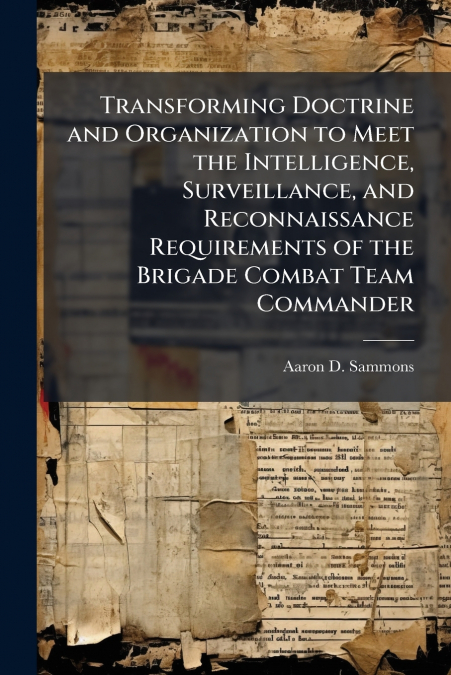
The metamorphosis of the United States Army’s tactical Military Intelligence (MI) organization and doctrine since 1976 has been remarkable. Transitioning from a conglomerate of capabilities borrowed from disparate organizations, MI units became holistic MI organizations. Equipped with increasingly robust collection capability MI became ever more capable of all-source intelligence production. Change continues through the provision of MI capability to lower echelons. As collection capability in the brigade combat team (BCT) increased collective MI experience and leadership in planning and direction of collection decreased. While intelligence, surveillance, and reconnaissance (ISR) assets and soldiers transferred from the division echelon to the BCT, the MI collective experience and leadership did not. Additionally, a 30-year old inconsistency concerning staff authority in collection direction continues. With an increasing ISR capability, reduction in collective MI experience influencing BCT ISR, and an ongoing rift in collection direction authority, does the Army model for ISR meet the needs of the BCT commander of the future?This work has been selected by scholars as being culturally important, and is part of the knowledge base of civilization as we know it. This work was reproduced from the original artifact, and remains as true to the original work as possible. Therefore, you will see the original copyright references, library stamps (as most of these works have been housed in our most important libraries around the world), and other notations in the work.This work is in the public domain in the United States of America, and possibly other nations. Within the United States, you may freely copy and distribute this work, as no entity (individual or corporate) has a copyright on the body of the work.As a reproduction of a historical artifact, this work may contain missing or blurred pages, poor pictures, errant marks, etc. Scholars believe, and we concur, that this work is important enough to be preserved, reproduced, and made generally available to the public. We appreciate your support of the preservation process, and thank you for being an important part of keeping this knowledge alive and relevant.





