

 Librería Samer Atenea
 Kálamo Books
 Librería Elías (Asturias)
 Librería Kolima (Madrid)
 Librería Proteo (Málaga)
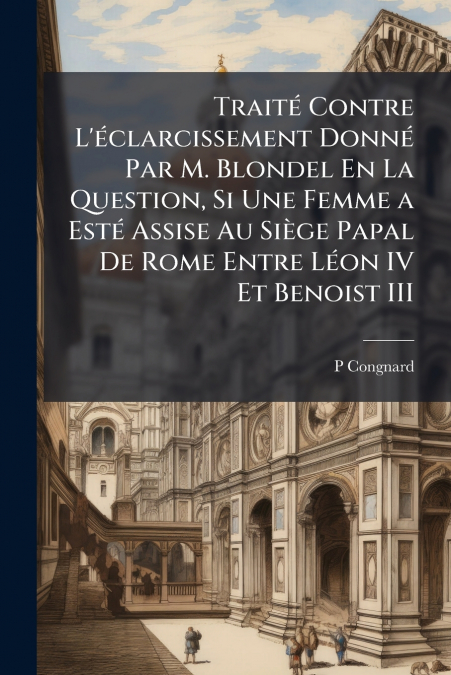
Traité Contre L’éclarcissement Donné Par M. Blondel En La Question, Si Une Femme a Esté Assise Au Siège Papal De Rome Entre Léon IV Et Benoist III is a historical treatise written by P Congnard, originally published in 1655. This work delves into the controversial question of whether a woman occupied the papal seat in Rome between the reigns of Leo IV and Benedict III.Congnard’s treatise engages with the arguments presented by M. Blondel on the existence of a female pope, often referred to as Pope Joan. The text provides a fascinating glimpse into the religious and historical debates of the 17th century, reflecting contemporary attitudes towards the papacy and the role of women in the church. This historical document offers valuable insights into the legends and controversies surrounding the papacy and the enduring questions they raise about faith, history, and power.This work has been selected by scholars as being culturally important, and is part of the knowledge base of civilization as we know it. This work was reproduced from the original artifact, and remains as true to the original work as possible. Therefore, you will see the original copyright references, library stamps (as most of these works have been housed in our most important libraries around the world), and other notations in the work.This work is in the public domain in the United States of America, and possibly other nations. Within the United States, you may freely copy and distribute this work, as no entity (individual or corporate) has a copyright on the body of the work.As a reproduction of a historical artifact, this work may contain missing or blurred pages, poor pictures, errant marks, etc. Scholars believe, and we concur, that this work is important enough to be preserved, reproduced, and made generally available to the public. We appreciate your support of the preservation process, and thank you for being an important part of keeping this knowledge alive and relevant.





