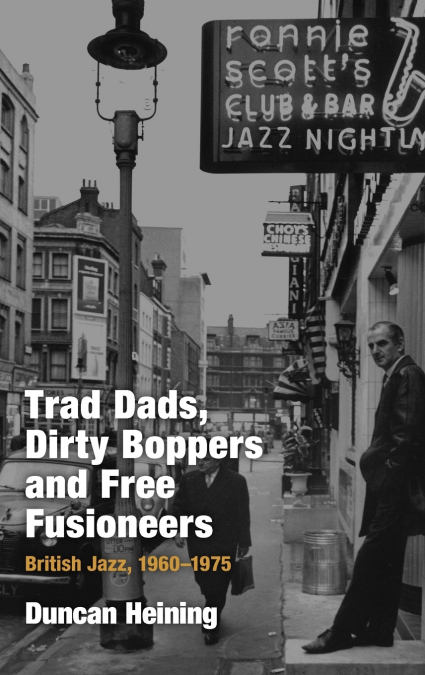

Trad Dads, Dirty Boppers and Free Fusioneers

Trad Dads, Dirty Boppers and Free Fusioneers

Duncan Heining

55,14 €
IVA incluido
Consulta disponibilidad
Editorial:
Equinox Publishing
Año de edición:
2012
Materia
Cultura popular
ISBN:
9781845534059

Selecciona una librería:

  • Librería Samer Atenea
  • Librería Aciertas (Toledo)
  • Kálamo Books
  • Librería Perelló (Valencia)
  • Librería Elías (Asturias)
  • Donde los libros
  • Librería Kolima (Madrid)
  • Librería Proteo (Málaga)

The 1960’s was a decade of major transformation in British jazz and in British popular music in general. The British jazz scene had been, arguably, the first outside America to assert its independence. At first slowly but with gathering speed, it began to define an identity that drew increasingly on sources from within its own culture, as well as those from African-American jazz, and from its shared European cultural heritage. This process would in itself prove highly influential, as French, Italian, German and Scandinavian scenes began to follow suit. The nature of jazz, its scope and potential were re-examined and reformulated in this period with important implications for its musicians and its audience.The external forces acting upon the British jazz scene were both global and local in origin. Jazz was not immune from the economic, social and cultural changes that occurred following the Second World War and which continued apace in the 1960’s. Its development was both affected by and reflected those changes and the new ways of thinking and acting that arose from them. And yet wider global economic and political changes, in particular in America, would continue to have a major impact on British jazz.For these reasons, any history of British jazz in the 1960’s must explain these trends and describe which were global and which were local in origin. It must show how forces outside the music acted upon it and both created and limited its potential for development. But it must also define the personalities, as well as the context in which they functioned. Jazz is made by its musicians and is ultimately changed by them. What were the records that they made which defined the era? From where did their inspiration arise? And how did their audience respond?Trad Dads, Dirty Boppers and Free Fusioneers follows a number of themes – class, education, drugs and addictions, relationships with rock and blues, race and immigration, gender issues, the arts, politics and that sixties buzzword: ‘freedom’. In doing so, the book challenges many conventional understandings of British jazz and its scene. This is the definitive history of British jazz in the 1960’s.
Artículos relacionados

  • Post-Revolutionary Cuban Spanish
    Jesus Nez Romay / Jesus Nunez Romay / Jesus Nzqez Romay
    Because the first socialist revolution in the Americas took place in Cuba, this country has also seen the rise of new terms and the introduction of new, very specific meanings for old terms, adopted as required to express new realities. How can these neologisms be rendered in English, when no English-speaking country has as yet carried out a Marxist-Leninist social revolution a...
    Disponible

    11,00 €

  • Studies In Structural Sociology
    Frank W Young
    This collection of articles and essays embodies a new approach to sociology based on the original meaning of the word. Its central concept is 'community,' which is defined to cover units as small as the household and as large as the nation-state. Individuals are a special case of community. So defined, communities account for almost all the independent social organization of th...
    Disponible

    18,65 €

  • Global Perspectives on Media Events in Contemporary Society
    Andrew Fox
    Media events have been described as broadcasts that involve an engaged audience viewing the same event simultaneously; though this definition is still relevant, the way media outlets interact with and react to their audiences has greatly changed. This is in part due to the emergence of social media platforms which allow a participatory audience, something that genre-specific te...
  • War Memory and Popular Culture
    This collection of essays investigates such diverse vehicles for war commemoration as poems, battlefield tours, souvenirs, books, films, architectural structures, comics, websites, and video games. Drawing on essayists from Australia, Canada, Great Britain, Israel and the United States, this work explores the evolution from traditional to contemporary forms of war commemorat...
    Disponible

    42,91 €

  • Representing the Crusades
    Sandra Gorgievski
    How are the Crusades portrayed in popular culture today? Have the medieval images of chivalric and military heroes survived the eras of Orientalism and decolonization? The first of its kind, this comparative study examines representations of the Crusades in both European and Arab medieval texts and in 20th and 21st century transmedia recreations. It follows the cartography...
    Disponible

    72,58 €

  • WHY BRITAIN ROCKED
    Elizabeth Sharkey
    Why Britain Rocked: How Rock Became Roll and Took Over the World challenges the origins of ’Beatlemania’ by travelling deep into Britain’s history to trace the events that led to Britain’s twentieth century musical explosion. With rigorous in-depth research, new discoveries and original insights Why Britain Rocked: How Rock Became Roll and Took Over the World completely reframe...

Otros libros del autor

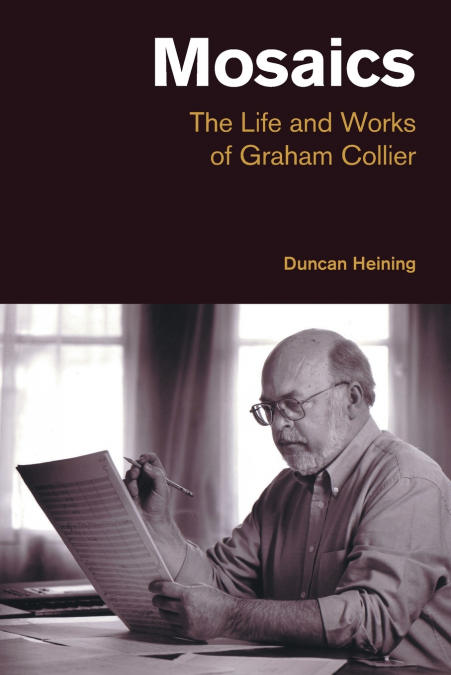
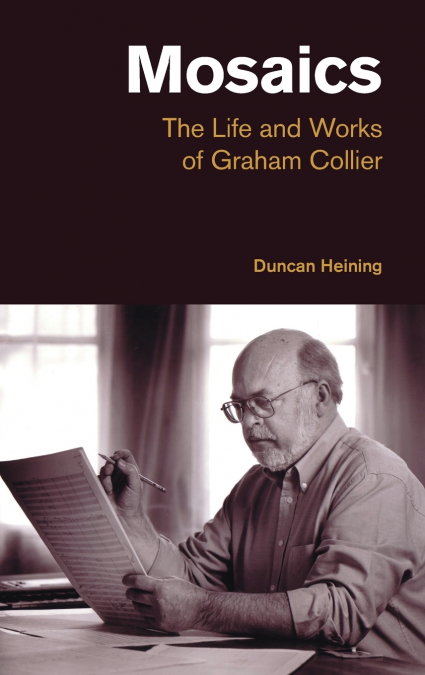
  • Mosaics
    Duncan Heining
    Graham Collier’s career in jazz lasted over five decades. He was a bassist, a band-leader, a composer, an educator and an author, who wrote extensively about the music. His working life was littered with ’firsts’. Amongst his many achievements, he was the first British jazz musician to study at the Berklee School of music in Boston and the first to receive an Arts Council grant...
    Disponible

    37,68 €

  • Mosaics
    Duncan Heining
    Graham Collier’s career in jazz lasted over five decades. He was a bassist, a band-leader, a composer, an educator and an author, who wrote extensively about the music. His working life was littered with ‘firsts’. Amongst his many achievements, he was the first British jazz musician to study at the Berklee School of music in Boston and the first to receive an Arts Council grant...