
Inicio > > Programación informática/desarrollo de software > Towards Engineering Free/Libre Open Source Software (FLOSS) Ecosystems for Impact and Sustainability
Towards Engineering Free/Libre Open Source Software (FLOSS) Ecosystems for Impact and Sustainability

Towards Engineering Free/Libre Open Source Software (FLOSS) Ecosystems for Impact and Sustainability


197,34 €
IVA incluido
Disponible
Editorial:
Springer Nature B.V.
Año de edición:
2020
Materia
Programación informática/desarrollo de software
ISBN:
9789811371011
197,34 €
IVA incluido
Disponible

Selecciona una librería:

  • Librería Samer Atenea
  • Librería Aciertas (Toledo)
  • Kálamo Books
  • Librería Perelló (Valencia)
  • Librería Elías (Asturias)
  • Donde los libros
  • Librería Kolima (Madrid)
  • Librería Proteo (Málaga)

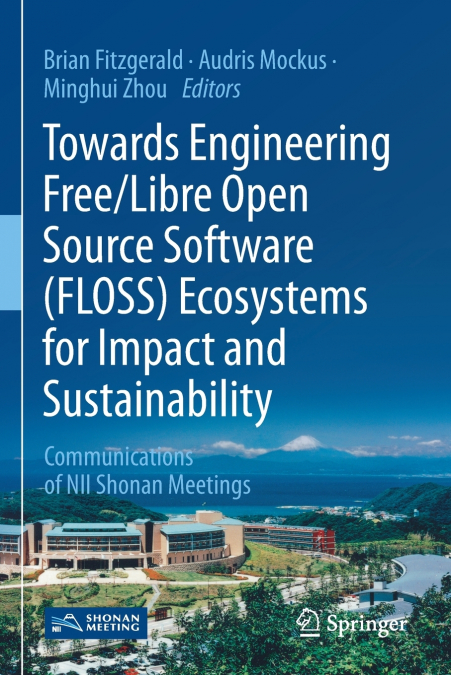
Free/libre open source software (FLOSS) ecosystems such as Linux have had a tremendous impact on computing and society and have captured the attention of businesses, researchers, and policy makers. Research on FLOSS has been ongoing for almost two decades.  From an economic perspective, the most common topics involve motivation and organization. As commercial participation in FLOSS has become common, the question of how to combine FLOSS practice with commercial practice has been the subject of research, particularly with a view to understanding how to ensure sustainability of the ecosystem.This book is based on a Shonan meeting on FLOSS ecosystem sustainability held in June 2017. The meeting brought together a blend of established and young researchers who were actively studying the FLOSS phenomenon. These researchers were drawn from a variety of disciplines including software engineering, human computer interaction, information systems, computer-supported cooperative work, data mining, cognitive science, psychology, operations research, and management. Industry practitioners who were active in the FLOSS space also participated. This book presents the results of discussion on fundamental questions related to the impact and sustainability of FLOSS ecosystems, including:·         How does an ecosystem form? How do different stakeholders work together to form a community that develops and maintains valuable and freely available software, and how does an ecosystem with millions of repositories and developers operate given the lack of centralized planning?·         How does an ecosystem evolve in response to the environment as technology and needs evolve over time?·         How do newcomers learn the protocols and practices of an ecosystem?  How would they sustain the ecosystem?  What is the relationship between people and ecosystem sustainability?
Artículos relacionados

  • SPARK 2014 Reference Manual
    AdaCore / Altran UK Ltd
    SPARK 2014 is a programming language and a set of verification tools designed to meet the needs of high-assurance software development. SPARK 2014 is based on Ada 2012, both subsetting the language to remove features that defy verification, but also extending the system of contracts and aspects to support modular, formal verification.This manual is available online for free at ...
    Disponible

    19,91 €

  • Software and Intelligent Sciences
    Yingxu Wang
    The junction of software development and engineering combined with the study of intelligence has created a bustling intersection of theory, design, engineering, and conceptual thought. Software and Intelligent Sciences: New Transdisciplinary Findings sits at a crossroads and informs advanced researchers, students, and practitioners on the developments in computer science, theor...
  • Power System Planning Technologies and Applications
    Fawwaz Elkarmi / Nazih Abu Shikhah / Nazih Abu-Shikhah
    Planning is an important function of the management of any business, providing knowledge of future prospects and enabling prudent and appropriate decision-making. Planning is especially critical for power systems, since electricity is a fundamental part of modern societies and many conventional electrical energy resources currently in use are limited. Power System Planning Tech...
  • Concept Parsing Algorithms (CPA) for Textual Analysis and Discovery
    Masha Etkind / Uri Shafrir
    Text analysis tools aid in extracting meaning from digital content. As digital text becomes more and more complex, new techniques are needed to understand conceptual structure. Concept Parsing Algorithms (CPA) for Textual Analysis and Discovery: Emerging Research and Opportunities provides an innovative perspective on the application of algorithmic tools to study unstructured d...
  • Model-Based Design for Effective Control System Development
    Wei Wu
    Control systems are an integral aspect of modern society and exist across numerous domains and applications. As technology advances more and more, the complexity of such systems continues to increase exponentially. Model-Based Design for Effective Control System Development is a critical source of scholarly information on model-centric approaches and implementations for control...
  • Verification, Validation and Testing in Software Engineering
    ...