

 Librería Samer Atenea
 Kálamo Books
 Librería Elías (Asturias)
 Librería Kolima (Madrid)
 Librería Proteo (Málaga)
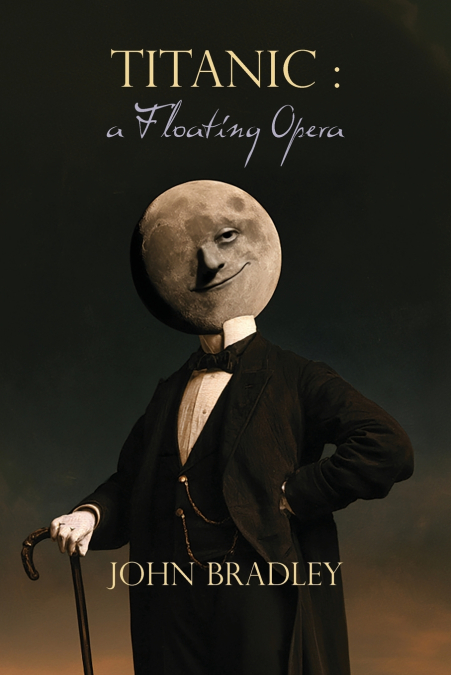
Titanic: A Floating Opera can be read as a play, an epic poem, and/or an experimental novel. Unmoored in space and time (the years vary, but it’s always April 14, the day the Titanic struck the iceberg), the ship wanders with a host of passengers (everyone from Buster Keaton to Mother Jones) who go on with their lives as if nothing unusual is occurring. Then there’s the campaign against the moon, which Captain J. Edgar Hoover calls a 'migrant' that’s 'invading' the ship. Constant bulletins announce freedoms that are being taken away in the name of security. Two interrogators question various landmarks-the Eiffel Tower, the Grand Canyon, Mount Rushmore, the Statue of Liberty, and Mount Fuji-for information on the moon. The interrogators plot with a passenger, whose name is Lorca Who Is Not Lorca, to assassinate the moon. Another passenger, Rene Magritte, tries repeatedly to communicate with an iceberg. Titanic: A Floating Opera is a surreal, satirical journey through our present historical whirlwind. Long ago, when I was an undergrad attending the University of Minnesota, I took a course on modern drama. We read work by Ibsen, Ionesco, Albee, Pinter, Beckett, Genet, and many others. I was taken by the wild possibilities offered by the Theater of the Absurd, as well as its humor and energy. For me, it captured the absurdity of American life. Drama was never the same for me after that class. Titanic: A Floating Opera is a child of the Theater of the Absurd. At the same time, Titanic: A Floating Opera is very much of our own time. Captain J. Edgar Hoover is a figure obsessed with his fear of an invasion by the Other, which in this case is the moon. More and more surveillance, interrogations, and removal of individual freedoms must occur to carry out this leader’s conception of security and liberty. The ship slowly becomes a prison, and very few of the passengers seem to notice. But the moon, of course, is beyond the control of the captain, and continues to defy him, as well as his hired assassin. The reader will notice how different actors take on the same role. I hope these fluid identities suggest the dream state, where nothing is stable, and reason and logic do not apply. Perhaps this book can also be read as an experimental novel, though I leave that to the critics and the readers. At any rate, however this work may be labelled, I hope the reader enjoys this surreal voyage. 6








