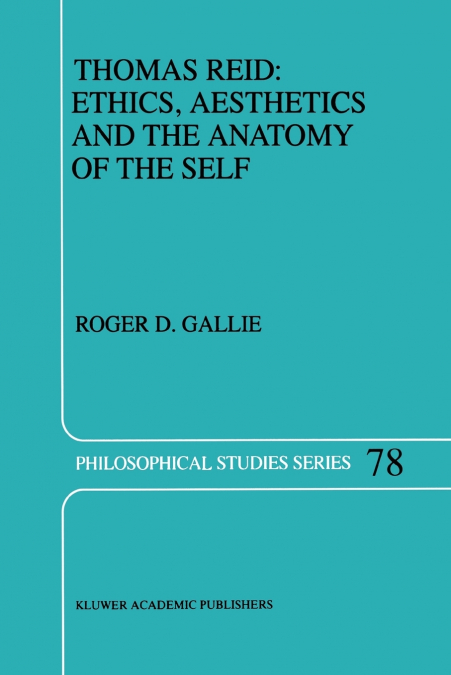

Thomas Reid

Thomas Reid

R.D. Gallie

134,26 €
IVA incluido
Disponible
Editorial:
Springer Nature B.V.
Año de edición:
2011
Materia
Ética y filosofía moral
ISBN:
9789048150953
134,26 €
IVA incluido
Disponible

Selecciona una librería:

  • Librería Samer Atenea
  • Librería Aciertas (Toledo)
  • Kálamo Books
  • Librería Perelló (Valencia)
  • Librería Elías (Asturias)
  • Donde los libros
  • Librería Kolima (Madrid)
  • Librería Proteo (Málaga)

I: BIOGRAPHICAL SKETCH OF REID Thomas Reid (1710-96) was born at Strachan in Kincardineshire, Scotland, not far from Aberdeen. Reid was fortunate in his family connections. For instance his mother’s brother was David Gregory, Savilian professor of Astronomy at Oxford and close friend of Sir Isaac Newton. Reid entered Marischal College, Aberdeen, at the age of twelve after the usual spell in Aberdeen Grammar School. After a short period as college librarian he married his cousin Margaret Gregory, having gained the position of (Presbyterian) minister at New Machar, in the gift of King’s College, Aberdeen, which he held from 1737 till 1752. Although Reid published only one paper, An Essay on Quantity, in this period he was far from intellectually idle; for one thing he familiarised himself with the works of Bishop Butler, especially The Analogy of Religion, which, together with those of Samuel Clarke and Isaac Newton, were to have a profound influence on his mature philosophy. In 1752 Reid was appointed a regent at King’s College, Aberdeen. During his regency he not only founded a crucially important discussion group, ’The Wise Club’, and familiarised himself with David Hume’s A Treatise of Human Nature both through his own reading and by exhaustive discussion of it within the group; he also wrote extensively. He composed and delivered his seminal Latin Philosophical Orations.
Artículos relacionados

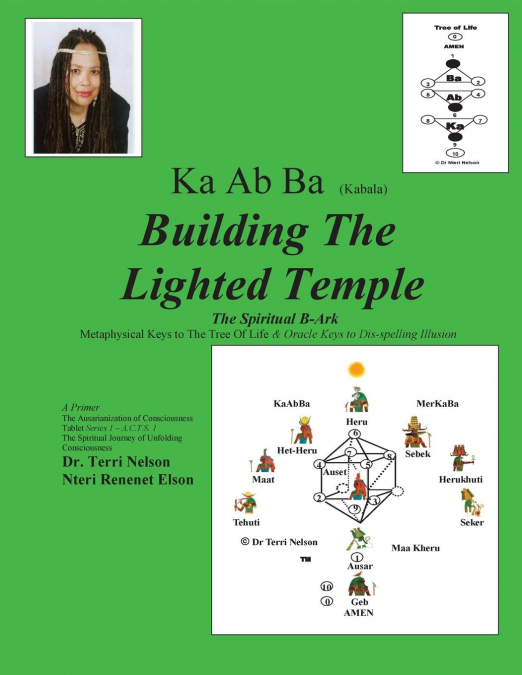
  • Ka Ab Ba Building The Lighted Temple
    Dr Terri R. Nelson / Dr Terri RNelson
    The book KaAbBa Building The Lighted Temple/Metaphysical Keys to the Tree of Life draws a circle that is inclusive of the Afrikan origin of the Ancient Kemetic/Egyptian wisdom. It reveals the undeniable root and link of Ancient Africa to all the religious systems that would develop worldwide. This book is explosive in its power to convey the meaning of KaAbBa, the Medu Neter  (...
    Disponible

    37,41 €

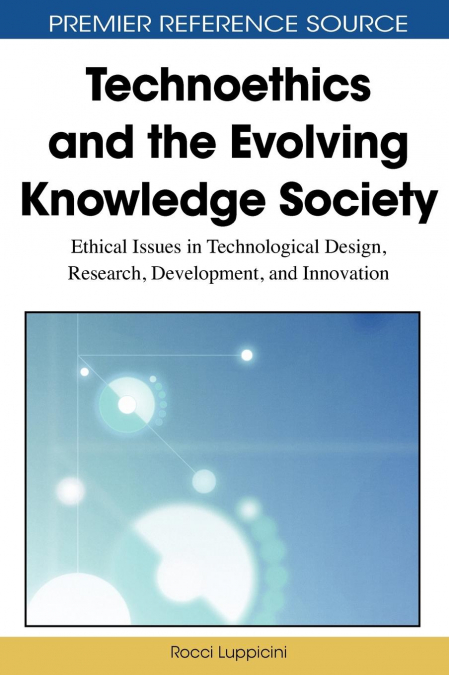
  • Technoethics and the Evolving Knowledge Society
    Rocci Luppicini
    Recently, there has been a major push to rediscover the ethical dimension of technology across the sciences, social sciences, and humanities. Technoethics and the Evolving Knowledge Society: Ethical Issues in Technological Design, Research, Development, and Innovation examines human processes and practices connected to technology embedded within social, political, and moral sph...
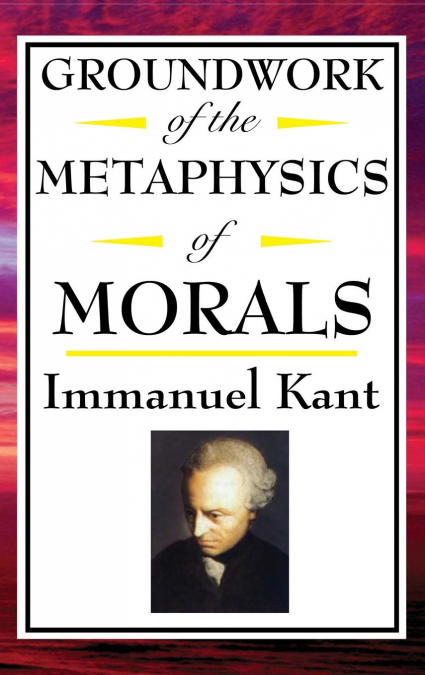
  • Kant
    Immanuel Kant
    Kant’s Groundwork of the Metaphysics of Morals is one of the most important works in modern moral philosophy. It belongs beside Plato, Aristotle, Machiavelli, and Hobbes. Here Kant sets out to articulate and defend the Categorical Imperative - the fundamental principle that underlies moral reasoning - and to lay the foundation for a comprehensive account of justice and human vi...
  • On the Duty of Civil Disobedience
    HENRY DAVID THOREAU
    Civil Disobedience argues that citizens should not permit their governments to overrule their consciences, and that they have a duty to avoid allowing their acquiescence to enable the government to make them the agents of injustice. Thoreau was motivated in part by his disgust with slavery and the Mexican-American War, but the sentiments he expresses here are just as pertinent ...
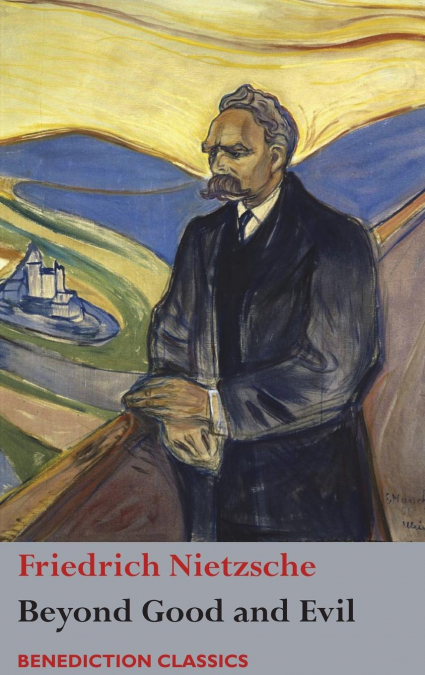
  • Beyond Good and Evil
    Friedrich Nietzsche
    Nietzsche, though primarily a philosopher, wrote widely on art, philology, history, religion, tragedy, culture, and science.  In 1886, at the height of his powers, he published Beyond Good and Evil.  Here he examines much of the best of human thought--dogmatic philosophy, Judeo-Christian morality, science and democracy – and finds it lacking.  Rejecting “slave-morality” he pres...
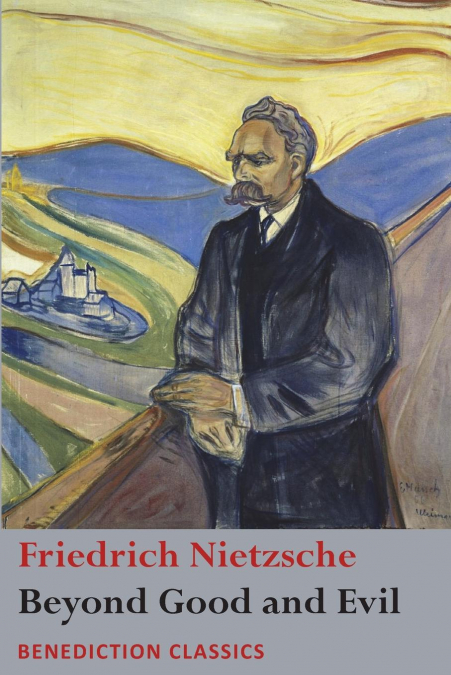
  • Beyond Good and Evil
    Friedrich Nietzsche
    Nietzsche, though primarily a philosopher, wrote widely on art, philology, history, religion, tragedy, culture, and science.  In 1886, at the height of his powers, he published Beyond Good and Evil.  Here he examines much of the best of human thought--dogmatic philosophy, Judeo-Christian morality, science and democracy – and finds it lacking.  Rejecting “slave-morality” he pres...
    Disponible

    9,99 €

Otros libros del autor

  • Thomas Reid
    R.D. Gallie
    I: BIOGRAPHICAL SKETCH OF REID Thomas Reid (1710-96) was born at Strachan in Kincardineshire, Scotland, not far from Aberdeen. Reid was fortunate in his family connections. For instance his mother’s brother was David Gregory, Savilian professor of Astronomy at Oxford and close friend of Sir Isaac Newton. Reid entered Marischal College, Aberdeen, at th...
  • Thomas Reid and ’The Way of Ideas’
    R.D. Gallie
    This book is meant to serve as an introduction to the philosophy of Thomas Reid by way of a study of certain themes central to that philosophy as we find it expounded in his extensive and influential published writings. The choice of these themes inevitably reflects philosophical interests of the author of this book to some extent but a main considera...