 Librería Samer Atenea
 Kálamo Books
 Librería Elías (Asturias)
 Librería Kolima (Madrid)
 Librería Proteo (Málaga)
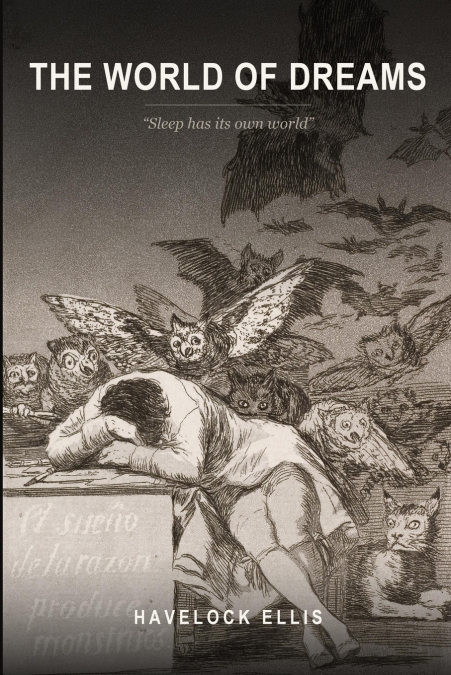
Henry Havelock Ellis was a physician, an essayist, and one of the most careful observers of his generation. By 1911 he had been recording his own dreams for two decades, and The World of Dreams is the book he built from that record together with a wide reading of the French, German and English literature on sleep.Its argument is empirical. Ellis is not hostile to the idea that dreams mean something, and he takes symbolism seriously enough to give it a chapter. But he begins from the position that before you interpret a dream you should know what it is made of, and most of the book is spent establishing that.So he works upward from the body. What the sleeping senses actually register, and how a sound or a pressure or a chill is worked into the fabric of a dream. How reasoning behaves when the critical faculty is lowered: not absent, he argues, but uncritical, which is why a dreamer will accept an impossible premise and then reason quite carefully from it. Why emotion in dreams runs so heavily to anxiety, embarrassment and grief. Why the sensation of flying is so common, and what physiological account can be given of it. What dreams of the dead have in common. How memory in dreams reaches past the recent and into childhood.The chapter on symbolism is the one a modern reader will find most interesting, because Ellis is arguing with Freud in real time. He accepts that dreams use symbols. He doubts that the symbols form a fixed vocabulary, and he says why.The book has been out of general circulation for a long time, which is a pity, because it is unusually readable and because the questions it asks are the ones the field returned to a century later.This edition presents the Constable text of 1911 in a fresh typeset, with Ellis’s preface and his full index preserved.



![My Life [Autobiography]]( https://distri.podiprint.com/imagenes/978/9/3/7/4/5/9/8/9789374598405_f_675x675.jpg "My Life [Autobiography]")