The Vanishing American Corporation

The Vanishing American Corporation

The Vanishing American Corporation

Gerald F. Davis / Gerald FDavis

39,32 €
IVA incluido
Disponible
Editorial:
ReadHowYouWant.com Pty Limited
Año de edición:
2016
Materia
Historia de empresas específicas/historia societaria
ISBN:
9780369313133
39,32 €
IVA incluido
Disponible

Selecciona una librería:

  • Librería Samer Atenea
  • Librería Aciertas (Toledo)
  • Kálamo Books
  • Librería Perelló (Valencia)
  • Librería Elías (Asturias)
  • Donde los libros
  • Librería Kolima (Madrid)
  • Librería Proteo (Málaga)

It may be hard to believe in an era of Walmart, Citizens United, and the Koch brothers, but corporations are on the decline. The number of American companies listed on the stock market dropped by half between 1996 and 2012. In recent years we’ve seen some of the most storied corporations go bankrupt (General Motors, Chrysler, Eastman Kodak) or disappear entirely (Bethlehem Steel, Lehman Brothers, Borders). Gerald Davis argues this is a root cause of the income inequality and social instability we face today. Corporations were once an integral part of building the middle class. He points out that in their heyday they offered millions of people lifetime employment, a stable career path, health insurance, and retirement pensions. They were like small private welfare states. The businesses that are replacing them will not fill the same role. For one thing, they employ far fewer people - the combined global workforces of Facebook, Yelp, Zynga, LinkedIn, Zillow, Tableau, Zulily, and Box are smaller than the number of people who lost their jobs when Circuit City was liquidated in 2009. And in the 'sharing economy,' companies have no obligation to most of the people who work for them - at the end of 2014 Uber had over 160,000 'driver - partners' in the United States but recognized only about 2,000 people as actual employees. Davis tracks the rise of the large American corporation and the economic, social, and technological developments that have led to its decline. The future could see either increasing economic polarization, as careers turn into jobs and jobs turn into tasks, or a more democratic economy built from the grass roots. It’s up to us.
Artículos relacionados

  • The Rise and Fall of H&H Bagels
    Marc Zirogiannis
    In September, 2015 President Barack Obama informed The Forward, in a historic interview, of his shock at learning of the closing of his favorite NYC Bagel eatery, H&H Bagels, in January of 2012. While the President was shocked by the closing of the world’s most famous, and recognizable, bagel brand, what was truly shocking were the underlying facts and circumstances surrounding...
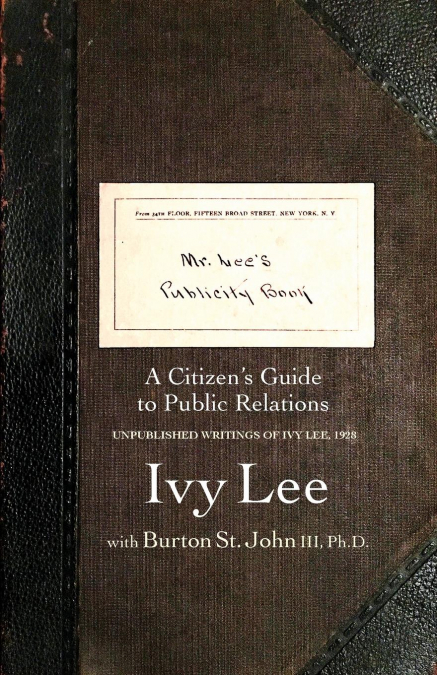
  • Mr. Lee’s Publicity Book
    Ivy Ledbetter Lee
    This book, newly discovered from the archives of his biographer, is Ivy Lee’s only known full-length manuscript. Written in the mid-1920s, a time when the public relations field was first coming into its own, it is a guide not as much for the practitioner, but wisely, for a Jazz-Age public facing its first-ever bout of “information overload.” Lee advises the reader how to ident...
    Disponible

    47,29 €

  • Selling Creative - Advertising Men and Women in the Hall of Fame
    Mary E. Warlick
    Americans have long enjoyed a fascination with advertising, a complex love-hate relationship. Ads are often connected with childhood recollections of favorite brands and characters-whether they are annoying, entertaining or persuasive, and the messages often lodge in our memories long after the actual product has disappeared from our consciousness. 'Melts in Your Mouth, Not in ...
    Disponible

    42,35 €

  • Global Electrification
    Mira Wilkins / Peter Hertner / William J. Hausman / William JHausman
    ...
    Disponible

    70,50 €

  • Verse by the Side of the Road
    Frank Rowsome
    ...
    Disponible

    23,50 €

  • Corporate Control, Corporate Power
    Edward S. Herman / Edward SHerman
    ...
    Disponible

    63,37 €