
Inicio > Humanidades > Filosofía > The Trial and Death of Socrates
The Trial and Death of Socrates

The Trial and Death of Socrates

The Trial and Death of Socrates

Plato

11,30 €
IVA incluido
Disponible
Editorial:
Aziloth Books
Año de edición:
2016
Materia
Filosofía
ISBN:
9781911405184
11,30 €
IVA incluido
Disponible

Selecciona una librería:

  • Librería Samer Atenea
  • Librería Aciertas (Toledo)
  • Kálamo Books
  • Librería Perelló (Valencia)
  • Librería Elías (Asturias)
  • Donde los libros
  • Librería Kolima (Madrid)
  • Librería Proteo (Málaga)

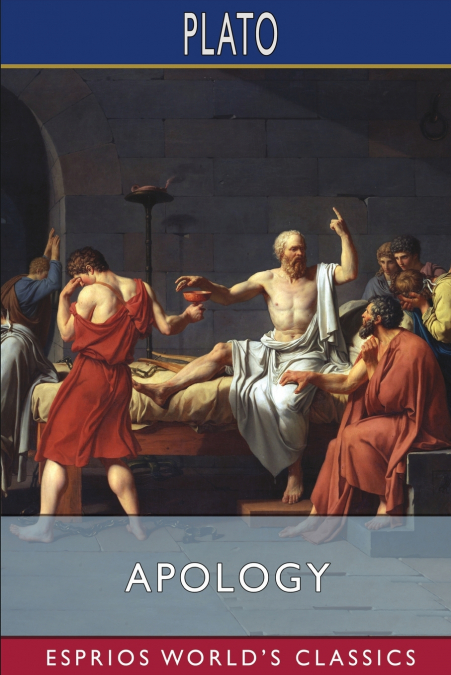
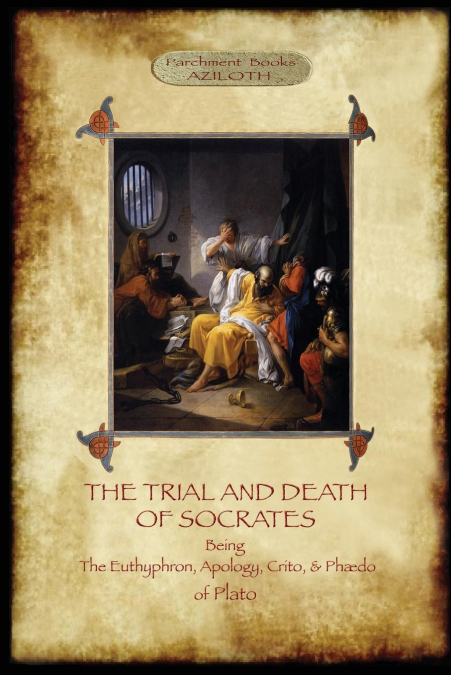
In 399 B.C., Socrates was tried for religious and political crimes: refusing to recognise the gods of Athens, introducing new deities, and corrupting the youth.  The verdict was guilty as charged, the penalty – death by poisoning.Despite growing up in Greece’s “Golden Age” of liberalism and democracy, Socrates was not a democrat. Influencing young men with his idea that people needed direction from wise men rather than self-government, was likely perceived as a threat to the cherished Athenian republic.  Socrates likened himself to a gadfly stinging the “lazy horse” of Athens and did this with zeal, believing his God-assigned purpose was to expose false wisdom as ignorance. Awareness of one’s ignorance was a key first step towards true wisdom or virtue, he declared, emphasising that although he, too, was ignorant, he knew it.  And that, he argued, was the reason the oracle of Delphi proclaimed “there was no man wiser than Socrates”.  Little wonder, then, that egos were pricked and enemies made.Socrates did not record any of his work, and it was left to some of his young disciples – Plato, being the most famous – to give an account of their master’s dialogues with Athenians from all walks of life. The Trial and Death of Socrates is a collection of four such dialogues – Euthyphron, Apology, Crito and Phaedo – covering the period from just before Socrates’ trial through his last few days in prison, to his courageous death.  The reader makes contact with the Socratic method of debate known as elenchus – an unwavering and incisive form of cross-examination that involved a series of questions and answers.  For Socrates, definitions and rational, syllogistic argument were key tools in discussing and dissecting subjects such as piety, virtue, the immortality of the soul and the difference between right and wrong.A misfit in his time, Socrates was arguably the world’s first martyr for free speech, and one that passed on an enduring legacy of questioning societal norms. 
Artículos relacionados

  • Introduction to a Future Way of Thought
    Kostas Axelos / Kenneth Mills
    'Technologists only change the world in various ways in generalized indifference; the point is to think the world and interpret the changes in its unfathomability, to perceive and experience the difference binding being to the nothing.'Anticipating the age of planetary technology Kostas Axelos, a Greek-French philosopher, approaches the technological question in this book, firs...
    Disponible

    18,58 €

  • Capsule
    John Kenneth Press
    Join John and Adam as they wander the mean streets of Japan on a psychedelic fueled search for identity. While fun for the average reader, this book could also serve as a philosphy textbook because of its ordered exploration of sources of identity. Ultimately this trip through nationalist attacks, sex, and drugs, will take you to a better understanding of yourself and your pl...
    Disponible

    11,51 €

  • If you look at it long enough...
    Paul Hallam
    Originally written for an academic journal, If you look at it long enough... is primarily a personal account of Paul Hallam’s recollections of “self-abuse” through the consumption of porn over several decades. Challenging the familiar form of an “academic essay,” this autobiographical narrative raises several questions in relation to our contemporary morals related to sex in ge...
    Disponible

    11,30 €

  • The Teachers of Gurdjieff
    Rafael Lafort / Rafael Lefort
    When The Teachers of Gurdjieff was first published more than 50 years ago, it made a considerable stir. George Ivanovich Gurdjieff had been one of the most famous mystics in the West in the first half of the 20th century - a teaching master who had many fashionable and influential pupils. He had a striking appearance and manner of teaching, and his teaching proved to be very in...
    Disponible

    20,45 €

  • Manifesto of the Communist Party
    Karl Marx
    The Communist Manifesto was first published on February 21, and it is one of the world’s most influential political tracts. Commissioned by the Communist League and written by communist theorists Karl Marx and Friedrich Engels, it laid out the League’s purposes and program. The Manifesto suggested a course of action for a proletarian (working class) revolution to overthrow the ...
  • The Art of Literature
    Arthur Schopenhauer
    Collected here are eight short essays, On Authorship, On Style, On the Study of Latin, On Men of Learning, On Thinking for Ones Self, On Criticism, On Reputation, On Genius, by the world renowned philosopher Arthur Achopenhauer. ...

Otros libros del autor

  • Plato’s Apology
    Plato
    Plato’s Apology - A Riveting Defense of Philosophy and the Pursuit of TruthStep into the courtroom of ancient Athens and witness a moment that forever shaped the course of Western thought. Plato’s 'Apology' is not an apology in the modern sense but a powerful and eloquent defense of philosophy, virtue, and the examined life, as spoken by Socrates himself.In this timeless dialog...
  • Gorgias
    Plato
    A Timeless Debate on Power, Justice, and the Pursuit of TruthPlato’s Gorgias is a masterful exploration of rhetoric, morality, and the essence of a just life. Through a dynamic dialogue led by Socrates, this philosophical classic dives into the art of persuasion and its role in politics and society.As Socrates engages with the influential sophist Gorgias and others, readers are...
  • Apologia Di Socrate
    Plato
    Platone scrisse questo testo nel 399 a. C. in seguito alla morte di Socrate. Come altri testi giovanili di Platone, l’Apologia di Socrate risulta tanto affine al pensiero di quest’ultimo, da risultarne come un suo scritto. In realtà Socrate sosteneva la diffusione orale del pensiero e non esistono libri scritti di suo pugno: l’Apologia, se non una cronaca, è certamente il docum...
  • Symposium (Esprios Classics)
    Plato
    Plato (428/427 or 424/423 - 348/347 BC) was an Athenian philosopher during the Classical period in Ancient Greece, founder of the Platonist school of thought and the Academy, the first institution of higher learning in the Western world. He is widely considered one of the most important and influential individuals in human history, and the pivotal figure in the history of Ancie...
  • Apology, Crito, and Phaedo of Socrates (Esprios Classics)
    Plato
    Plato (428/427 or 424/423 - 348/347 BC) was an Athenian philosopher during the Classical period in Ancient Greece, founder of the Platonist school of thought and the Academy, the first institution of higher learning in the Western world. He is widely considered one of the most important and influential individuals in human history, and the pivotal figure in the history of Ancie...
  • Apology (Esprios Classics)
    Plato
    Plato (428/427 or 424/423 - 348/347 BC) was an Athenian philosopher during the Classical period in Ancient Greece, founder of the Platonist school of thought and the Academy, the first institution of higher learning in the Western world. He is widely considered one of the most important and influential individuals in human history, and the pivotal figure in the history of Ancie...