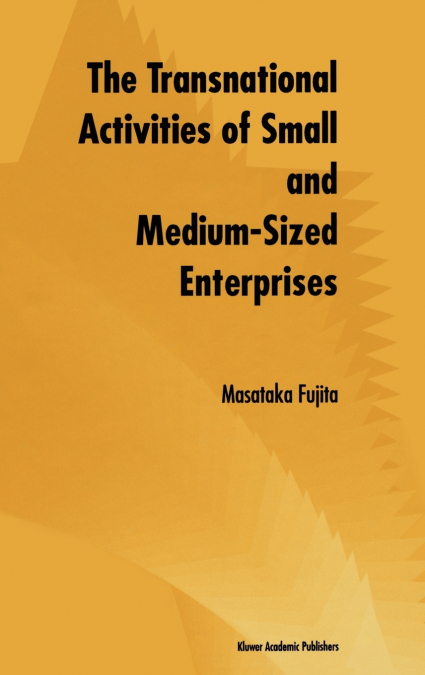

Inicio > Economía, finanzas, empresa y gestión > Empresa y gestión > Gestión y técnicas de gestión > The Transnational Activities of Small and Medium-Sized Enterprises
The Transnational Activities of Small and Medium-Sized Enterprises

The Transnational Activities of Small and Medium-Sized Enterprises

Masataka Fujita

132,61 €
IVA incluido
Consulta disponibilidad
Editorial:
Springer Nature B.V.
Año de edición:
1998
Materia
Gestión y técnicas de gestión
ISBN:
9780792381235

Selecciona una librería:

  • Librería Samer Atenea
  • Librería Aciertas (Toledo)
  • Kálamo Books
  • Librería Perelló (Valencia)
  • Librería Elías (Asturias)
  • Donde los libros
  • Librería Kolima (Madrid)
  • Librería Proteo (Málaga)

measure of the rate of innovation --research-and-development (R&D) expenditure per employee compared to new patents received per employee -- does not adequately capture a unique feature of SMEs, namely that owners and managers are often themselves innovators. For example, in Japan 52 per cent of SMEs’ innovations reported in 1986 were created by employers, whereas in large firms 72 per cent of innovations were created by research technicians. Nevertheless, patchy evidence from Germany, the United Kingdom and the United States indicates that SMEs at least hold their own in terms of innovation compared to large firms. Perhaps most significantly, a recent study indicates that, while the total number of innovations is positively related to R&D expenditures, skilled labour and the degree to which large firms comprise the industry, in innovative industries innovative activity tends to emanate more from SMEs than large firms. This is probably because in industries where large firms dominate, SMEs need to be innovative to survive. There is much information to suggest that in technologies such as micro-electronics, new materials and biotechnology SMEs tend to be in the vanguard of innovation. Small and medium-sized enterprises as exporters. The contribution of SMEs to a national economy from exporting is generally small; for example, in Japan SMEs accounted for only 13 per cent of merchandise exports in 1990.

Artículos relacionados

  • Cases on Management and Organizational Behavior in an Arab Context
    Khoury
    In the era of globalization and ease of international connectivity and business interactions, professionals from all over the world benefit from having a well-rounded view of business culture and organizational practice at the regional level. Cases on Management and Organizational Behavior in an Arab Context provides a presentation of teaching cases emphasizing the positive and...
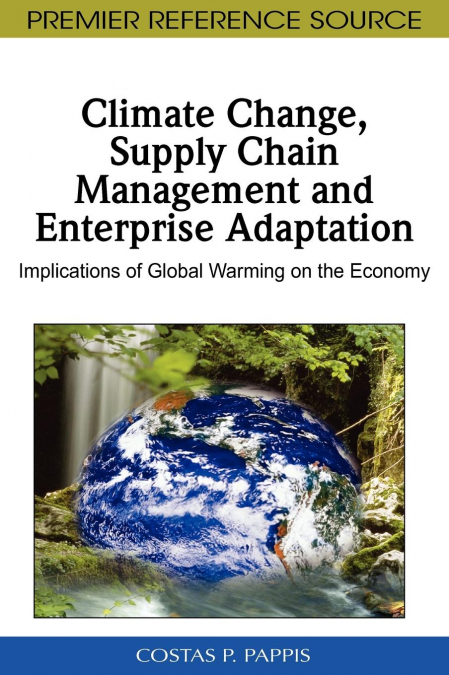
  • Climate Change, Supply Chain Management and Enterprise Adaptation
    Costas P. Pappis / Costas PPappis
    Mounting scientific evidence shows that Earth’s climate is dramatically changing due to the greenhouse emissions caused by human activities, notably by burning fossil fuels for energy production and transport. Climate Change, Supply Chain Management and Enterprise Adaptation: Implications of Global Warming on the Economy aims to provide one among many diverse responses to a gro...
  • # BUSINESS SAVVY PM tweet Book01
    Cinda Voegtli
    Does your job require you to manage projects? If yes, wouldn’t you like to be described as a project manager who is a successful, influential and respected leader of important efforts in the organization? Now if that already sounds like you, great! But if not, what you need to get there is known as ’business savvy.’Business savvy does not mean a bagful of academic credentials, ...
    Disponible

    22,55 €

  • Advanced Topics in Global Information Management Volume 2
    Felix Tan
    ...
  • Managing Business with SAP
    Linda Lau
    ...
  • Advances in Electronic Business, Volume I
    ...

Otros libros del autor

  • The Transnational Activities of Small and Medium-Sized Enterprises
    Masataka Fujita
    measure of the rate of innovation --research-and-development (R&D) expenditure per employee compared to new patents received per employee -- does not adequately capture a unique feature of SMEs, namely that owners and managers are often themselves innovators. For example, in Japan 52 per cent of SMEs’ innovations reported in 1986 were created by emplo...
    Disponible

    133,97 €