 Librería Samer Atenea
 Kálamo Books
 Librería Elías (Asturias)
 Librería Kolima (Madrid)
 Librería Proteo (Málaga)
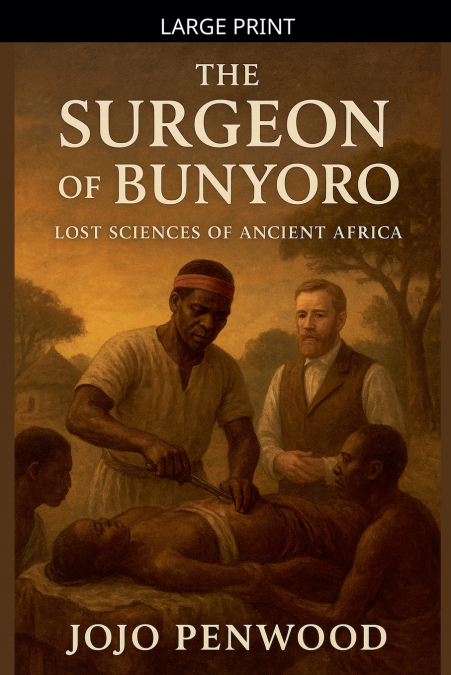
In 1879, a European doctor stepped into the Kingdom of Bunyoro in present-day Uganda expecting to encounter primitive medicine.What he witnessed instead would shake the foundations of Western science.An African surgeon performed a successful caesarean section using antiseptics, anesthesia, sterilized instruments, and advanced surgical technique-decades before such practices became standard in Europe. Both mother and child survived.That moment is not an anomaly. It is a doorway.The Surgeon of Bunyoro: Lost Sciences of Ancient Africa by Jojo Penwood is a groundbreaking exploration of Africa’s long-ignored scientific, medical, and technological genius. Blending vivid historical storytelling with rigorous research, the book uncovers a continent whose knowledge systems were empirical, sophisticated, and deeply integrated with nature, spirituality, and community life.From advanced surgical practices and herbal pharmacology to metallurgy, astronomy, architecture, and mathematics, this book reveals how African civilizations developed complex sciences-often hidden in oral traditions, rituals, and symbols-long before colonial contact.Penwood takes readers deep into:The astonishing Bunyoro caesarean surgery and its medical precisionIndigenous African anesthesia, antisepsis, and wound careThe role of women healers and midwives as custodians of lifeAfrica’s iron furnaces, astronomical systems, and urban engineeringHow colonialism silenced, dismissed, and dismantled indigenous knowledgeWhy modern science is only now rediscovering what Africa already knewThis is not a book of nostalgia. It is a reclamation.The Surgeon of Bunyoro challenges long-standing myths, confronts historical erasure, and invites a profound rethinking of where science truly comes from. It argues that Africa was never without science-only without recognition.Powerful, revelatory, and deeply human, this book is essential reading for anyone interested in history, medicine, science, Africa, and the future of global knowledge.