The Strait as Weapon

The Strait as Weapon

Naim Tahir Baig

67,59 €
IVA incluido
Disponible
Editorial:
Institute of Geo-Strategic Studies
Año de edición:
2026
Materia
Relaciones internacionales
ISBN:
9798235533714
67,59 €
IVA incluido
Disponible

Selecciona una librería:

  • Librería Samer Atenea

  • Kálamo Books
  • Librería Elías (Asturias)
  • Librería Kolima (Madrid)
  • Librería Proteo (Málaga)

BOOK DESCRIPTIONThe Strait as Weapon: Hormuz and the Insurance-Blockade TemplateBy Dr Naim Tahir BaigIn February-March 2026, the Islamic Republic of Iran did something that no analytical framework in maritime strategic studies had adequately anticipated. Following the opening strikes of Operation Epic Fury - the coordinated United States and Israeli military campaign that killed Supreme Leader Ali Khamenei in the first wave - Tehran’s response was not the conventional naval engagement that four decades of Pentagon planning had prepared for. It was, instead, a calibrated combination of VHF broadcasts, selective drone strikes, and a formal declaration of 'protective transit control' that delegated the enforcement of its blockade to a target the United States Fifth Fleet could not reach: the war-risk underwriting desks of the Lloyd’s marine insurance market in London. Within seventy-two hours, the Strait of Hormuz - through which twenty percent of global seaborne oil moves - was commercially closed without a single mine in the water. By 5 March, war-risk cover had been withdrawn entirely. Approximately 3,200 vessels lay stranded outside Fujairah. LNG transits fell to zero for the first time in the strait’s recorded history.The Strait as Weapon is the long-form analytical companion to Dr Naim Tahir Baig’s peer-reviewed paper Chokepoint as Weapon (Journal of International Security Studies, 2026), the framing of which was adopted by Riviera Maritime Media on 10 April 2026 under the headline 'is not an aberration - it is a template.' Across twelve chapters, the book reconstructs the crisis in forensic detail and develops the theoretical apparatus required to understand it: a five-layer model of the strait (physical, economic, political, legal, informational), a four-phase escalation sequence (VHF warnings, kinetic strikes, insurance cascade, formal declaration), and a new concept of insurance-blockade coercion that the book argues will become the dominant mode of chokepoint warfare in the decade ahead.The argument the book advances is sharp. The dominant frameworks for understanding maritime power - from Mahan’s command of the sea through Corbett’s graduated sea control to Posen’s command of the commons - were developed for a world in which decisive force resided in hulls and missiles. The 2026 crisis revealed a world in which decisive power had migrated to contracts, actuarial models, and a committee of underwriters convening in the Lloyd’s building on Lime Street. Naval supremacy remains necessary; it is no longer sufficient. The book traces the implications of that shift through international law (Chapter 9), energy and macroeconomic markets (Chapter 8), the diplomatic recalibration of four capitals (Chapter 10), and a comparative analysis of five further chokepoints - Bab el-Mandeb, Malacca, the Bosporus, Suez, and Panama - to establish where the Hormuz template travels and where it does not (Chapter 11). The book closes with a structured futures chapter (Chapter 12) containing three scenarios, an eleven-indicator basket for real-time tracking of which trajectory is operative, and a set of numbered policy recommendations addressed to identifiable actors.For scholars of international relations and strategic studies, The Strait as Weapon offers a new theoretical apparatus for analysing sub-threshold coercion in an era of globalised maritime finance. For policymakers in the United States, the United Kingdom, the European Union, the Gulf Cooperation Council, India, Pakistan, and China, it offers a diagnostic framework and a concrete set of resilience measures. The chokepoint, the book argues, is no longer a place. It is a system. Understanding the 2026 crisis is the first step to defending all of them.
Artículos relacionados

  • Realism in Practice
    The purpose of this book is to appraise the current relevance and validity of realism as an interpretative tool in contemporary International Relations. All chapters of the book are animated by a theoretical effort to define the conceptual aspects of realism and attempt to establish whether the tradition still provides the necessary conceptual tools to scholars.The chapters add...
    Disponible

    20,36 €

  • Predicting gender violence in India
    Shritha K Vasudevan
    In this provocative new book, Shritha Vasudevan argues that feminist international relations (IR) theory has inadvertently resulted in a biased worldview, the very opposite of what feminist IR set out to try to rectify. This book contests theoretical presumptions of Western feminist IR and attempts to reformulate it in contexts of non-Western cultures. Vasudevan deftly utilizes...
  • Contemporary security issues in Africa
    Isiaka Alani Badmus / Lere Amusan
    In volume, an emerging generation of African scholars examines specific states in Africa where instability is the order of the day. Considerations of African instability are highly relevant in today’s world, where one examines the types of regimes that were put in place after the Cold War and their effects on Africa. Multiparty systems introduced in Africa, rather than bringing...
  • Chronicles of the first and second chechen wars
    Ilya Milyukov
    Presented by Russian author and attorney Ilya Milyukov, Chronicles of the First and Second Chechen War presents the main events of the First (1994-1996) and Second (1999-2009) Wars in Chechnya, Russia’s deadliest conflicts since World War II. The First War began in December 1994 and lasted for one year and nine months, ending in August 1996. There were two major urban battles -...
  • Political instability in Africa
    Isiaka Alani Badmus / Lere Amusan
    This book offers broad-gauged analyses of the causes, nature, and changing patterns of armed conflict in Africa as well as the reasons for these patterns. It also situates conflicts that have been haunting the African continent since the time of decolonization within the various theoretical schools such as 'new war,' 'economic war,' 'neo-patrimonial,' and 'globalization.' It be...
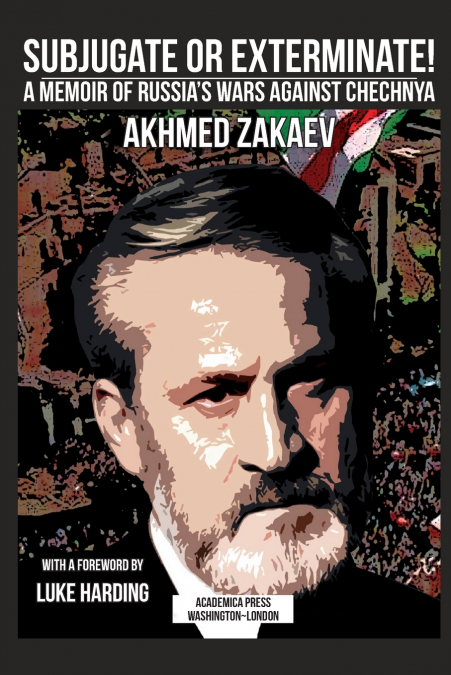
  • Subjugate or exterminate!
    Akhmed Zakaev / Arch Tait
    Foreword by Luke HardingAkhmed Zakaev is a symbol of the indomitable will of the Chechen nation. In this important memoir, he tells the story of the Chechen struggle as he experienced it, describing the conflict in human terms and providing a detailed documentary record of little known or badly understood events that will be of benefit to historians for generations to come.- Da...
    Disponible

    41,63 €

Otros libros del autor

  • The Orbit After Ambiguity
    Naim Tahir Baig
    SPACE SECURITY & ARMS CONTROLThe Orbit After AmbiguityHow the US Admitted It Has Weapons in SpaceThe first narrative account of what changed when the United States stopped keeping its space weapons secret.On September 14, 2026, the Secretary of the Air Force told a Washington audience that the United States 'has on-orbit space control weapons capable of defending the joint forc...
    Disponible

    73,95 €

  • The Stilwell Bypass
    Naim Tahir Baig
    In 1942 the United States Army pushed a road out of Ledo, in Assam, toward China. More than eighty years later, a question hangs over the same ground: could a different cargo travel part of that route, heavy rare earths dug from the clay hills of Kachin State in northern Myanmar and carried not east into China, as they are now, but west, toward India and toward separation plant...
    Disponible

    74,68 €

  • Extinction by Extraction?
    Naim Tahir Baig
    What we choose when we choose our mineralsEvery wind turbine, electric vehicle, guided missile and smartphone depends on a group of metals most people have never heard of. Rare earth elements make the modern world’s energy, defense and computing systems possible. They also come from some of the most toxic, concentrated and politically contested supply chains on Earth.Extinction...
    Disponible

    73,62 €

  • Theory in the Interregnum
    Naim Tahir Baig
    Theory in the InterregnumWhich International Relations Theory Explains What in a World of Fraying RulesBy Naim Tahir BaigThe liberal international order is fraying, and every school of International Relations claims to have seen it coming. Theory in the Interregnum asks a sharper question: which theory explains what? Dr Naim Tahir Baig argues that no new grand theory has displa...
    Disponible

    70,52 €

  • Rules of the Strong, Rules of the Many
    Naim Tahir Baig
    Rules of the Strong, Rules of the ManyAuthorship, Membership and the Ratchet of International Norms from Antiquity to the PresentBy Dr Naim Tahir BaigWho writes the rules of international order, and who do those rules protect? Rules of the Strong, Rules of the Many argues that international norms move in two rhythms at once. Authorship, meaning who writes and interprets the rul...
    Disponible

    75,59 €

  • Custody
    Naim Tahir Baig
    CustodyHow States Compete to Govern the Making of PersonsBy Dr Naim Tahir Baig States everywhere are claiming a new kind of authority: the right to act as guardian over how their citizens are formed. A South Korean subsidy to raise the birth rate, an Australian ban on social media for under-16s, a Brazilian court order against a platform and a Chinese rule for generative AI loo...
    Disponible

    75,54 €