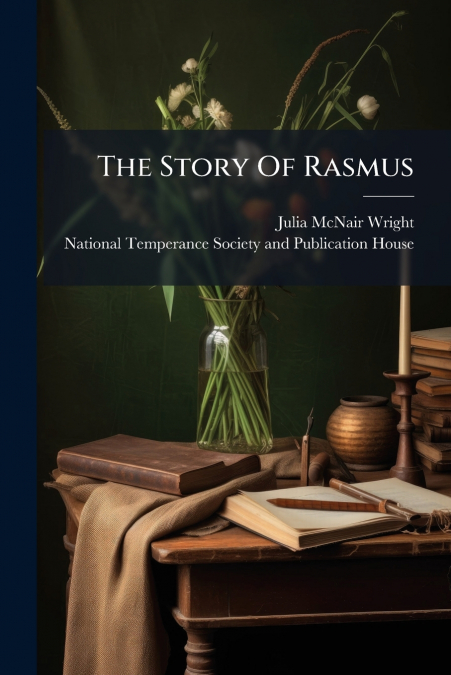
Julia McNair Wright / National Temperance Society and Publica
 Librería Samer Atenea
 Kálamo Books
 Librería Perelló (Valencia)
 Librería Elías (Asturias)
 Donde los libros
 Librería Kolima (Madrid)
 Librería Proteo (Málaga)
'The Story Of Rasmus, Or, The Making Of A Man' is a compelling 19th-century narrative exploring themes of temperance, morality, and personal growth. Penned by Julia McNair Wright, with the National Temperance Society and Publication House, this story follows Rasmus on his journey to become a man of character. With vivid descriptions and engaging prose, Wright crafts a world where decisions carry significant weight and shape one’s destiny. A timeless exploration of virtue and the challenges of navigating a complex world, 'The Story Of Rasmus' remains relevant for readers interested in historical fiction with a strong moral compass. Its enduring appeal lies in its ability to inspire reflection on the choices we make and the impact they have on our lives. It’s a reminder that the path to self-improvement is often fraught with obstacles but ultimately rewarding.This work has been selected by scholars as being culturally important, and is part of the knowledge base of civilization as we know it. This work was reproduced from the original artifact, and remains as true to the original work as possible. Therefore, you will see the original copyright references, library stamps (as most of these works have been housed in our most important libraries around the world), and other notations in the work.This work is in the public domain in the United States of America, and possibly other nations. Within the United States, you may freely copy and distribute this work, as no entity (individual or corporate) has a copyright on the body of the work.As a reproduction of a historical artifact, this work may contain missing or blurred pages, poor pictures, errant marks, etc. Scholars believe, and we concur, that this work is important enough to be preserved, reproduced, and made generally available to the public. We appreciate your support of the preservation process, and thank you for being an important part of keeping this knowledge alive and relevant.