

 Librería Samer Atenea
 Kálamo Books
 Librería Elías (Asturias)
 Librería Kolima (Madrid)
 Librería Proteo (Málaga)
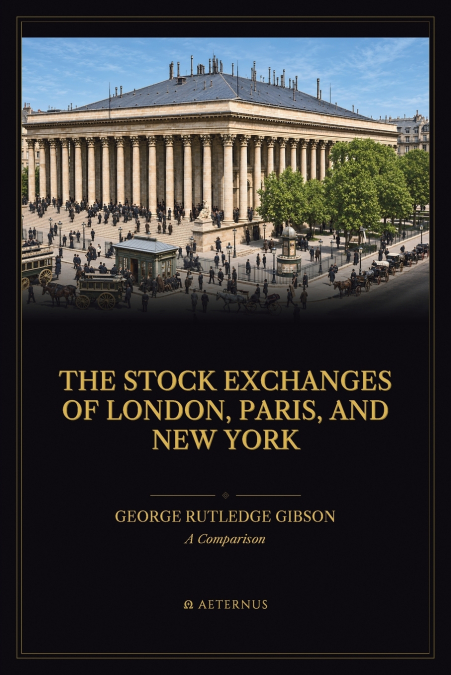
Complete text of the first edition of 1889Publisher’s Foreword and Publisher’s AfterwordAbout the Author and a historical portraitGlossary, Chronology and Select AuthoritiesSeven original plates and four contemporary engravingsThe Three Capitals of Finance - A World Governed by CreditIn the closing decades of the nineteenth century, the great stock exchanges of London, Paris and New York stood at the center of an extraordinary transformation. Across oceans and continents, capital moved to finance railways, industries, mines, government obligations and the vast undertakings of an expanding commercial civilization. Behind the prosperity of nations operated institutions whose influence extended far beyond the crowded halls in which securities were bought and sold.In 1889, the American financial writer George Rutledge Gibson undertook a remarkable comparative examination of these three commanding centers of international finance.His inquiry revealed three distinct financial worlds: London’s powerful traditions of private enterprise and institutional self-government; the Paris Bourse, shaped by the authority of the French state and its privileged brokers; and New York’s dynamic securities markets, propelled by the immense industrial expansion of the United States.Gibson examined their origins, regulations, trading practices, clearing arrangements and speculative operations. He defended the productive functions of organized markets while exposing the dangers of fraudulent dealing and the predatory practices of the notorious bucket-shops.Most strikingly, his observations anticipated an enduring question of financial economics: how effectively does the market price embody the knowledge and judgment of those who participate in it?Published at the height of the Victorian commercial age, The Stock Exchanges of London, Paris, and New York remains a revealing testimony to the institutions through which modern financial capitalism acquired its international character.An examination of the machinery of wealth, written when the great financial capitals were learning to operate as parts of a single world market.





