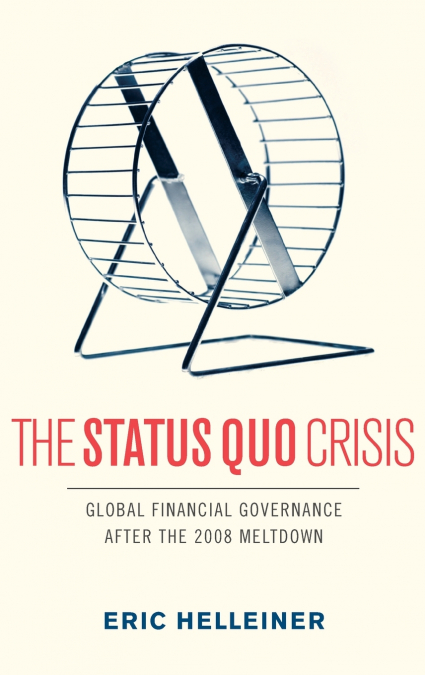

The Status Quo Crisis

The Status Quo Crisis

HELLEINER

77,23 €
IVA incluido
Consulta disponibilidad
Editorial:
Oxford University Press
Año de edición:
2014
Materia
Macroeconomía
ISBN:
9780199973637

Selecciona una librería:

  • Librería Samer Atenea
  • Librería Aciertas (Toledo)
  • Kálamo Books
  • Librería Perelló (Valencia)
  • Librería Elías (Asturias)
  • Donde los libros
  • Librería Kolima (Madrid)
  • Librería Proteo (Málaga)

The 2008 financial crisis was the worst since the Great Depression and many voices argued that it would transform global financial governance. Analysts anticipated a 'Bretton Woods moment ', referring to the 1944 conference that established the postwar international financial order. Widespread expectations of change were then reinforced by the creation of the G20 leaders’ forum, extensive debates about the dollar’s global role, the launching of international financial regulatory reforms, and the establishment of the Financial Stability Board.But half a decade later, how much has really changed? In The Status Quo Crisis, Helleiner surveys the landscape and argues that continuity has marked global financial governance more than dramatic transformation. The G20 leaders forum contributed much less to the management of the crisis than advertised. The US dollar remains unchallenged as the world’s dominant international currency. The market-friendly nature of pre-crisis international financial regulation has been not overturned in a significant manner. And the Financial Stability Board has strengthened the governance of international financial standards in only very modest ways.What we are left with are some small-bore incremental changes that, collectively, have not fundamentally restructured the governance of the global financial system. Helleiner argues that this strangely conservative result was generated partly by the structural power and active policy choices of the country at the center of the crisis: the United States. Status quo outcomes also reflected the unexpected weakness of Europe and conservatism of policymakers in large emerging market countries. Only if this distinct configuration of power and politics among and within influential states shifted in the coming years might the 2008 crisis leave a more transformative legacy over the longer term.Cutting against much of the received wisdom on offer today, The Status Quo Crisis will be essential reading for those interested in the politics of global finance and for anyone curious how expectations of change can be thwarted after even in the most dire of crises.
Artículos relacionados

  • Introduction to Dynamic Macroeconomic General Equilibrium Models
    José Luis Torres Chacon
    This book offers an introductory step-by-step course in Dynamic Stochastic General Equilibrium modelling. Modern macroeconomic analysis is increasingly concerned with the construction, calibration and/or estimation and simulation of Dynamic General Equilibrium (DGE) models. The book is intended for graduate students as an introductory course to DGE modelling and for those econo...
    Disponible

    61,40 €

  • International Education and the Next-Generation Workforce
    Wei Wang
    Education is the first stage in developing a viable, dynamic, and long-lived global economy. Unfortunately, in times of economic hardship, educational programs, teacher salaries, and extracurricular opportunities are often the first to be cut. International Education and the Next-Generation Workforce: Competition in the Global Economy presents a detailed discussion of present e...
  • Macroeconomic Policies of Developed Democracies
    Robert J Franzese Jr
    ...
  • End Of The Road
    Louis Holder
    This book is about the mismanagement of Western economies in pursuit of political power, which resulting devastation will have to be borne by future generations. The book establishes that postponement is no longer doable and lays out the hard choices ahead causing much misery and agony.Although not fully recognized because of masking by asset bubbles, which are spun/sold as in...
    Disponible

    16,42 €

  • The Darwin Economy
    Robert H. Frank
    What Charles Darwin can teach us about building a fairer societyWho was the greater economist-Adam Smith or Charles Darwin? The question seems absurd. Darwin, after all, was a naturalist, not an economist. But Robert Frank, New York Times economics columnist and best-selling author of The Economic Naturalist, predicts that within the next century Darwin will unseat Smith as the...
    Disponible

    22,42 €

  • Myth and Measurement
    Alan B. Krueger / David Card
    From David Card, winner of the Nobel Prize in Economics, and Alan Krueger, a provocative challenge to conventional wisdom about the minimum wageDavid Card and Alan B. Krueger have already made national news with their pathbreaking research on the minimum wage. Here they present a powerful new challenge to the conventional view that higher minimum wages reduce jobs for low-wage ...
    Disponible

    39,64 €

Otros libros del autor