 Librería Samer Atenea
 Kálamo Books
 Librería Elías (Asturias)
 Librería Kolima (Madrid)
 Librería Proteo (Málaga)
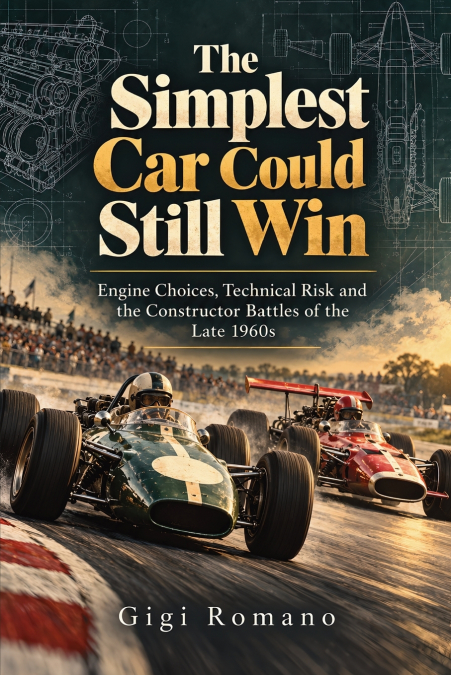
What happens when the simplest solution defeats the most ambitious engineering? In 1966, Formula One entered a new era. Engine capacities doubled, manufacturers pursued increasingly powerful designs, and established teams faced difficult decisions about how to remain competitive. Yet while some constructors embraced mechanical complexity, Jack Brabham and Repco demonstrated that a compact V8 and a carefully developed chassis could still win World Championships. The Simplest Car Could Still Win explores the remarkable engineering contest between Brabham and Lotus from 1966 to 1968, when two contrasting philosophies reshaped Grand Prix racing. From the championship-winning Brabham-Repco partnership to Colin Chapman’s ambitious Lotus designs and the arrival of the revolutionary Ford-Cosworth DFV, this book examines the decisions that determined success and failure. It explores engine development, chassis construction, reliability, driver performance and the growing influence of aerodynamics, revealing why greater power did not always produce better results. Through three seasons of changing fortunes, it follows the rise of Brabham, the technological breakthrough achieved by Lotus and the dramatic reversal that transformed the competitive order. A detailed historical examination of engineering ambition, practical judgement and the difference between building the fastest car and building a championship winner. Disclaimer: This is an independent, unofficial historical publication. It is not affiliated with, authorised, sponsored or endorsed by Formula One, the FIA, Brabham, Lotus, Repco, Ford, Cosworth or their respective rights holders. All trademarks and names remain the property of their owners and are used solely for factual, descriptive and historical identification.