 Librería Samer Atenea
 Kálamo Books
 Librería Elías (Asturias)
 Librería Kolima (Madrid)
 Librería Proteo (Málaga)
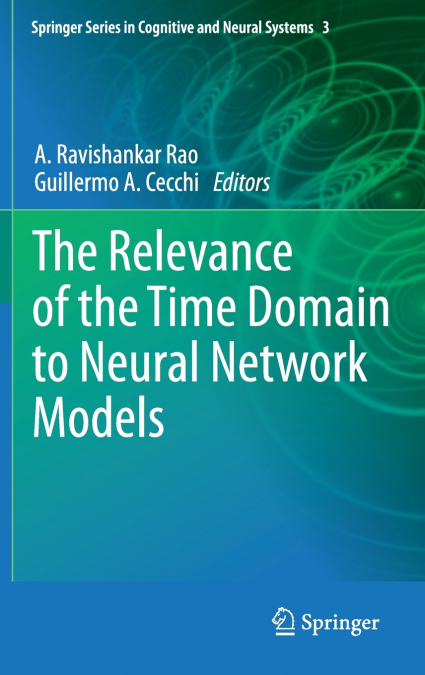
A significant amount of effort in neural modeling is directed towards understanding the representation of information in various parts of the brain, such as cortical maps [6], and the paths along which sensory information is processed. Though the time domain is integral an integral aspect of the functioning of biological systems, it has proven very challenging to incorporate the time domain effectively in neural network models. A promising path that is being explored is to study the importance of synchronization in biological systems. Synchronization plays a critical role in the interactions between neurons in the brain, giving rise to perceptual phenomena, and explaining multiple effects such as visual contour integration, and the separation of superposed inputs.The purpose of this book is to provide a unified view of how the time domain can be effectively employed in neural network models. A first direction to consider is to deploy oscillators that model temporal firing patterns of a neuron or a group of neurons. There is a growing body of research on the use of oscillatory neural networks, and their ability to synchronize under the right conditions. Such networks of synchronizing elements have been shown to be effective in image processing and segmentation tasks, and also in solving the binding problem, which is of great significance in the field of neuroscience. The oscillatory neural models can be employed at multiple scales of abstraction, ranging from individual neurons, to groups of neurons using Wilson-Cowan modeling techniques and eventually to the behavior of entire brain regions as revealed in oscillations observed in EEG recordings. A second interesting direction to consider is to understand the effect of different neural network topologies on their ability to create the desired synchronization. A third direction of interest is the extraction of temporal signaling patterns from brain imaging data such as EEG and fMRI. Hence this Special Session is of emerging interest in the brain sciences, as imaging techniques are able to resolve sufficient temporal detail to provide an insight into how the time domain is deployed in cognitive function.The following broad topics will be covered in the book: Synchronization, phase-locking behavior, image processing, image segmentation, temporal pattern analysis, EEG analysis, fMRI analyis, network topology and synchronizability, cortical interactions involving synchronization, and oscillatory neural networks.This book will benefit readers interested in the topics of computational neuroscience, applying neural network models to understand brain function, extracting temporal information from brain imaging data, and emerging techniques for image segmentation using oscillatory networks