 Librería Samer Atenea
 Kálamo Books
 Librería Elías (Asturias)
 Librería Kolima (Madrid)
 Librería Proteo (Málaga)
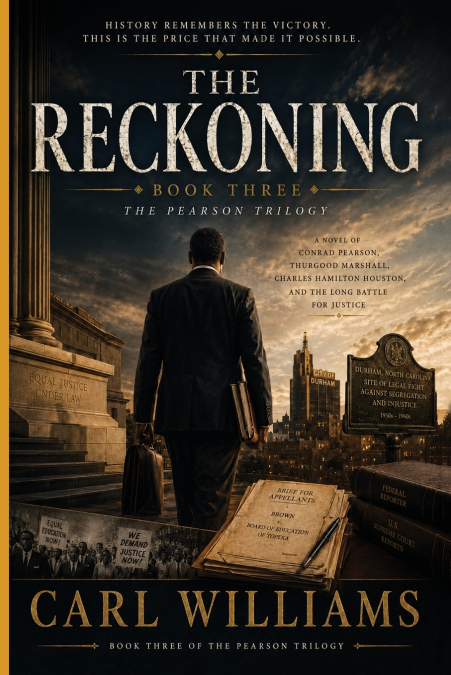
In 1951, the door finally opened. Then they learned what waited on the other side.In 1951, eighteen years after he lost the Hocutt case, Conrad Pearson stands in a federal courtroom beside Thurgood Marshall and wins. In the case remembered as Epps and McKissick against Carmichael, the Fourth Circuit ordered the University of North Carolina to open its law school to Black students, and that summer, Floyd McKissick, Harvey Beech, James Lassiter, and J. Kenneth Lee walked through the door that had been barred to Thomas Hocutt. Pearson lives to see it. It is the victory made possible by the first defeat, and it is not invented.It is also only the beginning. The Reckoning follows the road out of that courtroom and into the years that test what a court can actually deliver. Brown argued and won. On the seventeenth of May 1954, the country changed on paper. Then comes all deliberate speed, and interposition, and the slow grind of a state that has decided to lose as slowly as the law will allow. There is Wheeler against Durham, and the daily toll paid by the people whose names the histories misplace. Told one last time by Anthony Brakes, now near the end, this is the trilogy’s reckoning in full, with the movement, with the doctrine, and with himself. It asks the harder question that arrives only after victory. What is a courtroom win worth to the children who still have to walk the hallway? What does it cost the ones who open a door to keep standing in it? By the final chapter, Brakes is no longer naming cases. He is naming people, the ones who paid the toll on the far side of the door, and asking his students to carry the names he refuses to let disappear.He had taught them the law. At the end, he taught them the names.