 Librería Samer Atenea
 Kálamo Books
 Librería Elías (Asturias)
 Librería Kolima (Madrid)
 Librería Proteo (Málaga)
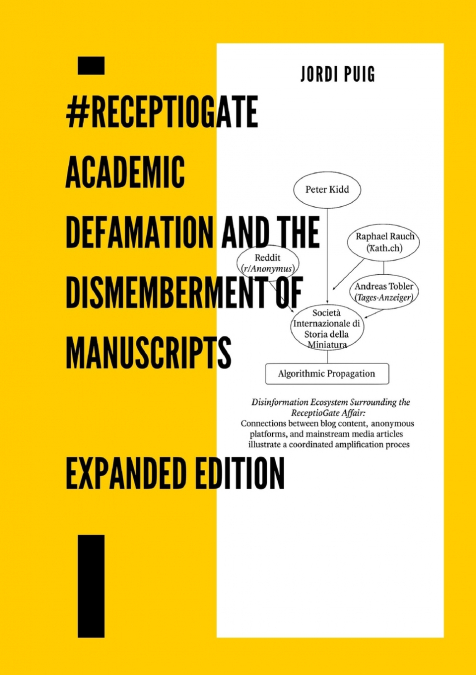
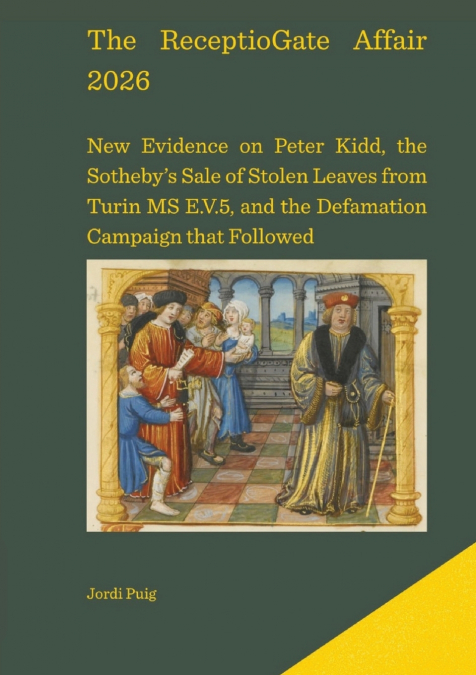
For more than four years, the public was told a simple story.A prominent scholar was repeatedly accused of plagiarism and self-plagiarism. Her research centre was described as fictitious. Collaborators were portrayed as non-existent. Legal advisers were dismissed as inventions. Academic institutions acted. Journalists repeated the accusations. Blogs and social media amplified them.The affair became known as ReceptioGate.Yet one question remained largely unexplored.Why did the attacks begin only after Professor Carla Rossi started documenting the dismantling of medieval manuscripts and the circulation of stolen manuscript leaves on the international antiquarian market?Why did the campaign intensify after evidence concerning stolen cultural property was submitted to the Italian authorities?Why did so much attention focus on the researcher who documented the evidence while so little was devoted to the evidence itself?At the centre of this story stand two manuscripts.One was the Book of Hours of Louis de Roucy, digitally reconstructed after centuries of dispersal. The other was Turin MS E.V.5, a manuscript preserved in the Biblioteca Universitaria di Torino, from which three illuminated folios were removed and later appeared on the international market.Both appeared in the same Sotheby’s sale in London on 7 July 2015.Peter Kidd prepared the catalogue descriptions associated with both manuscripts.Years later, one became the object of plagiarism allegations directed against the scholar who reconstructed it. The other became the subject of a cultural-heritage investigation that ultimately led to the recovery and restitution of stolen material.The allegations that had dominated public discussion for years were ultimately tested in court. The judgment of the Swiss Federal Administrative Court of 7 January 2026 fundamentally altered the narrative that had dominated public discussion for years and marked a decisive turning point in the ReceptioGate affair.Drawing upon judicial decisions, including the ruling of the Swiss Federal Administrative Court, archival records, auction catalogues, correspondence, institutional documents, and previously unpublished evidence, Jordi Puig reconstructs the chronology of one of the most extraordinary controversies in recent academic history.The resulting picture differs profoundly from the narrative that dominated public discussion for years.What emerges is a story involving manuscript provenance, cultural-heritage protection, academic politics, institutional failures, reputational attacks, and the economic interests surrounding the circulation of stolen manuscript leaves and dismembered manuscripts.ReceptioGate entered public debate as an alleged plagiarism scandal.The documents examined in this investigation suggest that the central issue lay elsewhere: in the collision between provenance research, the protection of cultural heritage, and the interests challenged by those who sought to document the destruction, dispersal, and commercial circulation of medieval manuscripts.