 Librería Samer Atenea
 Kálamo Books
 Librería Elías (Asturias)
 Librería Kolima (Madrid)
 Librería Proteo (Málaga)
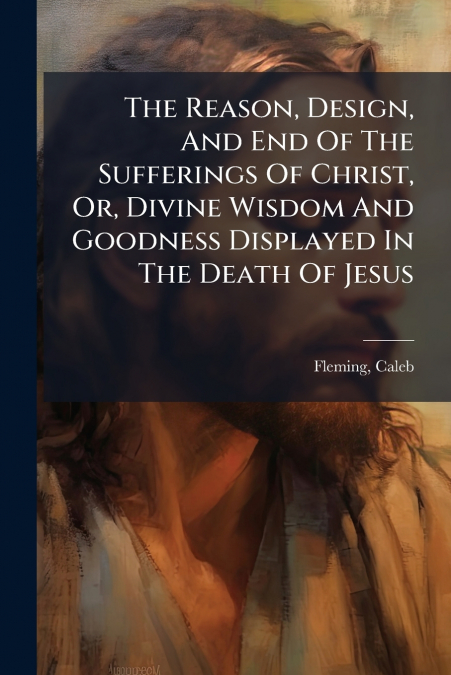
'The Reason, Design, And End Of The Sufferings Of Christ, Or, Divine Wisdom And Goodness Displayed In The Death Of Jesus' by Caleb Fleming, originally published in 1728, presents a reasoned theological exploration of the significance of Christ’s suffering and death. Dedicated to those deists who question Christian revelation, this discourse seeks to illuminate the divine wisdom and goodness inherent in the sacrifice of Jesus. Fleming’s work delves into the theological underpinnings of Christ’s suffering, offering a perspective that integrates reason and faith. The book explores the reasons behind Christ’s suffering, the divine design manifested in it, and its ultimate end, aiming to reconcile faith with rational inquiry. This edition preserves the original text, offering readers insight into 18th-century theological discourse and the ongoing dialogue between faith and reason. It remains relevant for those interested in historical theology, the relationship between Christianity and Deism, and the enduring questions surrounding the suffering and death of Jesus Christ.This work has been selected by scholars as being culturally important, and is part of the knowledge base of civilization as we know it. This work was reproduced from the original artifact, and remains as true to the original work as possible. Therefore, you will see the original copyright references, library stamps (as most of these works have been housed in our most important libraries around the world), and other notations in the work.This work is in the public domain in the United States of America, and possibly other nations. Within the United States, you may freely copy and distribute this work, as no entity (individual or corporate) has a copyright on the body of the work.As a reproduction of a historical artifact, this work may contain missing or blurred pages, poor pictures, errant marks, etc. Scholars believe, and we concur, that this work is important enough to be preserved, reproduced, and made generally available to the public. We appreciate your support of the preservation process, and thank you for being an important part of keeping this knowledge alive and relevant.